
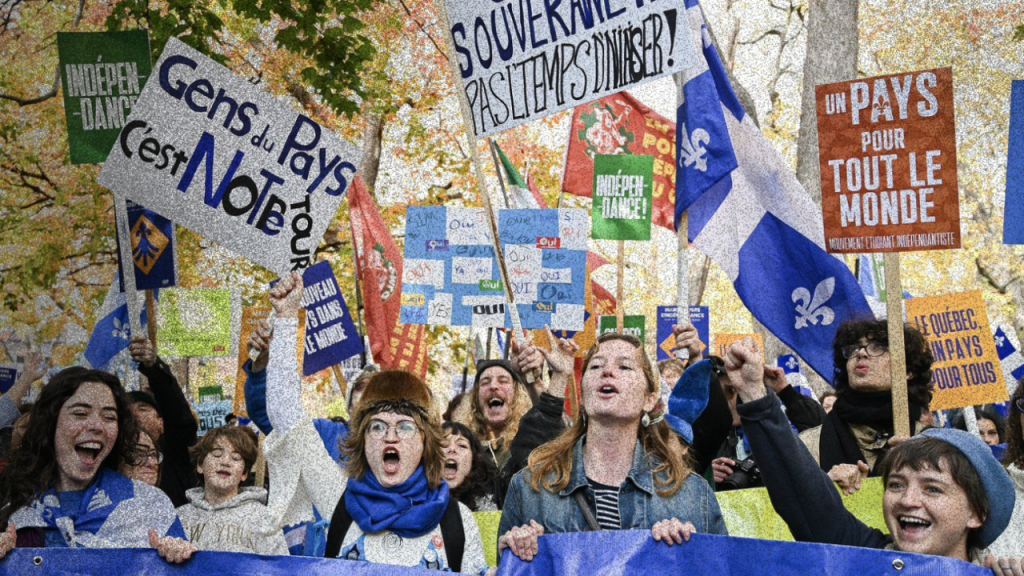
Quebec election polls claim sovereignty is at a 30-year low. A generation of aggrieved young Quebecers becoming politically active suggests otherwise.
The surface reading is straightforward enough: the Parti Québécois leads, Paul St-Pierre Plamondon has pledged a referendum, and the CAQ—which won 90 seats on 41 percent of the vote in 2022—is now projected to win zero. Philippe Fournier’s 338Canada model puts the PQ at 66 seats, a majority, with 99 percent odds of winning the most seats and 68 percent odds of a majority government outright. FPTP math is doing extraordinary work here: a four-way split of the opposition means the PQ can likely govern with a majority on 31 or 32 percent of the vote.
But dig one layer down and the picture complicates immediately. The PQ’s commanding lead has nearly evaporated. Sovereignty sentiment has hit its lowest recorded level. And the party most responsible for both phenomena is not the Liberals or the CAQ — it’s Donald Trump.
The Trump Effect Runs Backwards
The instinctive read — Trump radicalizes Quebec leftward, accelerates sovereignty sentiment, strengthens the PQ — is not what happened. The data moves in the opposite direction.
A Léger survey released March 4, 2026 found sovereignty support at 29 percent — the lowest level the firm has ever recorded, and the lowest since the 1995 referendum. The PQ’s lead, which sat at double digits through most of 2025, has collapsed to statistical dead heat: 31 percent PQ, 30 percent Liberal. The Liberals gained four points in a single month. The Bloc Québécois — which was on track to sweep more than 40 federal seats before Trump’s election — has shed 11 points federally while the Liberals gained 7. Sovereigntist voters are temporarily migrating toward Canadian unity parties at every level of government.
Léger’s executive vice-president Sébastien Dallaire identified the mechanism clearly: Canadian patriotism in Quebec jumped 13 points between December and February — the largest gains anywhere in the country. “It’s clearly related to the current context of increased patriotism in Canada,” Dallaire said, “an increased feeling that we need to stick together and stand up to the United States.” Quebec, which dislikes Trump more intensely than any other province, responded to his annexation threats not by asserting its own nationhood but by temporarily reaching for Canadian identity as a shield.
This is the Trump eclipse: a brief, structurally contingent suppression of sovereignty sentiment driven by the logic of rallying to the larger unit under external threat. It is real. It is also not durable.
Dallaire himself acknowledged the contingency directly: “We can expect the numbers will rise again if tensions ease up.” But the more important dynamic is not what happens when tensions ease — it’s what happens when Ottawa demonstrably fails to protect Quebec against American pressure. The sovereigntist counter-argument writes itself: Canada’s membership provided no shield against the tariff threat; the federal government cannot deliver what it is promising; Quebec’s interests are subordinated, as they always have been, to the calculations of a larger unit it does not control. That argument lands harder every month Ottawa fails to fully deliver. The unity bump rests entirely on the assumption that belonging to Canada works. The moment that assumption cracks, the current reverses.
There is also a structural irony the PQ has been pointing to. PQ MNA Pascal Paradis drew the parallel explicitly: Ottawa is defending Canadian sovereignty “tooth and nail” against Trump’s annexation threats — but the same logic that makes sovereignty worth defending at the federal level applies to Quebec’s relationship with Canada. The argument is not subtle, and it will get louder.
Four Byelections Tell a Different Story
The sovereignty polling and the electoral momentum are running as two separate phenomena, and collapsing them into one reading produces the wrong analysis.
Since 2022, the PQ has won four consecutive byelections — each in territory that should have been hostile. Jean-Talon in October 2023 was a riding the PQ had never won before, former Liberal then CAQ ground in Quebec City. Terrebonne in March 2024 was CAQ minister Pierre Fitzgibbon’s seat. Arthabaska in August 2025 was a CAQ stronghold since 2012: the PQ took 46 percent against Conservative leader Duhaime’s 35 percent, with the CAQ finishing fourth. Chicoutimi in February 2026 brought the PQ to seven seats, up from three after 2022.
Every one of these wins was outside Montreal. Every one was in francophone regional Quebec. This is not a sovereignty wave in the polling sense — voters backing the PQ in Arthabaska are not necessarily voting yes in a referendum. They are voting against a collapsing CAQ, expressing discontent with the status quo, and backing the party that is winning. The organizational momentum is real and independent of where sovereignty polling sits in a given month.
The CAQ’s trajectory makes the electoral math stark. A party that won 90 seats on 41 percent of the vote in 2022 is now projected to win zero. François Legault resigned January 14, 2026, citing “plummeting support and a desire for change.” His party is running a leadership race with a new leader arriving by mid-April — eight months before an election — with no time to rebuild and no natural base to rebuild toward. The PQ does not need a sovereignty wave to win. It needs the CAQ to continue disintegrating, and that work is already done.
Majority or Minority — And Why It Matters
338Canada’s current projection gives the PQ a 68 percent chance of majority and a 31 percent chance of plurality only. Those are not long odds on the minority outcome — and the minority scenario is materially better for Quebec’s left than the majority.
Québec solidaire is in poor shape province-wide: down from 15.4 percent in 2022 to 9 percent now, projected at 6 seats, and having lost both its most recognizable faces simultaneously. Gabriel Nadeau-Dubois and Manon Massé both departed, citing internal strife. The party nearly failed to register in the Terrebonne byelection, where it took less than 5 percent. At province-wide scale, QS is struggling.
But province-wide polling flattens the geographic reality. In 2022, eight of QS’s eleven seats were in Montreal, with the remainder in urban hubs including Quebec City and Sherbrooke. Montreal’s political culture is distinct — more cosmopolitan, more climate-focused, less reflexively nationalist, and insulated from the francophone regional wave that is carrying the PQ through the rest of Quebec. The PQ’s byelection surge has run entirely through non-Montreal territory. QS’s urban floor has not been tested under current conditions, and there is no structural reason to expect the PQ wave to hit Montreal ridings the same way it hit Arthabaska.
If the PQ lands at 58 to 62 seats instead of 66 — well within the stated projection range — and QS holds 6 to 8 Montreal seats, QS holds the balance of power in a minority legislature. Fournier himself described the election as having “no recent precedent” with “many, many storylines” — which is another way of saying the variance is high and the minority scenario is live.
A PQ minority dependent on QS confidence and supply is unambiguously the better political outcome for Quebec’s working class and for the sovereignty movement itself. The PQ is not a left party. PSPP has echoed Trump’s criticisms of Canadian immigration and border policy. The Charter of Values lineage runs through the PQ — the cultural identity politics that the CAQ institutionalized in Bill 21 drew on a tradition the PQ built. Former sovereigntist columnist Mathieu Bock-Côté, a prominent voice in the movement’s intellectual ecosystem, operates in explicitly far-right cultural politics. Without a structural check, a PQ majority has no institutional incentive to move toward the version of Quebec nationalism that connects sovereignty to housing, climate, workers’ rights, and class transformation rather than ethnic and linguistic self-assertion.
QS is that check. A QS balance-of-power position forces the PQ to negotiate with the left wing of the sovereignty coalition — the wing that represents the version of an independent Quebec worth building. The minority scenario is not a consolation prize. It is the more politically productive outcome, and it is within the projection range.
The Number That Tells You Where This Goes
The current sovereignty polling — 29 percent, historic low, Trump eclipse in full effect — is not the number that tells you where this goes. The number that tells you where this goes is from a CROP survey conducted in July and August 2025: 56 percent of Quebecers aged 18 to 34 support independence. That is the highest level recorded among that cohort in thirty years.
This is the cohort voting in October. It is the cohort that will vote in every election after October. The Trump eclipse is suppressing a number that, among voters under 35, was already majority territory before the suppression began. The Globe and Mail noted in December 2025 that in late 1993, sovereignty also hovered around 40 percent province-wide, most pundits predicted the federalists would easily win any referendum — and the 1995 result came within 54,288 votes of breaking the country. The aggregate number and the underlying current have diverged before. They diverged badly.
The PQ will win in October. The majority-versus-minority question remains genuinely open, and the minority outcome is preferable. The Trump-unity bump is real, contingent, and structurally bound to reverse as Ottawa’s limits become visible. And the generation that will decide the trajectory of this movement — not just in 2026 but in 2030, 2034, and beyond — already supports independence at majority levels, even now, even under the eclipse.
The surface reading says watch the polls. The materialist reading says watch the cohort.
For the structural argument on what the PQ became and what left-Quebec sovereignty requires, read Does the PQ Align with Progressive Politics? and The Bloc’s Nationalism Isn’t Enough. For the concrete policy case for BRICS orientation, read Quebec in BRICS.
Sources
- 338Canada / Philippe J. Fournier. Quebec seat projections. February 27, 2026. 338canada.com
- Léger / Global News. “Sovereignty at 30-year low; PQ-Liberal dead heat.” March 4, 2026. globalnews.ca
- Global News. “PQ faces drop in sovereignty support amid Trump threats.” globalnews.ca
- The Walrus / Pallas Data. “Sovereignty poll.” January 2026. thewalrus.ca
- CBC News. “Where Quebec’s parties stand.” January 2026. cbc.ca
- CBC News. “PQ struggles for relevance in Trump era.” cbc.ca
- The Globe and Mail. “Sovereignty comeback analysis.” December 2025. theglobeandmail.com
- The Globe and Mail. “Trump deprives sovereigntists of strongest argument.” theglobeandmail.com
- CROP / France24. “56% of Quebecers 18–34 back independence.” August 2025. france24.com
- CP24. “New generation reshapes sovereignty debate.” February 2026. cp24.com
- CFJC Today / The Canadian Press. “Fournier on ‘unprecedented’ election.” March 2026. cfjctoday.com
- Wikipedia. “2026 Quebec general election.” wikipedia.org




 Spark Solidarity