Israel Lebanon war 2026 did not begin in March — the ceasefire was a fiction, the buffer zone deliberate, and Hezbollah reconstituted the whole time.
What Israel Destroyed — and What It Left Intact
Israel’s 2024 campaign against Hezbollah inflicted real damage. Senior commanders were killed. Intelligence penetration reached deep into Hezbollah’s internal communications. Infrastructure was struck at a scale and precision that exceeded most prior Israeli operations in Lebanon. Netanyahu declared the campaign had set back Hezbollah “decades.” Western outlets amplified the conclusion: Hezbollah had been degraded, contained, and deterred.
What was destroyed was the visible architecture — commanders, warehouses, logistics nodes, communications hardware. What survived was the organizational logic that makes all of those things replaceable. Hezbollah does not operate as a rigid command hierarchy that collapses when the top is removed. It is a layered, redundant network with localized cells capable of continuing operations without centralized direction. Naim Qassem was elected secretary-general by 29 October 2024 — within weeks of the leadership strikes. Commanders at every level had trained replacements. Local units kept functioning throughout.
The IDF’s own Northern Command later acknowledged it had overestimated the damage done to Hezbollah’s capabilities during the 2024 ground offensive. That acknowledgment matters structurally, not as a tactical embarrassment, but as confirmation that the entire premise of the campaign — destroy the organization by destroying its visible form — was wrong from the start. The visible form and the organization are not the same thing. Israel destroyed one and left the other intact, then declared victory. That declaration set the terms for everything that followed.
Reconstitution Proves the Model Failed
By mid-December 2025, according to Middle East Eye’s exclusive, Hezbollah’s military commanders had informed the organization’s leadership that everything that could be rebuilt had been rebuilt — “mission accomplished.” This did not happen despite the 2024 campaign. It happened because of the organizational structure the campaign failed to account for. Fighters were replaced, commanders trained successors, decentralized logistics filled the gaps left by destroyed centralized infrastructure, and the transition to smaller operating cells increased resilience rather than reducing capability.
This is the structural refutation of the deterrence model, not just a data point about military capacity. The IDF’s doctrine of decisive degradation — strike hard enough, fast enough, to produce lasting incapacitation — was falsified by the organization it targeted. Hezbollah was not just surviving. It was reorganizing into a form better suited to absorb the next round of strikes. Every adaptation it made during the ceasefire period was a direct consequence of what Israel had done in 2024 and a direct product of what Israel failed to do: address the political and social conditions that make Hezbollah organizationally irreplaceable in southern Lebanon.
Understanding reconstitution as confirmation rather than recovery reframes the entire post-2024 period. The window Israel claimed as a victory was actually the interval during which its failure was becoming structurally legible — while Israel used that same interval to pursue a different objective entirely. That objective was not the destruction of Hezbollah. It was the reorganization of territory.
The Ceasefire Was Cover for Territorial Work
The ceasefire announced in late November 2024 was not a pause in hostilities. It was a change in the administrative designation of ongoing hostilities. UN experts confirmed the IDF conducted over 500 airstrikes in Lebanon since the truce came into effect, and UNIFIL logged more than 10,000 violations between November 2024 and the collapse of the agreement. The Lebanese health ministry documented over 330 people killed — including 127 civilians — by Israeli forces during the ceasefire period. These are not anomalies or edge cases. They are the operational content of what was called a ceasefire.
The dominant Western framing of the March 2026 escalation — that a war “resumed” — depends on the fiction that something had stopped. The evidence does not support that fiction. What changed in March 2026 was not the existence of hostilities but their symmetry: Hezbollah launched its first offensive action in over a year, triggered by the U.S.-Israeli assassination of Iranian Supreme Leader Ali Khamenei on 28 February 2026. That trigger was real and discrete. But a ceasefire under which one party conducts 500 airstrikes and accumulates 10,000 documented violations is not a ceasefire in any meaningful sense. It is war conducted under a label that insulates one side from accountability while preventing the other from publicly claiming the status of a belligerent. The label served Western narrative management. It did not describe conditions on the ground.
The Buffer Zone Is the Strategy — Displacement the Method
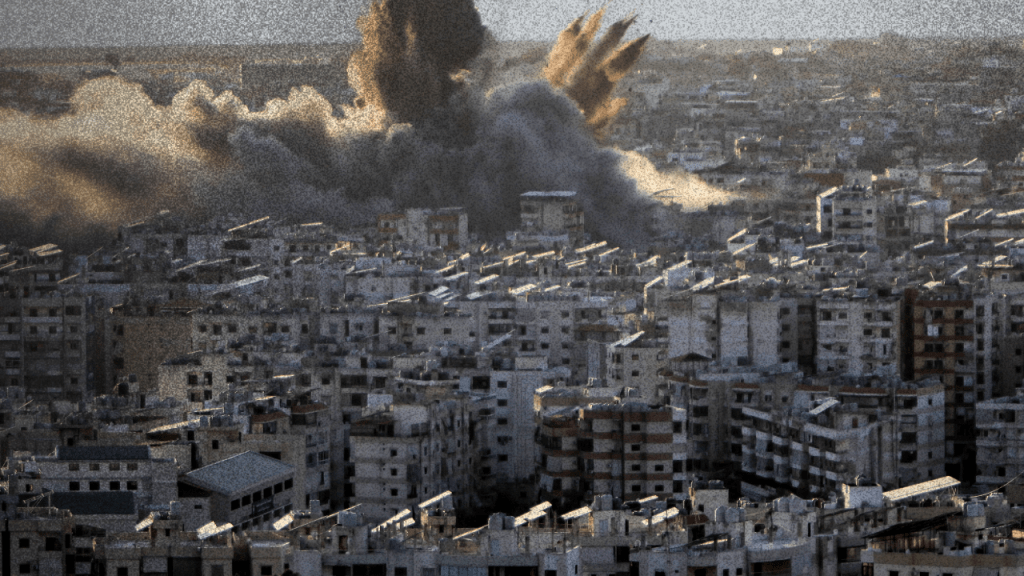
While the ceasefire provided narrative cover, Israel used the interval to pursue territorial objectives that airstrikes alone cannot achieve. Defense Minister Katz stated explicitly that the IDF would demolish all homes in villages adjacent to the border following the Rafah and Beit Hanoun model in Gaza, and that civilians would not be permitted to return south of the Litani River until the Hezbollah threat was removed. That is not a security condition. It is a territorial designation. The Litani River sits 15 to 20 miles north of the Israeli border. The area between the border and the river encompasses the historical base of Hezbollah’s political and social infrastructure — the communities that built the organization, sustained it, and embedded it into the fabric of daily life across generations.
Approximately a quarter of Lebanon’s population was displaced at the peak of the campaign. The Carnegie Endowment for International Peace documented the southern border as a wasteland still preventing return to normal life — functioning as a de facto buffer zone. Al Jazeera reported that forced evacuation orders had displaced more than 1.2 million people and that Israel had stated its intent to occupy southern Lebanon and establish a permanent security zone. The language used was bureaucratic: security, stabilization, prevention. The effect was territorial consolidation through demographic reorganization.
Depopulated territory is easier to control. A cleared landscape eliminates the ambiguity that counterinsurgency doctrine finds operationally inconvenient — anyone remaining can be treated as a combatant by default. Evacuation becomes permanent when return is structurally prevented. This is not a new strategy. Its variations have appeared across every major counterinsurgency campaign of the last century, from the strategic hamlets of Vietnam to the cordon-and-clear operations of Iraq. What is constant across all of them is the logic: sever the population from the organization, and the organization loses its roots. But the logic contains a structural error that these campaigns have consistently failed to correct.
Displacement Deepens What Made Hezbollah Necessary
The buffer zone strategy rests on an assumption that is historically falsified: that displacing a population from the terrain in which a resistance movement is embedded destroys the movement’s base. The inverse is closer to accurate. Hezbollah did not emerge from southern Lebanon because of geography. It emerged because the Lebanese state provided no meaningful protection, no reconstruction, no political representation, and no alternative to the vulnerability that Israeli bombardment produced repeatedly across decades. The organization filled a vacuum the state could not or would not fill. Displacement does not eliminate that vacuum. It deepens it.
Every family forced north, every village razed, every return blocked is a concrete demonstration of exactly the political argument Hezbollah has made about the Lebanese state’s incapacity and about what resistance means in practice. The buffer zone is not only a military tactic. It is an attempt to sever Hezbollah from the social terrain in which it grew. But the attempt reproduces the conditions of that growth. Displacement produces grievance. Grievance produces political loyalty. Political loyalty produces organizational capacity. The strategy generates what it claims to prevent. This is the mechanism behind every reconstitution cycle in Lebanese history, and it is the mechanism behind the one documented by Hezbollah’s own commanders in December 2025.
Lebanon’s internal divisions are real. The Lebanese state has attempted to assert control, called for disarmament, and banned independent military action. Opposition to Hezbollah within Lebanon exists and has intensified in some communities. But opposition is structured by the same material conditions: communities most exposed to Israeli strikes, with no alternative source of protection or reconstruction support, maintain organizational loyalty not out of uncritical allegiance but out of structural necessity. Western framing of dissent as evidence that Hezbollah lacks legitimacy misreads the relationship between political loyalty and material conditions. Legitimacy in this context is not an ideological choice. It is a function of who shows up when the state does not.
Deterrence Fails Without the Right Preconditions
The model Israel applied — inflict enough damage to make continued resistance more costly than restraint — has a specific set of preconditions that must hold for the model to work. The opponent must have viable alternatives to resistance. The population must be capable of compliance without facing the vulnerability that produced resistance in the first place. The organization must be structured such that leadership losses produce organizational collapse rather than adaptation. None of these conditions existed in southern Lebanon. None of them have existed in southern Lebanon at any point in the last forty years.
Deterrence did not fail in 2024 because of execution errors. It failed because the theory of change embedded in the strategy does not correspond to the material conditions of the population it targets. Civilian harm does not isolate Hezbollah from its base when Hezbollah is the base’s primary source of protection, reconstruction financing, social services, and political representation. Leadership strikes do not end an organization built with explicit redundancy against leadership strikes. Territorial destruction does not produce compliance when the alternative to resistance is not peace but an undefended exposure to the same destruction. The strategy deepens the conditions that make the organization structurally necessary, and then expresses surprise when the organization reconstitutes.
By March 2026, the UN humanitarian chief was asking the Security Council how the international community should prepare for a new occupied territory. Hezbollah had launched missile barrages described as among the largest in years — more coordinated, more effective than earlier phases of the conflict. A movement built to absorb exactly the punishment Israel delivered, embedded in exactly the terrain Israel sought to depopulate, fighting for exactly the political leverage that makes any post-war settlement require its participation. The “victory” of 2024 produced the escalation of 2026. That is not a paradox. It is the predictable outcome of a strategy built on assumptions that never held.
Sources
- Middle East Eye — Exclusive: How Hezbollah rebuilt while its enemies declared it dead, March 2026
- OHCHR — UN experts warn against continued violations of ceasefire in Lebanon, October 2025
- Al Jazeera — Canada tells Israel that Lebanon’s sovereignty must not be violated, March 2026
- Al Jazeera — Israel says four soldiers killed as army pushes deeper into south Lebanon, March 2026
- Carnegie Endowment for International Peace — Israel’s Ring of Buffer Zones, December 2025
- Al Jazeera — Israel’s unending attacks in Lebanon push country’s population to the brink, March 2026
- Al Jazeera — UN aid chief warns of new Israeli occupation in southern Lebanon, March 2026
- Al Jazeera — Israel’s buffer zone, created by bombing Lebanon with white phosphorus, December 2024