
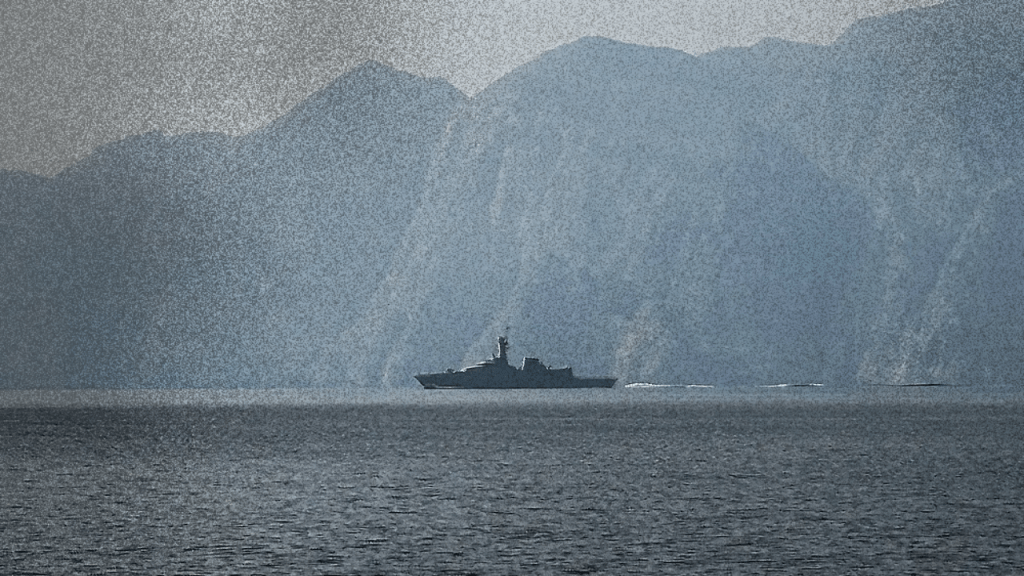
Over 1,100 ships lost GPS in the Strait of Hormuz as war escalated. Why the disruption isn’t a side effect — and what it reveals about who controls global infrastructure.
In the past 24 hours, maritime intelligence firm Windward has documented GPS jamming and AIS signal interference affecting more than 1,100 vessels in the Middle East Gulf. Ships are appearing on navigation systems at airports, at a nuclear power plant, and on land in Abu Dhabi. The Combined Maritime Forces coalition based in Bahrain has declared conditions in the Strait of Hormuz “critical”, warning of “active kinetic hazard conditions” and urging watchstanders not to rely solely on GPS for positioning. Windward identified at least 21 new jamming clusters across Emirati, Qatari, Omani, and Iranian waters. Maersk has announced rerouting. Some Western-affiliated tankers have switched off their AIS signals and are transiting dark. Others have reversed course entirely.
This is not a technical glitch. It is what war looks like when fought over the invisible infrastructure of global logistics.
About 20 percent of the world’s oil and gas exports pass through the Strait of Hormuz. The jamming and spoofing now active across that corridor affect not just vessel positioning but the entire operational logic of commercial maritime traffic — collision avoidance, insurance compliance, port timing, cargo scheduling. The US Navy has established a maritime warning zone across the Persian Gulf, Gulf of Oman, and adjacent waters, explicitly warning that it cannot guarantee the safety of neutral or merchant shipping. Jakob Larsen, head of maritime security at BIMCO, said it plainly: “The Persian Gulf, Strait of Hormuz and adjacent waters are the most dangerous place right now for commercial shipping.”
Understanding what’s actually happening here requires stepping back from the technical details and asking a different question: what does it mean that GPS has become a weapon?
The Infrastructure You Rely On Is Not Neutral
GPS is not civilian infrastructure that the military also uses. It is military infrastructure that civilians have been permitted to use.
The system is owned and operated by the United States Space Force, the successor to the Air Force unit that built it. From its inception, GPS was designed to give the U.S. military an absolute positioning advantage in any theater of operations. Civilian access was a secondary function, initially limited and degraded deliberately — what the U.S. government called “Selective Availability,” which introduced errors into civilian signals to prevent adversaries from using GPS precision for weapons guidance. Selective Availability was only switched off in May 2000, a decision made unilaterally by the Clinton administration, for reasons of U.S. economic interest. It can be switched back on.
The 1993 Yinhe incident makes the stakes concrete. The United States alleged that a Chinese civilian container ship was carrying chemical weapons precursors to Iran. Without trial, without evidence sufficient to board the vessel, and without consent from China, the U.S. jammed the ship’s GPS signals, leaving it adrift in the Indian Ocean for three weeks while Washington applied pressure. The inspection eventually conducted in Saudi Arabia found nothing. The ship was clean. The weapons did not exist.
China was forced to concede control over its own vessel’s navigation because the United States controlled the signal that told the ship where it was. That incident is now cited routinely in Chinese state media as the founding grievance that drove BeiDou’s development — the moment Beijing resolved that ceding navigational control to American infrastructure was a form of strategic subordination it could not afford.
This is the material history behind the satellite navigation map as it exists today. GPS was not built as a global public good. It was built as a power tool, and global civilian dependence on it is a form of structural leverage.
What Jamming and Spoofing Actually Do
Electronic interference with satellite navigation operates along two main vectors. Jamming floods receivers with noise powerful enough to overwhelm the legitimate signal — ships lose their fix and navigation systems fail. Spoofing is more sophisticated: it broadcasts counterfeit signals that receivers accept as legitimate, placing vessels at false positions. The AIS data now showing ships on land in Abu Dhabi, at airports, in rings on the water — that is spoofing. The ship’s system believes it is somewhere it is not.
Because GPS signals arriving from orbit are weak by the time they reach Earth’s surface, overcoming them requires relatively modest power output from ground-based transmitters. The technical barrier to GPS disruption at regional scale is not high. What has restrained its use is not capability but choice.
The timing and pattern of the current disruptions are consistent with defensive counter-drone and counter-missile operations. Iranian forces and U.S. and Israeli forces are both operating drone and missile systems that rely on GPS or GPS-adjacent guidance in the same airspace. Disrupting adversary guidance without a kinetic strike is precisely the kind of gray-zone capability that electronic warfare offers — force application that remains below the threshold of acknowledged military engagement, and that carries built-in deniability. Multiple regional advisories have warned that GPS jamming and spoofing are “likely” in the current environment — not accidental, not surprising, but structurally expected.
The civilian vessels caught in this disruption are collateral to a contest they are not parties to. Their navigation systems are failing because the electromagnetic environment they depend on has been turned into a military instrument.
BeiDou and the Fragmentation of Infrastructure Sovereignty
This is where the geopolitical logic of the current moment becomes legible.
China built BeiDou because of the Yinhe. Iran has been transitioning to BeiDou for navigation — in missile guidance, drone systems, and critical infrastructure — precisely because repeated GPS jamming incidents in the Strait, most recently during the June 2025 twelve-day conflict, demonstrated that dependence on the U.S.-controlled signal in a conflict environment meant ceding operational control to the adversary. The European Union built Galileo for the same reason: strategic autonomy requires independent infrastructure, including independent timing and positioning. Russia maintained GLONASS through economic difficulty for the same reason.
The world now has four operational global navigation satellite systems — GPS, BeiDou, GLONASS, Galileo — each built by a major power bloc specifically to avoid dependence on the others. That fragmentation is not a technical redundancy. It is a political map drawn in orbit.
The significance is not that one system is superior to another in a technical sense. It is that control over positioning and timing infrastructure is now understood as a dimension of sovereignty. The states and institutions that depend entirely on GPS have outsourced a critical slice of their operational capacity to American military infrastructure. That outsourcing is invisible during peacetime. It becomes visible exactly when the U.S. is a belligerent in the same region where your ships are sailing.
What is happening in the Strait of Hormuz right now is what the end of GPS’s global monopoly looks like in practice. For decades the world operated on a single navigational standard, not because GPS was the best system, but because the U.S. had built it first and the rest of the world had built dependency into its logistics, its aviation, its financial clearing systems, and its military hardware. That dependency is now being tested at the pressure point where U.S. military action has made GPS a liability rather than a service.
Energy, Insurance, and the Cascade
The commercial consequences are already unfolding. Hull and machinery insurance premiums rose over 60% during the June 2025 Hormuz jamming incidents, with war-risk surcharges per voyage adding over a million dollars per tanker. Marine cargo insurance rates rose 15 to 30 percent. If the strait becomes too dangerous to transit, the alternative route around the Cape of Good Hope adds 10 to 15 days to journeys between Asia and Europe — a delay that cascades through container scheduling, port congestion, and energy supply chains across both regions. China imports roughly 45 percent of its fuel from Gulf countries. The disruption is not abstract.
BIMCO warns that insurance rates for ships with U.S. or Israeli business connections are set to increase “manyfold” and that those vessels may be unable to get war-risk coverage at any price. This is how military escalation transmits into global economic infrastructure without a single missile striking a commercial target. The disruption to navigation systems is sufficient on its own to alter the operational calculus for hundreds of vessels and the companies and states that depend on them.
The Strait of Hormuz has always been described as a chokepoint. What the current moment makes clear is that it is a chokepoint in multiple overlapping dimensions simultaneously — physical, electronic, legal, and financial — and that military action in any one of those dimensions radiates consequences into the others.
The Spectrum as a Domain of Class Power
There is a materialist analysis that the draft framing around “invisible battlefields” doesn’t quite reach. The GPS system, like most critical infrastructure, was built with public resources for military purposes and then extended to civilian use in ways that produced global dependency. That dependency is profitable — the civilian GPS industry generates enormous value — and structurally asymmetric: the infrastructure serves all users, but control over it is held by one state. When that state is engaged in military operations, the interests of commercial users become secondary to military operational requirements. Ships lose their navigation. Tankers reverse course. Insurance premiums spike. Energy prices move. The cost of that is distributed globally; the control is not.
This is not unique to GPS. It is the logic of infrastructure developed under empire: built ostensibly for general use, structured to preserve the leverage of the builder. BeiDou, Galileo, and GLONASS are not counter-hegemonic projects in any transformative sense — they extend the same logic to additional state actors. But their existence as alternatives at least fractures the monopoly and forces the question of who controls the systems that the world depends on to move, to navigate, and to trade.
When signals flicker in the Strait of Hormuz, it is not a technical anomaly. It is the infrastructure of power becoming legible — briefly, violently, and at enormous cost to everyone who had no vote in the matter.
For more on how the UAE’s structural role in U.S. military infrastructure made it a target in this conflict rather than a neutral party, read The Cost of Hosting Empire.
Sources
- Windward Maritime AI. “GPS Jamming Disrupts 1,100 Ships in the Middle East Gulf.” February 28, 2026. https://windward.ai/blog/gps-jamming-disrupts-1100-ships-in-the-middle-east-gulf/
- Maritime Executive. “Iran Tries to Intimidate Shipping With Attacks in the Strait of Hormuz.” March 1, 2026. https://maritime-executive.com/article/iran-tries-to-intimidate-shipping-with-attacks-in-the-strait-of-hormuz
- Fox News / BIMCO. “Hormuz Erupts: Attacks, GPS Jamming, Houthi Threats Rock Strait Amid US–Israeli Strikes.” March 1, 2026. https://www.foxnews.com/world/strait-hormuz-maritime-incidents-follow-us-israeli-operation-epic-fury-strikes-iran
- Lloyd’s List. “Maritime Warning Zone in Place as US and Israel Launch ‘Massive’ Strikes on Iran.” February 28, 2026. https://www.lloydslist.com/LL1156475/Maritime-warning-zone-in-place-as-US-and-Israel-launch-massive-strikes-on-Iran
- bne IntelliNews. “1,000 Ships’ GPS Jammed in Straits of Hormuz, Sending Up Costs and Disrupting Deliveries.” June 23, 2025. https://www.intellinews.com/1-000-ships-gps-jammed-in-straits-of-hormuz-sending-up-costs-and-disrupting-deliveries-387363/
- The Washington Institute. “China’s Push for Satellite Cooperation in the Middle East.” https://www.washingtoninstitute.org/policy-analysis/chinas-push-satellite-cooperation-middle-east
- Defence Security Asia. “Iran Abandons US GPS for China’s BeiDou, Redrawing the Strategic Map of Middle East Electronic Warfare.” https://defencesecurityasia.com/en/iran-abandons-us-gps-china-beidou-middle-east-security/
- Seatrade Maritime. “Shipping Security Risk Increases Dramatically in Persian Gulf.” February 28, 2026. https://www.seatrade-maritime.com/security/shipping-security-risk-increases-dramatically-in-persian-gulf







 Spark Solidarity