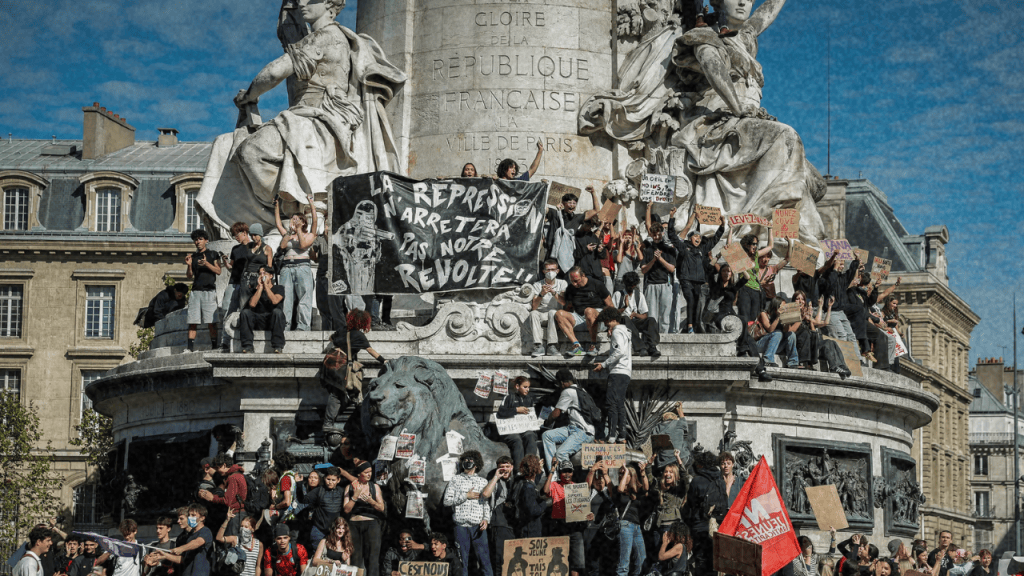
France’s school revolt grew from missing staff and broken facilities into a national fight over public services, living costs and police power.
The movement that filled streets across France on October 17 began weeks earlier inside schools that were already struggling to function. At Lycée Antoine-de-Saint-Exupéry in Créteil, teachers, students and parents mobilized in September over severe staffing gaps and deteriorating conditions.
A September 22 account from the LFI-aligned Union Populaire pour Créteil listed vacancies for a deputy principal, a school nurse, a half-time social worker, a vocational and technical training director, a business-relations manager, and teachers in French, mathematics and economics-law. It also reported only 2.5 full-time-equivalent disability-support aides for a need estimated at at least 10. On September 21, students, staff and parents marched from the school to the Créteil education authority demanding that the missing posts be filled.
Similar grievances were surfacing across Seine-Saint-Denis. StreetPress reported students describing classes of roughly 35 pupils, months without teachers, damaged facilities and shortages in school health and support services. In Bagnolet, students and staff at Lycée Hénaff said the school had gone without a nurse since the start of term and that a broken lift remained out of service. At Paul-Éluard in Saint-Denis, a student representative described one half-time nurse serving roughly 2,000 pupils.
The reality is that responsibility for these failures is split across different levels of government. The central state recruits and pays teachers and most education and health staff. Municipalities maintain primary schools, départements are responsible for collèges, and regions oversee lycée buildings and major material operations. Within the same school, a missing teacher, an absent nurse and a broken building can reflect failures in different parts of the public system.
Students did not need a national budget document to tell them something was wrong. They could see it in overcrowded classrooms, vacant posts and services that existed on paper but not in the building. The first political demand was simple: make the schools work.
Blockades Spread Beyond the Schools
From there, the revolt moved from school to school and campus to campus. Union Étudiante and the Union Syndicale Lycéenne called for lycée and university blockades on October 1 and youth demonstrations on October 6. Their demands stretched beyond staffing to Parcoursup, Mon Master, student financial support, foreign-student fees and the growing cost of education.
Local assemblies gave the movement different shapes in different cities. In Toulouse, Révolution Permanente and IAATA reported an occupation at Mirail, assemblies bringing students and campus workers together, and rotating lycée blockades. In Rennes, Révolution Permanente reported a Rennes 2 assembly of more than 1,000, an INSA blockade backed by staff, and participation from lycée students, workers and parents. In Lyon, Rebellyon carried calls for inter-lycée and university assemblies, while an autonomous collective announced separate October 17 gathering points at Bellecour and Place de la République.
Workers began entering the same struggle through their own organizations. Solidaires 13 called a Marseille contingent for October 17 and linked student demands to wages and public services. In Paris, CGT Paris said it provided safety cordons at demonstrations and opened the Bourse du Travail for student general assemblies. The major union federations were also building toward a national public- and private-sector strike on November 5.
That produced something broader than a student campaign without creating a single leadership. Students were fighting over schools and access to education. Unions brought wages, pensions, jobs and public services. Yellow Vest networks returned with anger over prices and purchasing power. Autonomous groups brought a different tradition of street politics. They shared a crisis before they shared a strategy.
The Streets Brought Different Forces Together
The strategic differences became clearer as the protests grew. Student groups wanted immediate action around schools and universities. The main labour federations backed the youth movement but were preparing their largest coordinated workplace action for November 5. Some campus assemblies and local groups wanted escalation sooner. Autonomous networks had little interest in waiting for a national union timetable.
This is the basic problem every expanding movement eventually faces. A large crowd can share anger without sharing an organization capable of acting on it. A lycée blockade, a union strike, a Yellow Vest roundabout and an autonomous march all put pressure on the state in different ways. Bringing them into the same political moment is easier than making them move together.
Visibility can force a government to respond, but organized leverage changes the balance of power. France now had hundreds of thousands of people moving through overlapping struggles. The question was whether that overlap could become something more durable.
October 17 Turned Scale Into Confrontation
By October 17, the school protest movement was already nationwide. The difference that day was scale. Students, trade unions, Yellow Vest networks and other groups filled streets across the country at the same time. The Interior Ministry said 550,000 people participated; union and student organizers put the number at about 800,000.
The day also produced serious property destruction. Associated Press and Reuters reported burning vehicles, a kiosk and refuse bins around Paris’s Place de la République. In Lyon, a tourist office was damaged and set on fire. Marseille saw an intrusion into the city-hall lobby and damage to shops and a municipal police station, while Limoges city hall suffered extensive fire damage.
But these were not attacks on some world outside the people carrying them out. City halls, public buildings and municipal institutions are built, financed and sustained through the labour and wealth of the population itself. When those institutions come to represent austerity, abandonment or coercive state power, public ownership does not make them politically sacred. What people build can also become a target when they no longer believe it is being used for them.
By late evening, the scale of the police response had become a story of its own. Prime Minister Sébastien Lecornu said about 1,200 people had been arrested and more than 150 police officers injured, up from 272 arrests reported by mid-afternoon and roughly 400 earlier in the evening. The pace of those arrests showed how rapidly the confrontation escalated as demonstrations spread across the country. What began as a revolt over schools, public services and living costs was now also a struggle over policing, detention and the state’s ability to contain mass dissent.
Police Became Part of the Conflict
Police tactics had already become part of the movement before October 17. On October 5 in Dunkirk, videos authenticated by Le Monde showed a police four-wheel-drive repeatedly accelerating toward young demonstrators. The Nord prefecture acknowledged that the conduct did not conform to normal intervention doctrine, and the incident prompted both an administrative inquiry and a preliminary criminal investigation.
In Saint-Étienne, a 17-year-old lost his right hand after picking up a grenade fired by police during the October 17 demonstrations. Prosecutor Anne Gaches opened an investigation and referred the case to the IGPN, France’s police internal-affairs body. The exact type of grenade and legal responsibility for the injury remained under investigation.
As the protests spread, police violence and repression became part of the conflict itself. Students who had first mobilized over missing staff, broken facilities and failing public services were now also confronting riot police, mass arrests and serious injuries. The struggle was no longer only about what the state failed to provide. It was also about how the state responded when people organized against those failures.
The Budget Put a Price on the Crisis
The 2027 budget gave the revolt a new target. The government proposed a €54 billion fiscal adjustment package combining spending restraint, revenue measures and changes already set in motion. Of that total, €43 billion comes from measures in the new finance and social-security bills. The government wants to reduce the deficit from a forecast 5.4 percent of GDP in 2026 to 5.0 percent in 2027.
What matters is where the pressure lands. The proposal freezes the parameters used to calculate housing assistance and the prime d’activité for a year. The state budget is expected to provide more than €9 billion of the savings effort, and local governments are also being asked to contribute. At the same time, the government plans to reduce the exceptional surtax on large corporate profits.
The school budget itself shows why national numbers do not tell the whole story. The 2027 plan proposes about €90.86 billion in school-education payment credits, up from roughly €89.64 billion in 2026, an increase of about 1.36 percent before inflation. Some secondary-teacher lines fall while trainee-teacher, disability-support, nursing and social-work positions increase. A national budget can rise while a particular school still cannot fill a nurse’s office or put a teacher in front of every class.
For students and workers already mobilizing over understaffed schools, strained services and rising living costs, the budget turned those grievances into a wider fight over who pays. Debt service and defence are protected differently from housing support, local services and household benefits. Corporate taxation can be eased while ordinary people are told the state has to tighten its belt. Fiscal policy turns scarcity into a political decision about whose needs come first.
Anger Is Not Power Until It Is Organized
France has already shown that it can fill the streets. Students can shut schools and universities. Workers can strike. Yellow Vests can return to roundabouts and city centres. Autonomous groups can disrupt the normal rhythm of a city. The state can still outlast those actions when they remain separate and episodic.
The harder problem begins when those forces start giving each other leverage. A school blockade becomes more powerful when workers can stop transport or production around it. A strike becomes harder to isolate when students and neighbourhood movements keep pressure in the streets. The movement does not need every participant to share one ideology. It needs enough organization to make separate grievances land on the same centres of power.
That is the question hanging over the November 5 strike call. October 17 showed how far the revolt had expanded beyond its school origins, but scale alone does not decide who wins. Governments can survive enormous demonstrations. They have a harder time surviving coordinated disruption that reaches schools, workplaces, transport and public institutions at once.
The schools exposed the breakdown. October 17 exposed the scale. The next phase will show whether that anger can become organized power.
Sources
- Union Populaire pour Créteil, reporting on staffing shortages and the Saint-Exupéry mobilization, September 22, 2026
- StreetPress, reporting from lycée protests across Seine-Saint-Denis, October 9, 2026
- StreetPress, reporting on school health and support shortages, October 15, 2026
- Union Étudiante and Union Syndicale Lycéenne, national blockade and demonstration call, 2026
- CGT Paris, “Mouvement lycéen,” October 13, 2026
- Rebellyon, Lyon lycée and university mobilization notice, October 2026
- Rebellyon, rolling account of Lyon-area school blockades, October 2026
- Rebellyon, autonomous October 17 mobilization call in Lyon, October 16, 2026
- Révolution Permanente, Toulouse student and campus mobilization report, October 14, 2026
- IAATA, timeline of the Toulouse lycée movement, October 2026
- Révolution Permanente, Rennes student mobilization report, October 7, 2026
- CGT and interunion organizations, call for wages, public services, employment and industry, October 2026
- CGT, statement on the student movement and October 17 mobilization, October 16, 2026
- Solidaires 13, October 17 mobilization call in Marseille, October 14, 2026
- Associated Press, reporting on the nationwide school protest movement before October 17
- Le Monde, Yellow Vest and student mobilization ahead of October 17, 2026
- Associated Press, nationwide October 17 protest coverage
- Reuters, nationwide October 17 protest coverage
- Le Monde, verified video reporting on the October 5 Dunkirk police-vehicle incident
- TF1/AFP, Saint-Étienne injury and IGPN investigation, October 17, 2026
- Élysée, Council of Ministers presentation of the proposed 2027 budget, October 1, 2026
- French Ministry of Economy, presentation of the proposed 2027 budget
- Assemblée nationale, 2027 Finance Bill dossier
- Assemblée nationale, 2027 annual performance plan for school education
- French Ministry of Economy, proposed 2027 measures affecting households and businesses
- French Ministry of Education, division of state and local responsibilities for schools