
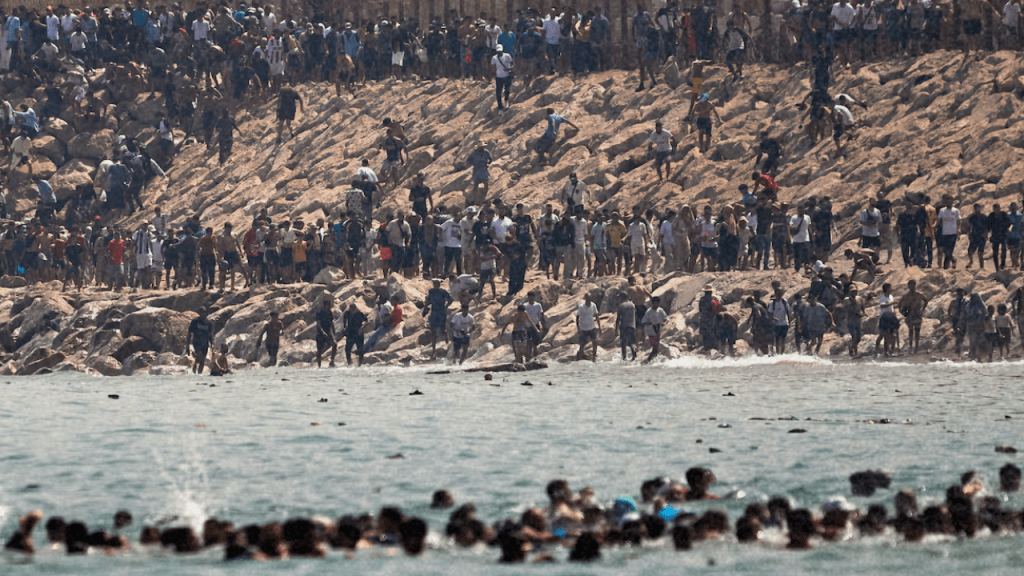
Morocco weaponized migration at Ceuta to discipline Spain, while Washington and Israel reinforced the political pressure against the Sánchez government.
Ceuta was not invaded by migrants. Morocco turned their movement into a hybrid coercion operation against Spain.
The people crossing from Morocco on July 30 were civilians, including families and children. They moved by land, swam around the breakwater and forced their way through border gates. Spanish television estimated that 2,000 to 3,000 people entered the city. Madrid deployed 200 specialized police officers and 60 troops. Nine bodies were recovered that day, adding to dozens of deaths along the route in recent months.1
The invasion narrative turned desperate people into enemy units and concealed the state power operating around them. Morocco controlled the border. Morocco had already used migration as leverage against Spain. Morocco knew that opening the route would overwhelm Ceuta, force a military deployment and produce images that would dominate European politics.
The crossing came ten days after Pedro Sánchez restored strategic ties with Algeria, Morocco’s principal regional rival. It came after American policy advocates proposed a civilian Green March into Ceuta and Melilla, a senior Republican questioned Spanish sovereignty, and a House committee described the cities as Spanish-administered territory located in Morocco. It unfolded while Washington was punishing Spain for refusing to support the Iran war and while Israel deepened its military partnership with Morocco.
The migrants were not an army. They were the human material of an operation designed to make Spanish sovereignty costly.
The Border Was Opened for Political Effect
No Moroccan military force entered Ceuta. Spain retained control of the city, its port, government buildings and security apparatus. The arrivals did not carry a territorial programme or operate through a visible command structure.
That does not make the event spontaneous. A state does not need to place civilians under military command to weaponize their movement. It can withdraw enforcement, tolerate gathering near a sensitive border, circulate the expectation of an opening and allow desperation to do the rest.
Ceuta is constitutionally Spanish and part of the European Union. Reaching the enclave does not automatically grant unrestricted passage to mainland Spain or the rest of the Schengen area. Madrid and Rabat announced cooperation to prevent further crossings and return people without a legal right to remain.1
Morocco controlled both sides of the pressure cycle. It allowed the surge to reach crisis scale, then resumed enforcement and presented itself as the indispensable partner required to restore order. The route did not need to remain open indefinitely. It only needed to stay open long enough to overwhelm Ceuta and demonstrate Spain’s dependence on Moroccan cooperation.
The Spanish military was responding to institutional overload rather than territorial conquest. Reception centres exceeded capacity, local businesses closed and authorities feared more deaths at sea. The emergency was real. The political use of that emergency was also real.
Morocco Had Already Proven the Method
Morocco had already demonstrated that migration could be used to force Spanish concessions.
Spain admitted Polisario Front leader Brahim Ghali for medical treatment in April 2021. Morocco, which claims Western Sahara and rejects Sahrawi independence, treated the decision as a direct challenge. The following month, roughly 9,000 people crossed into Ceuta after Moroccan police relaxed border controls, opened barriers and failed to stop the movement.2
The European Parliament explicitly condemned Morocco’s use of border control, migration and unaccompanied minors as political pressure against an EU member state. It reaffirmed that Ceuta formed part of the European Union’s external border and that the territorial integrity of member states was non-negotiable.2
Rabat then received the policy shift it had demanded. In March 2022, Sánchez endorsed Morocco’s autonomy proposal for Western Sahara as the most serious and realistic basis for settlement, abandoning Spain’s previous position. Madrid and Rabat restored relations shortly afterward.3
The sequence established a durable lesson for Moroccan decision-makers: a border crisis could impose domestic costs on Spain and be followed by a historic diplomatic concession.
The tactic echoed Morocco’s 1975 Green March into Western Sahara. King Hassan II used a mass civilian mobilization to force Spain into a coercive choice without declaring a conventional war. The same strategic principle reappeared at Ceuta: civilians produced the political effect while the state preserved deniability.
The Algeria Visit Triggered the Operation
On July 20, Sánchez travelled to Algiers and declared Algeria a strategic partner and friend. Spain and Algeria agreed to intensify political dialogue, hold a high-level bilateral meeting in the autumn and expand cooperation in energy, migration and security. The Spanish government also emphasized Algeria’s role as its leading natural-gas supplier in 2026.4
Ten days later, Ceuta’s border collapsed.
Algeria is Morocco’s primary regional rival, the Polisario Front’s principal external supporter and the central counterweight to Rabat’s campaign to make its control of Western Sahara irreversible. Sánchez’s return to Algiers threatened the diplomatic alignment Morocco had secured from Spain in 2022.
The Ceuta operation delivered a direct warning. Spain could rebuild relations with Algeria, but the security of its North African territories remained vulnerable to Moroccan decisions. Rabat did not need to annex Ceuta. It needed to remind Madrid that independent diplomacy carried an immediate domestic cost.
The objective was discipline. Morocco used the border to define the limits of Spanish manoeuvre.
Washington Made the Pressure Safe
Washington had already weakened Spain’s position and supplied political cover for Moroccan pressure.
In March, Michael Rubin, an American Enterprise Institute veteran and former Pentagon official, urged Morocco to organize a new Green March into Ceuta and Melilla. His proposal called for unarmed civilians to cross, raise Moroccan flags and force Spain to choose between violence and negotiation.5
Rubin publicly described the method before the event occurred.
On April 1, Republican Representative Mario Díaz-Balart told El Español that Ceuta and Melilla were geographically in Morocco and that their status should be discussed among friends and allies. Díaz-Balart chaired the House appropriations subcommittee responsible for national security, the State Department and related programmes. He also accused Sánchez of endangering the U.S.-Spanish alliance and suggested Washington might explore alternatives.6
Later that month, the House Appropriations Committee called Ceuta and Melilla “Spanish-administered cities,” said they were “located in Moroccan territory” and supported diplomatic engagement over their “future status.”7
That language converted settled Spanish territory into a negotiable question. “Spanish-administered” reduced sovereignty to temporary management. “Future status” placed Morocco’s territorial claim inside an official congressional framework.
By July, Washington had made the strategic message unmistakable. American policy circles had proposed the civilian method, questioned Spanish sovereignty and institutionalized the idea that Ceuta’s status could be mediated.
Trump Was Already Punishing Spain
The territorial pressure formed part of a larger American campaign against the Sánchez government.
Spain refused to allow the jointly operated Rota and Morón bases to be used for attacks on Iran. Fifteen American aircraft left the facilities after Madrid said Spanish territory would not support operations it considered inconsistent with the UN Charter.8
That refusal exposed the fracture explored in Spark Solidarity’s account of NATO’s breakdown under the Iran war. Washington treated Spanish control over its own territory as disloyalty.
An internal Pentagon email circulated options for punishing European allies that withheld access, basing and overflight rights. Reuters reported that the proposals included suspending Spain from prestigious NATO positions and reducing Europe’s supposed sense of entitlement. NATO’s treaty contains no mechanism for suspending a member. The threat was designed to intimidate.9
On July 8, Trump ordered officials to prepare an immediate halt to trade with Spain, citing defence spending and Madrid’s refusal to support the Iran war. The threat announced that Washington was prepared to use economic coercion against an ally for exercising control over its own bases.10
Morocco therefore acted in an environment where the United States was already attacking Sánchez, threatening Spanish trade and weakening Spain’s territorial position. The expected diplomatic cost of pressuring Madrid had been stripped away.
Israel Reinforced the Same Offensive
Israel had a direct political interest in weakening Sánchez and a mature military relationship with Morocco.
Madrid formally recognized Palestine in May 2024. Spain later adopted restrictions on defence and dual-use trade with Israel, targeted products from illegal settlements and denied use of Spanish bases for the U.S.-Israeli war against Iran.11 12
These policies made Spain one of Israel’s sharpest governmental critics in Western Europe. As Spark Solidarity argued after the Bilbao airport assault, the political violence surrounding the Gaza war does not remain confined to Palestine.
Israel and Morocco signed a defence pact in 2021 covering intelligence cooperation, military exercises and arms procurement. In January 2026, their Joint Military Committee signed a work plan after meetings involving strategic planning, Israeli military units and defence industries.13 14
The Ceuta crisis served both states. Morocco demonstrated leverage over Spain. Israel’s allies gained a new domestic cost to attach to Sánchez’s support for Palestine. The operation shifted attention from Gaza toward migration, territorial fear and the supposed danger of Spanish independence.
Washington and Israel did not need to administer the border. Morocco possessed the direct capacity. Their role was political reinforcement: both had already turned Sánchez into a target and both benefited from a crisis that weakened him.
Ceuta Is Built for Hybrid Coercion
Ceuta is more than a local border crossing. It places Spain and the European Union on the African shore near the western entrance to the Mediterranean. A crisis there implicates migration policy, shipping, military surveillance, Morocco’s territorial claims and the cohesion of NATO.
NATO says it protects all members, but Article 6 defines the geographic scope of collective defence through language focused on Europe, North America and specified islands. Asked directly about Ceuta and Melilla in 2022, the secretary general said any invocation of Article 5 would require consensus among the allies.15
That ambiguity gives Morocco room to apply pressure below the threshold of conventional war. A military attack would unify support for Spain. A migration crisis places the burden on Madrid while allowing every ally to avoid answering the territorial question directly.
Recurrent emergencies make Spanish control more expensive, increase dependence on Moroccan enforcement and normalize mediation over a “future status.” Territorial revision begins by changing what governing elites consider negotiable.
The Migrants Were Used, Not Invaders
Moroccan and sub-Saharan migrants did not need intelligence officers to invent their desire to leave. They faced unemployment, inequality, repression and the visible proximity of Europe. Some crossed with relatives. Others moved alone. Some died before reaching Spanish territory.
Their agency did not prevent the state from using them. Morocco exploited grievances already produced by the social order it governs. It converted authentic desperation into geopolitical leverage.
This is why the invasion narrative protects power. It directs anger downward toward migrants rather than upward toward the monarchy controlling Morocco’s security apparatus, the Spanish and European border regimes, or the geopolitical confrontation that made Ceuta useful.
The migrants will be detained, returned or absorbed into prolonged legal uncertainty. The image remains available to every party that benefits from fear: Morocco demonstrates leverage, Trump’s allies punish Sánchez, Israel’s supporters attach a domestic cost to solidarity with Palestine, and the European right receives footage for its next campaign.
The Gate Was Political
Ceuta was not invaded by the people swimming toward it. They were attempting to escape conditions that states had helped create, and some died during the attempt.
Morocco opened the pressure point because the moment was politically useful. Sánchez had restored ties with Algeria. Washington had made Spanish sovereignty negotiable and was punishing Madrid for refusing the Iran war. Israel had a deep military partnership with Morocco and a direct interest in weakening one of Europe’s strongest governmental critics of Gaza.
The crossing was hybrid coercion carried through civilian movement and migrant desperation. Its architects did not need to command every person who crossed. They needed only to recognize the opportunity, loosen the gate and understand the political force of the resulting image.
The migrants were not the enemy. They were used to discipline Spain.
Sources
- Reuters, “Migrants Pour Into Spain’s Ceuta From Morocco, Military Called In,” July 30, 2026.
- European Parliament, “Breach of the UN Convention on the Rights of the Child and the Use of Minors by the Moroccan Authorities in the Migratory Crisis in Ceuta,” June 10, 2021.
- Reuters, “Morocco, Spain Patch Up Diplomatic Feud After Spanish Shift on Western Sahara,” April 7, 2022.
- Government of Spain, “Spain and Algeria Agree to Usher in a New Phase in Bilateral Relations,” July 20, 2026.
- Michael Rubin, “Morocco Should Send a New Green March Into Ceuta and Melilla,” Middle East Forum, March 2026.
- José Ismael Martínez, “Díaz-Balart: Ceuta and Melilla Are in Morocco,” El Español, April 1, 2026.
- U.S. House Committee on Appropriations, Report on the National Security, Department of State, and Related Programs Appropriations Bill, 2027, pp. 86–87.
- Reuters, “U.S. Aircraft Leave Spain After Government Says Bases Cannot Be Used for Iran Attacks,” March 2, 2026.
- Reuters, “Pentagon Email Floats Suspending Spain From NATO,” April 24, 2026.
- Reuters, “Trump Orders Halt to U.S. Trade With Spain Over NATO Spending, Iran,” July 8, 2026.
- Reuters, “Spain, Ireland and Norway Recognize Palestinian Statehood,” May 28, 2024.
- Reuters, “Spain Exempts Airbus From Israeli Technology Ban,” December 30, 2025.
- Reuters, “Israel Signs Defence Pact With Morocco,” November 24, 2021.
- Times of Israel, “Israel and Morocco Sign Joint Military Plan for 2026,” January 5, 2026.
- NATO, Press Conference on Article 5, Ceuta and Melilla, June 30, 2022.






 Spark Solidarity