Bilbao Airport police beat flotilla activists who had just survived Israeli detention — exposing the security pipeline that runs from Gaza into Europe.
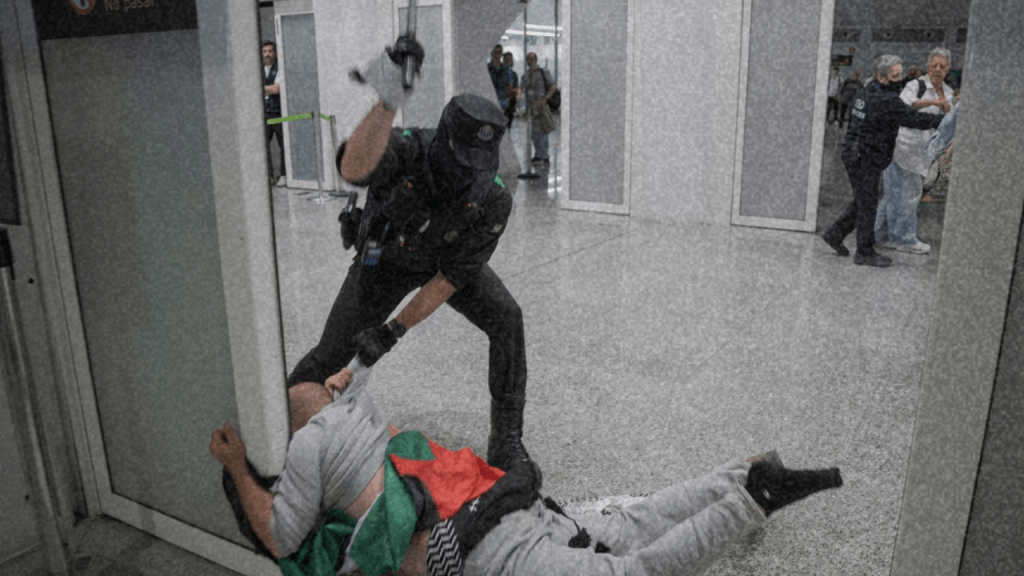
The footage from Bilbao Airport on May 23 looks less like the homecoming of humanitarian activists than the opening scene of a crackdown. Families had gathered in the arrivals hall to welcome home six Basque members of the Global Sumud Flotilla, who days earlier had been intercepted by Israeli forces in international waters and briefly detained before being deported. Supporters waved Palestinian flags. Then, when a relative of one of the activists tried to cross a barrier to reach them, an officer blocked his way, and the Ertzaintza — the Basque autonomous police — moved in with batons.
People were shoved to the ground, dragged across the terminal floor, and struck while already restrained. Four people were detained, three of them activists who had just stepped off the plane, and charged with serious disobedience, resistance, and assaulting an officer — the standard package of charges through which solidarity is converted into criminality.
The Ertzaintza’s internal affairs division has since opened an investigation into whether the officers’ conduct followed procedure. The footage spread within hours, carrying an almost surreal contradiction: people who had survived interception and detention by Israel, returning to Europe only to be beaten by the police of their own region.
The shock of the images came from that contradiction. These were not armed militants or rioters but activists arriving home to their families after a failed aid mission. The optics were devastating for Spanish authorities, because the images collapsed the distance European governments work to maintain between their rhetoric on Palestine and the behaviour of their institutions.
A state can condemn Israeli actions in Gaza, call for investigations, and present itself as morally opposed to the destruction — and then, the moment that politics arrives home in physical form, carried by activists who challenged Israel directly, the machinery of repression becomes visible.
The contracts behind the batons
Within hours, protests erupted across Bilbao against the Ertzaintza, and online the footage spread alongside a more specific charge: that the Basque police are tied to Israeli security firms through contracts, technology, and training. These claims come largely from movement researchers and from the flotilla’s own statement rather than from wire reporting, and they should be read as such — but they are specific, and they are not new.
According to reporting circulated after the incident, Basque institutions have spent more than 1.6 million euros on contracts involving Israeli-linked security companies. The Ertzaintza’s phone-tapping infrastructure is said to come from Verint — a major surveillance firm with a subsidiary based in Herzliya, Israel, whose tools have been sold to governments across more than a hundred and eighty countries and documented in surveillance operations from Peru onward. The same reporting cites Israeli-made body armour, cameras, and listening devices in Basque police use.
The most politically charged claim concerns training. According to those accounts and to the flotilla’s statement, the Ertzaintza has taken part in courses run by Israeli-linked security firms, including Guardian Defense & Homeland Security — a company led by a former Mossad officer that has reportedly provided “live fire” training to Spanish police — along with firms such as ISDS and ICTS, founded and staffed by former Israeli military and intelligence personnel.
The flotilla has called these procurement and training ties a matter of public record, and has demanded the termination of every such contract between Basque institutions and Israeli security firms.
Whether or not every figure in that reporting holds, the underlying relationship is not speculative. European police forces and Israeli security institutions are bound together through surveillance technology, equipment contracts, training exchanges, and shared counterterrorism doctrine. That is the thread the Bilbao footage pulled, and it runs far beyond one airport.
Palestine as the laboratory
Over the past two decades, Israeli security firms have positioned themselves as the world’s leading vendors of counterterrorism and urban-security expertise. Governments across Europe, North America, and Latin America have imported Israeli surveillance systems, riot-control methods, predictive-policing tools, and intelligence-sharing frameworks. The marketing is explicit, and it is the same everywhere: the methods are sold as battle-tested, effective precisely because they were developed through decades of military occupation, urban warfare, and counterinsurgency against Palestinians.
Techniques developed under occupation do not stay in the occupied territory. They travel outward through police conferences, private contractors, weapons expos, surveillance companies, and training seminars. What begins in Gaza or the West Bank reappears in European airports, migrant detention systems, anti-protest legislation, and militarised riot units. Palestine becomes not only a site of occupation but a laboratory for globalised systems of control, and the products of that laboratory are exported to the same governments that profess to oppose the occupation.
That is the deeper significance of Bilbao. The question is not whether one officer used excessive force. It is the worldview embedded in the security institution itself. When a state interprets political dissent through the language of counterterrorism, solidarity movements stop being democratic expressions and become destabilising threats to be managed. Protesters stop being citizens exercising rights and become a population to monitor, contain, and suppress. Seen that way, the response to the flotilla activists is not an aberration. It is the doctrine working as designed.
Spain condemns Israel and trains with it
Spain embodies the contradiction more sharply than almost any other European state. Prime Minister Pedro Sánchez has been among the loudest European critics of the war, calling Israel’s campaign in Gaza a genocide, recalling its ambassador. Spain recognised a Palestinian state in 2024 and permanently recalled its ambassador to Israel in March 2026. At the level of public diplomacy, Madrid has positioned itself in open moral opposition to the destruction of Gaza.
At the level of infrastructure, the security relationships continue. That is the split: a government can speak the language of human rights and international law with one institutional voice while operating through surveillance contracts, intelligence partnerships, and crowd-control doctrine with another. Most of the time the two are kept far enough apart that the contradiction can be managed rhetorically. Bilbao forced them into the same frame, in front of the cameras, in the arrivals hall.
Israel, for its part, enjoyed the spectacle. Its foreign ministry used the footage to taunt Madrid, demanding an explanation for Spain’s treatment of what it called the “flotilla anarchists” — a government that had just been condemned for detaining these activists at sea now mocking another government for beating them on arrival. The exchange captured the whole structure in miniature: two states, ostensibly opposed, speaking the same security grammar about the same people.
When the contradiction comes home
The airport violence reflects a broader shift across Europe and North America. Palestine solidarity is increasingly treated not as protest but as a security concern. Demonstrations are monitored more aggressively, activists surveilled, university encampments cleared, extremism frameworks invoked against dissident movements. The policing of Palestine solidarity has come to resemble the policing of anti-globalisation protest, Indigenous land defence, climate movements, and migrant-justice campaigns. The common thread is not ideology. It is disruption.
Modern states tolerate dissent while it stays symbolic and manageable. What they move against is the movement capable of exposing institutional hypocrisy, interrupting an economic relationship, or generating an international legitimacy crisis. The flotilla activists were precisely that kind of danger. They did not only attempt to deliver aid; they challenged the legitimacy of the blockade and returned carrying testimony about their detention, turning a distant geopolitical issue into a domestic political crisis and exposing the contradiction European governments most need to keep compartmentalised.
That is why the footage felt so bleak to so many, and why it mattered beyond the bruises. People were not only reacting to police violence. They were reacting to the sudden visibility of a system usually hidden behind bureaucratic language and diplomatic performance — the recognition that the contracts, the intelligence cooperation, the training pipelines, and the political alliances form an architecture far larger than any single protest.
And yet the protests that followed showed the other half of the lesson: the more aggressively states suppress this solidarity, the more openly they reveal whose interests their institutions actually protect. Every baton strike at an arrivals gate makes the alignment harder to deny, and the moral authority Western states claim abroad harder to sustain at home.
Sources
- Al Jazeera — Police beat and detain Gaza flotilla activists at Bilbao Airport (May 23, 2026)
- The Times of Israel — Spanish police beat and detain flotilla activists; four arrested; Sánchez “genocide” stance; ambassador recall
- ARA — Israel mocks police charges against Basque flotilla activists; the relative-at-the-barrier trigger; charge language; internal-affairs probe
- Euro-Med Human Rights Monitor — condemnation of the Ertzaintza assault; four arrested on non-compliance/resistance allegations
- Global Sumud Flotilla — statement on the Bilbao assault; procurement and training ties called “a matter of public record”; demand to end contracts
- The Times of Israel / AP — Verint Systems, Herzliya-based surveillance firm, sells tools to governments worldwide
- Roya News — Gaza flotilla activists beaten and detained at Bilbao Airport; Ertzaintza statement and internal investigation