Trump’s Iran war address promised an exit in weeks while oil spiked 3% the moment he finished and U.S. troops remain staged across the region.
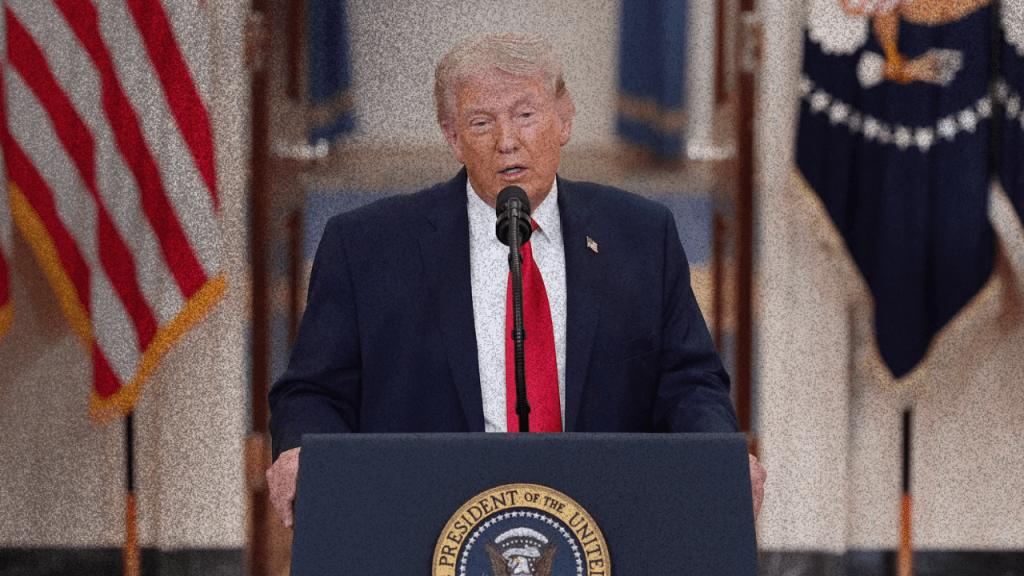
After more than a month of U.S. and Israeli bombing of Iran, Trump’s first Iran address aired Wednesday night — and his central disclosure was that 13 American soldiers have been killed since the war began. Iran, for its part, Iran’s reported casualties exceed 1,700. That asymmetry went unaddressed.
The speech, framed around “Operation Epic Fury,” offered no ceasefire announcement, no formal NATO decision, and no meaningful accountability for how the war started or where it is heading. The weeks-long completion timeline — a promise Trump had already made to the New York Post the day before — came wrapped in a series of self-congratulatory claims about military success. For why that timeline is structurally impossible to fulfill, see the exit strategy piece.
Regime Change “Not the Goal”
One of the more revealing moments came when regime change disavowed — Trump stated explicitly that regime change in Iran was “not our goal.” The stated objectives, repeated throughout the address, were destroying Iran’s ballistic missile capabilities, sinking its navy, and ensuring it could never acquire a nuclear weapon.
This framing matters. What the United States has conducted is not a war to liberate the Iranian people or dismantle the Islamic Republic — it is a surgical campaign designed to permanently degrade Iran’s ability to deter Israel and project regional power. The goal was always subordination, not transformation. The White House objectives document confirms it: obliterate missiles, annihilate the navy, sever proxy support, prevent nuclear acquisition.
Trump’s nuclear pretext claim — that Iran had attempted to rebuild its nuclear program at a new location after last year’s “Operation Midnight Hammer” strikes — has not been independently verified and Iran denies it.
NATO Threat Floated, Then Pocketed
In the hours before the speech, NATO withdrawal threatened — Trump told Reuters he was “absolutely” considering withdrawing the United States from NATO, citing European allies’ refusal to join the war on Iran or help reopen the Strait of Hormuz. The threat dominated pre-speech coverage and sent European defence ministries into open alarm.
NATO threat withheld in the actual address. He raised frustration with allies, but stopped short of the declaration many had anticipated. The threat was deployed — and then withheld. In Trump’s political arsenal, ambiguity is often more useful than action.
He did, however, make clear that Hormuz Europe’s problem now. Countries that rely on Middle Eastern oil, Trump said, will have to secure it themselves. For the structural logic of what that shift actually means, see the Marines deployment analysis.
Troops Staged, Options Open
The most significant detail of Wednesday’s address was not what Trump said — it was what the pre-speech reporting revealed. According to CBS News, pre-positioned U.S. forces — hundreds of Special Operations Forces along with thousands of Marines and Army paratroopers — are currently in the Middle East. Those forces could, if ordered, participate in operations to reopen the Strait of Hormuz, strike Iran’s Kharg Island oil terminal, or seize Iran’s stockpile of enriched uranium.
Trump’s Stone Ages threat — that the U.S. would hit Iran “extremely hard over the next two to three weeks” and bring them “back to the Stone Age” — came in the same speech where he said the mission was nearing completion. The contradictions are not accidental. They preserve maximum flexibility for escalation while keeping the public off-balance. For the governance logic behind that pattern, see Manufacturing Crisis as Governance.
You do not pre-position that scale of ground force to execute a withdrawal. The infrastructure of escalation is in place. The speech was a placeholder.
Markets Didn’t Buy It Either
Oil spiked 4 percent the moment Trump finished speaking — markets pricing in the same conclusion the text of the speech warranted. No ceasefire. No concrete withdrawal plan. Troops still staged. Strait still closed.
The broader picture is worse. IEA supply fragility warning: the global supply system has shifted from buffered to fragile, with the loss of oil in April projected to be twice that of March. One more disruption and there is nothing left to absorb it.
Trump blamed Iran — not the war — for rising gas prices, framing the surge as a consequence of Iranian attacks on oil tankers rather than the conflict the United States initiated. U.S. gas prices have risen more than 30% to top $4 per gallon for the first time in years. Diesel is above $5. Those costs land on working people, not on the architects of the war. For the full structural analysis of what the regime change logic was always designed to produce, see the regime change piece.
Sources
- Trump speech live updates: President addresses the nation on Iran — CNBC
- Trump to address nation at critical moment in his war with Iran — NPR
- Live updates: U.S. considers withdrawal from NATO — NBC News
- Trump’s address on Iran war tonight will lay out timeframe for ending conflict — CBS News
- Live updates: Trump to address nation in speech on Iran war — Washington Post
- Trump’s Iran speech ignores the risks of a return to the 1970s — CNBC
- In prime-time speech, Trump vows U.S. forces will ‘finish the job’ soon in Iran — Spectrum News
- President Trump’s Clear and Unchanging Objectives — White House
- Trump Iran War Exit Strategy Doesn’t Exist — Here’s Why — Spark Solidarity
- Trump Iran War Strategy: Manufacturing Crisis as Governance — Spark Solidarity
- Trump Declares Victory While Deploying More Marines to Iran — Spark Solidarity
- US Iran War: How Regime Change Logic Drives Escalation — Spark Solidarity