
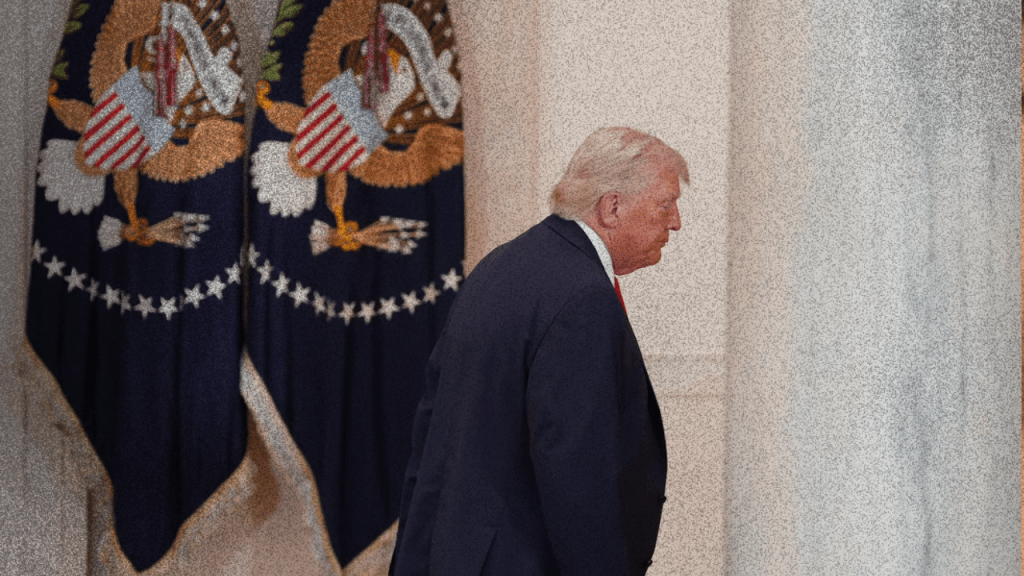
Trump Iran war strategy — victory declared while escalation intensifies — is not incoherence. It is a governing method built to produce that tension.
On April 1, Trump delivered a roughly 20-minute prime-time address — his first formal statement on the Iran war since U.S. and Israeli strikes began on February 28 — and said, with apparent confidence: Trump’s completion claim — “the core strategic objectives are nearing completion.” In the same speech, he promised to hit Iran “extremely hard over the next two to three weeks” and threatened to bring the country “back to the Stone Ages” if a deal was not reached. Power plants, bridges, oil infrastructure — all named as targets.
This is not a speech that contains a contradiction. The contradiction is the speech. War won. War intensifying. Both, simultaneously, presented as facts. Parsi on Iran — Trita Parsi of the Quincy Institute read the address as evidence of no plan: “I did not detect anything new. Essentially, it was a summary of all of the tweets he has issued over the last 30 days.” That reading is not wrong. It is incomplete.
The absence of a conventional plan is not the same as the absence of a logic. The address was not designed to resolve the tension between victory and escalation. It was designed to produce that tension — to make it inhabitable as a political condition.
The Escalation Loop Is Structural, Not Impulsive
The Hormuz ultimatums trace a pattern that predates April 1 and will outlast it. March 21 ultimatum: Trump gave Iran 48 hours to open the strait or face strikes on power plants. The deadline passed. March 26 extension: a 10-day deadline replaced it. That deadline was extended. April 5 post: “Tuesday will be Power Plant Day, and Bridge Day, all wrapped up in one, in Iran. There will be nothing like it!!! Open the F–kin’ Strait, you crazy b-stards, or you’ll be living in Hell — JUST WATCH!”
The post was not a policy statement. It was a pressure device — and it functioned as one regardless of whether the threat was ever carried out. The structure repeats: escalate the stakes, shift the negotiating baseline, extract leverage from the instability, frame any outcome as success. Once the threat of destroying power plants is live, a deal that stops short of that looks like restraint. The more apocalyptic the opening position, the more reasonable the eventual landing zone appears — regardless of what that landing zone actually contains.
This is not traditional diplomacy operating badly. It is a different instrument entirely, one that requires crisis not as a temporary condition to be managed but as the operating environment to be sustained. The Hormuz ultimatums are not isolated events. They are instances of the same loop, run repeatedly — which connects directly to the narrative inversion piece that makes such loops legible as governance rather than chaos.
The Spectacle Is Not Decoration — It Is the Leverage
Guy Debord’s diagnosis was that advanced capitalist politics transforms into representation — that perception displaces reality as the terrain on which power operates. Trump does not simply operate within that dynamic. He weaponizes it. Speeches function as episodes. Threats function as plot points. The profanity-laced Truth Social posts, the theatrical deadlines, the infrastructure target lists — these are not policy communications that happen to be dramatic. They are content, engineered to dominate a media cycle that rewards intensity over clarity.
In the Iran war, the spectacle is not secondary to the strategy. It is the strategy. Control how the crisis is understood and you control what outcomes appear acceptable. A ceasefire reached under the shadow of “Power Plant Day” looks like Trump delivering results. A continuation of strikes looks like Trump following through. A stalemate can be narrated as patient pressure. Every possible material outcome has been pre-framed as validation. This is the same function the China Panama analysis served: manufacture the threat, position yourself as the only available response.
Absurdity Is a Political Asset, Not a Liability
The style is not incidental to the method. Trump’s rhetoric — unfiltered, deliberately excessive, dismissive of institutional norms — performs cultural work that the policy content alone cannot. It signals authenticity to audiences who experience elite political language as a form of class condescension. The crude threat, the vulgar post, the boast about winning a war still actively escalating — these are not gaffes that survive in spite of their absurdity. They survive because of it. Absurdity in this context is proof of operating beyond the limits the establishment imposes.
This produces a split perception that is itself a strategic resource. Critics read the threats literally and respond with alarm — fact-checking the timeline of Hormuz deadlines, cataloguing the contradictions between victory claims and continued strikes, demanding coherence. Supporters read the same statements symbolically and register strength, flexibility, decisiveness. Both reactions circulate the content. Both sustain the spectacle. The alarm and the enthusiasm are not competing responses to the same message — they are the message’s dual functions, running simultaneously on different audiences.
Opponents Cannot Escape a Frame They Didn’t Build
Traditional political actors are not built for this environment because their operational assumptions — coherence, process, incremental change, appeal to institutional norms — are structurally disadvantaged inside a system driven by shock and spectacle. They respond to policy positions. They attempt to clarify contradictions. They appeal to facts. But each escalation resets the conversation before the previous response can land. The pace is dictated externally. The framing is set before opponents enter it.
Media dynamics amplify the trap structurally. Sensational statements receive disproportionate coverage not because editors are captured but because the incentive architecture of attention-based media rewards intensity. A measured response to “Power Plant Day” cannot compete with “Power Plant Day” for column inches or airtime.
Criticism becomes part of the content cycle — it confirms that the statement landed, that it required response, that it was significant. The critics are not countering the spectacle. They are extending it. As the Iran trajectory analysis showed well before February 28, the logic of confrontation was always going to be framed as strength regardless of outcome.
War Does Not Resolve Through Perception Alone
In business or media, a strategy built on sustained manufactured crisis has natural limits but manageable consequences when it fails. Deals collapse and get renegotiated. Narratives shift. War operates under different physics. Escalation introduces compounding variables that do not respond to narrative management: other actors with their own decision-making, regional dynamics that shift under pressure, energy markets already absorbing 10 million barrels offline, military and civilian systems that interact in ways no planning process fully models.
The improvisation is the plan, and the plan’s central vulnerability is that it assumes escalation can always be calibrated, that the exit remains available, that pressure can always be turned down before it produces consequences that escape narrative framing. At a certain threshold of escalation, the tension stops being a tool and becomes the reality.
The people who absorb the uncontrollable consequences of that reality are not the people running the spectacle. They are the Iranians facing infrastructure destruction, the Global South economies absorbing the energy shock, the working-class populations everywhere that energy price spikes hit hardest and longest. The spectacle externalizes its costs onto those with the least capacity to absorb them. That is not an unintended side effect. It is the structure.
Sources
- NPR — Trump makes his case for war with Iran, saying the conflict is “nearing completion,” April 2026
- Time — Trump Promises Iran War Is “Nearing Completion,” April 2026
- Al Jazeera — Trump’s primetime speech on Iran war: Key takeaways, April 2026
- Al Jazeera — Trump issues 48-hour Hormuz Strait ultimatum, March 2026
- CBS News — Trump 48-hour deadline, Hormuz, April 2026
- Al Jazeera — Trump threatens hell for Iran over Hormuz Strait, April 2026
- PBS NewsHour — U.S. won’t strike Iran’s power plants for 5 days, Trump says, March 2026
- Iran War Narrative Inverts Who Struck First — Spark Solidarity
- Trump on China and the Panama Canal — Spark Solidarity
- Jiang Xueqin’s Iran Prediction: What He Got Right and Wrong — Spark Solidarity





 Spark Solidarity