
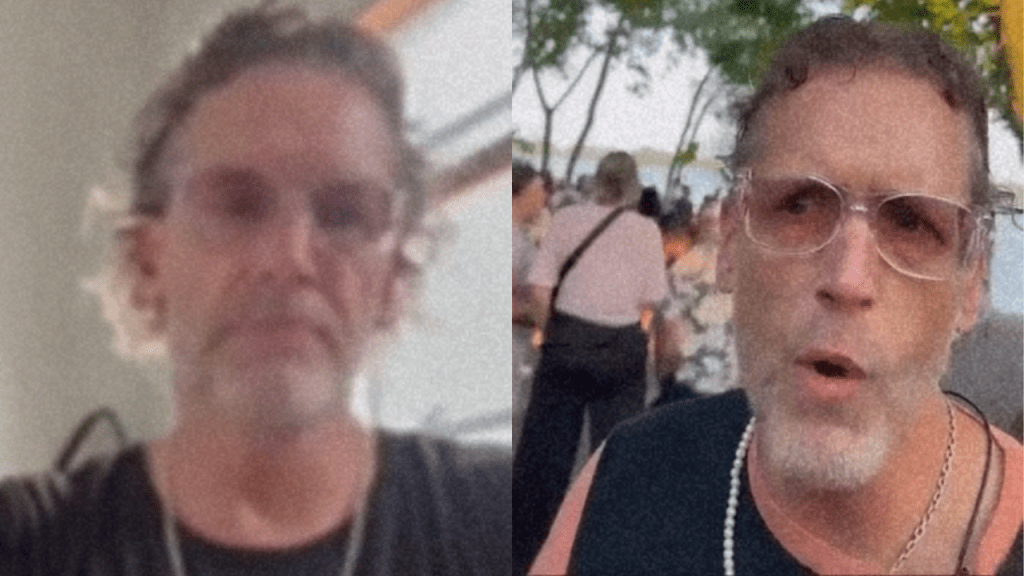
A reported confrontation over a small “Free Palestine” stone exposed the selective boundary beneath Promise Cherry Beach’s inclusive branding.
At the July 26 Promise party at Cherry Beach in Toronto, a woman reportedly placed a small rock near the stage bearing two words: “Free Palestine.”
According to the account posted with the circulating video, an event organizer removed the stone, discarded it because it was “too political.” The recording captures the argument that followed.
The man confronting her was not a security guard or an irritated stranger. Irving Shaw is a co-founder of Promise and has long served as one of the central public figures associated with the Cherry Beach series. Promise grew from underground parties organized by Shaw and David Macleod into a permitted Toronto institution.
Shaw’s position appears straightforward. The Israeli-Palestinian conflict is complicated. People should not presume to possess moral certainty about it. A dance party is not the appropriate place for political declarations. Once one message is admitted, organizers will have to decide where to draw the line.
That position sounds moderate only because Shaw classified his own exercise of authority as neutral while describing the woman’s message as political. The stone did not interrupt the music, endorse a government or prevent anyone from dancing. It said Palestinians should be free.
“Read a Book” Without Naming One
In the most widely circulated video of the exchange, Shaw tells the woman: “Anyone who feels like they have a lock on what is right and wrong in the Middle East doesn’t know what the fuck they are talking about, and they need to read a book.”
“Read a book” is not an argument. It is a performance of intellectual superiority that allows Shaw to dismiss her without demonstrating any knowledge of his own.
He never identifies the historical fact she supposedly misunderstood. He does not explain what is objectionable about Palestinian freedom, name the book she should read or offer an interpretation she could meaningfully answer. Instead, he turns a specific, small act of solidarity into an examination on the entire history of the Middle East, then declares her unqualified for failing a test he never defines.
This tactic of deflection is familiar. Palestinian solidarity is buried beneath demands for more context, perfect language and encyclopedic expertise. The person calling for freedom is expected to account for ancient history, competing national narratives, every armed faction and every failed negotiation. The person silencing her is not required to explain why removal made anyone safer or whether Promise consistently applies a published rule against political expression.
Complexity becomes a tool of institutional power. As an organizer, Shaw could convert his own preference into policy. The woman’s refusal to accept that preference could then be recast as evidence of ignorance.
The Middle East is complicated. That observation does not answer whether Palestinians possess rights. In December 2025, the UN General Assembly reaffirmed the Palestinian people’s right to self-determination by a vote of 164 to 8. The International Court of Justice concluded that Israel’s continued presence in the occupied Palestinian territory is unlawful and obstructs Palestinian self-determination.
Those findings do not settle every possible meaning attached to “Free Palestine,” but they make it impossible to dismiss Palestinian freedom as an eccentric opinion held by an uninformed partygoer. A demand for freedom can be defined, debated and criticized. It cannot honestly be reduced to evidence that the person making it has failed to read enough books.
Promise Was Never Apolitical
Promise Cherry Beach does not ordinarily purge political meaning from its events. The series has appeared in Pride Toronto programming, promotes itself as a space serving queer communities and describes its parties through the language of inclusion, protection and authentic expression.
Pride is celebratory, but its celebration cannot be separated from political struggle. Queer people did not obtain public visibility, legal recognition or protection from police harassment through apolitical festivities. Pride’s music, flags and community space commemorate movements that confronted governments, criminalization and institutions that tried to exclude queer life from public space.
Promise has also promoted events during the Canada Day long weekend, including a July 1 Canada Day party. Celebrating Canada expresses attachment to a state, its institutions and its national story. That political meaning does not disappear because the holiday is familiar, officially recognized or accompanied by house music.
The Promise website even goes as far as carrying a land acknowledgement naming the Mississaugas of the Credit, Anishinaabeg, Chippewa, Haudenosaunee and Wendat peoples, along with the treaties governing the land and water. A land acknowledgement addresses sovereignty, colonization, dispossession and continuing Indigenous presence. It is not politically neutral, and it is not supposed to be.
Promise therefore already accepts that questions of identity, land, nationhood, sovereignty and liberation belong within its cultural environment. The issue was never an absolute prohibition against politics. It was which political expressions Shaw considered familiar enough to disappear into the event’s identity.
Canadian nationalism could appear as a holiday. Indigenous dispossession could appear as an acknowledgement. Queer liberation could appear through Pride. Palestinian freedom appeared on a small rock and was reportedly treated as an unacceptable intrusion.
When Breaking Rules Was the Culture
Promise also has a long history of treating resistance to government regulation as part of rave culture. In 2006, police arrived at a Promise party with five cruisers, mounted officers and a prisoner-transport wagon amid noise and bylaw complaints. A city waterfront official acknowledged that Toronto had been trying to shut the raves down, while organizers defended the parties as a legitimate communal use of public space.
A 2014 history of Promise described its early parties as unpermitted and openly confrontational before Shaw and Macleod developed a relationship with the city and secured approval. The series subsequently became permitted, regulated and institutionally recognized.
Shaw has continued to defend the need for outdoor rave space. When Toronto investigated a separate unauthorized waterfront party in 2024, he argued that the city needed flexible alternatives rather than another layer of restriction. Toronto City Councilor Paula Fletcher simultaneously cited Promise as the responsible model: a permitted event that meets conditions and ends before violating noise rules.
That history destroys the claim that the Cherry Beach dance floor exists outside politics. Promise’s own existence was shaped by conflict over who could use public land, how late people could gather, how police and bylaw officers governed nightlife and whether city regulations should determine the boundaries of rave culture.
Promise never believed politics was inappropriate when the political issue was its own freedom to occupy public space. It celebrates Pride, marks Canada Day, acknowledges Indigenous land and traces its origins through resistance to municipal authority. Palestine became “too political” only when solidarity required the institution to extend that understanding of freedom beyond itself.
Promise does not object to politics at the rave. It objected to Palestinian politics and disguised that choice as neutrality.
Inclusion on Promise’s Terms
Promise presents itself as a haven for expression. Its website calls the 26-year-old series a cornerstone of Toronto electronic music dedicated to fostering “inclusive spaces for authentic artistic expression.”
Shaw once offered an even broader description. In a 2015 profile, he said individual personality was celebrated at Promise. Earlier accounts described the parties as welcoming spaces where audiences could participate rather than merely consume entertainment.
Those values sound expansive when nothing is demanded from the institution. The confrontation supplied a test. Would inclusion cover someone displaying a modest declaration of Palestinian freedom? Would authentic expression remain welcome when it discomforted the organizer? Would community mean negotiating disagreement rather than discarding the object and reportedly removing its owner?
According to the video of Shaw’s confrontation over a small rock, the answer was no.
The online reaction focused heavily on that contradiction. Commenters have mocked the idea of “PLUR” — peace, love, unity and respect — being available only to people who accepted the organizer’s boundaries. Others connected dance music to Black and queer political histories or said they would no longer attend Promise events.
Those responses reveal the real dispute. It is not between politics and no politics. It is between different conceptions of communal space. One treats solidarity as contamination and imagines the party works only when structural violence remains outside the frame. The other recognizes that the ability to gather, dance, love and appear publicly was itself won through political struggle.
The Rave Scene Was Already Divided
Shaw spoke as though the woman had imported an alien dispute into an otherwise settled culture. By July 2026, Palestine had already become one of international electronic music’s defining fault lines.
Boiler Room became a major target after it entered the Superstruct portfolio under KKR ownership. Boiler Room emphasized that its staff had no control over the sale, said KKR held investments contradicting its values and described its own position as “unapologetically pro-Palestine.” Activists argued that editorial statements could not erase the financial structure above the brand.
When Boiler Room held a Toronto event in September 2025, DJ EZ, MCR-T and Taylah Elaine withdrew. Organizers connected the campaign to KKR’s investments involving Israel and its previous interest in the Coastal GasLink pipeline through unceded Wet’suwet’en territory. Spark Solidarity traced that ownership structure in its Boiler Room boycott analysis.
The conflict escalated in New York City earlier this month. On July 10 and 11, activists disrupted Boiler Room events beneath the K Bridge in Brooklyn, distributed literature, staged a die-in and organized a nearby counter-rave featuring artists who had declined Boiler Room bookings. Another protester disconnected equipment and displayed a message condemning the company’s ownership.
Video from the event showed an attendee jumping onto protesters lying on the ground. Boiler Room said the conduct had no place at its events, affirmed the right to peaceful protest and said it was reviewing the incident with the venue. The Brooklyn disruption demonstrated that the argument over Palestine, ownership and rave culture was already active inside major electronic-music institutions.
While Promise has no established organizational connection to Boiler Room, Superstruct or KKR. The relevance is cultural. Toronto DJs had already abandoned prominent bookings over Palestine. Organizers had built alternative events. Protesters had interrupted the music rather than accept the claim that ownership and investment were irrelevant to the dance floor.
Israel Was Already in the Sound
Shaw’s apparent Israeli-flag comparison does much to answer this conflict. There is no argument that an Israeli must be prohibited from displaying a flag. In fact, Israeli identity, national imagery and cultural production are already well represented across international EDM, especially psytrance, with Israeli artists having performed at Cherry Beach without their presence being treated as a threat to the event’s neutrality.
The flag and “Free Palestine” also occupy different relationships to power. One represents a state with a military, diplomatic apparatus and system of territorial control. The other demands freedom for people living under occupation, displacement and statelessness. Treating those positions as materially identical removes power from the analysis precisely when power explains the conflict.
Israeli presence was already normalized as culture, yet Palestinian freedom is the expression that is marked as political.
That asymmetry cannot be understood without understanding EDM’s relationship to Israel.
When Unity Accompanies the Occupation
Psytrance developed from the international Goa trance scene in India, where DJs, travellers and countercultural communities built long parties around electronic music and psychedelic experience. Israel nevertheless became one of the genre’s most important centres.
Beginning in the late 1980s and early 1990s, young Israelis travelled to Goa after compulsory military service. Many returned and reproduced the parties they had encountered abroad. Illegal gatherings spread through forests, beaches and deserts before the music entered radio, weddings, university events and commercial festivals. A detailed history of Israeli psytrance traces that development.
The relationship between military service and post-service escape is central. Psytrance offered release from a society structured by conscription, conflict and constant appeals to national security. Participants could rebel against conventional Israeli life while carrying much of that life’s political architecture into the scene.
Israeli musicians subsequently became some of psytrance’s most influential global exports. Astral Projection and Infected Mushroom helped move the music beyond its underground audience. Astrix, Ace Ventura and Vini Vici became major international festival acts. Their prominence made Israeli cultural presence ordinary across global electronic-music circuits.
Palestinian participation was never normalized on the same terms. The 2016 account noted that non-religious Ashkenazi Jews formed the bulk of the Israeli scene’s organizers and participants, while a Palestinian psytrance initiative achieved only limited expansion. That asymmetry created the background against which Palestinian visibility could be treated as an intrusion into a culture already saturated with Israeli presence.
Some artists have moved beyond national identity into explicit political alignment.
Skazi, one of Israeli psytrance’s best-known acts, withdrew from Tomorrowland in 2025 amid controversy over his support for the Israeli military. Reporting described his tours of military bases, use of the label “combat DJ,” appearance at an IDF base and participation in pro-military media. He had also expressed support for Israel from the Tomorrowland stage in 2024, where Israeli flags were visible in the audience.
During the controversy, Skazi appealed to the familiar rave vocabulary of unity, joy and mutual respect. The military-support record did not disappear because it was surrounded by universal language. The language supplied a cultural frame around the mobilization.
This is the central weakness of the “music, not politics” position. Explicit identification with military power can enter a festival as biography, tribute or community expression. Opposition to that power then becomes the divisive act that threatens unity.
Electronic Music as Statecraft
Israel’s use of culture as foreign policy is documented. The Israeli Ministry of Foreign Affairs operates cultural departments through its embassies. Its Toronto cultural office promotes Israeli arts and artists in Canada, while the embassy in Britain says its cultural department helps musicians, dancers, filmmakers and other creatives bring Israeli narratives to foreign audiences.
This is cultural diplomacy: artistic circulation used to produce familiarity, relationships and favourable national associations. It does not require every performer to receive direct instructions from a ministry. Soft power is strongest when it arrives through festivals, nightlife, tourism and collaboration rather than an official government statement.
Researchers have described an Israeli strategy of “un-nation branding,” in which the state promotes itself indirectly through cities such as Tel Aviv and Jerusalem. A study of the tourism campaign “Two Cities. One Break” found that desirable urban experiences allowed borders, settlements and conflict to recede from view. The branding research identifies culture and lifestyle as mechanisms that separate the national image from the violence organizing the state.
Electronic music fits that project particularly well. Tel Aviv can be presented as youthful, sexually liberal, technologically advanced and internationally connected. The party offers an image of Israel detached from checkpoints, occupation, military rule and Palestinian displacement.
Ravers for Palestine has accused Israel of co-opting rave culture through pinkwashing and the promotion of Tel Aviv nightlife. The group’s argument is that cultural normality becomes a reputational asset when international audiences consume an appealing image of Israel while the conditions governing Palestinians disappear. Its intervention formed part of a wider electronic-music boycott extending through major European clubs.
Music does not become politically neutral because its political work is carried through atmosphere, prestige and international circulation rather than explicit slogans.
Promise and Selective Normalization
Promise has previously booked Israeli artists. Its 2022 Cherry Beach lineup included Red Axes, the internationally recognized Tel Aviv duo of Dori Sadovnik and Niv Arzi.
The booking demonstrates what Promise considered ordinary cultural programming. A Tel Aviv act could enter the Cherry Beach environment as music. Its geographic and cultural identity did not have to be removed to preserve an apolitical atmosphere. Nobody demanded that Promise resolve the Israeli-Palestinian conflict before allowing the artists to perform.
A woman’s small rock saying “Free Palestine” reportedly received the opposite treatment.
Promise’s complicity does not require proof of a contractual partnership with an Israeli ministry. It lies in reproducing the asymmetry on which cultural normalization depends. Israeli cultural production circulated as entertainment, artistry and cosmopolitan exchange. Palestinian freedom was isolated as controversial ideology.
One became part of the scenery. The other had to explain and defend its presence. Promise did not create that structure, but Shaw’s reported decision enforced it.
Shaw’s “read a book” remark makes that enforcement more revealing. He presented himself as the sophisticated observer standing above an intractable conflict, yet the only expression reportedly removed was the one supporting Palestine. His supposed neutrality produced a directional result: Israel remained culture, while Palestine became the problem.
Toronto’s Larger Dance Circuit
The pattern extends beyond Promise. Toronto’s major electronic-music institutions are connected to Israel through both corporate structure and booking practice. Live Nation acquired a majority stake in Embrace Presents in 2019, placing the promoter behind Electric Island inside its Canadian network. Live Nation’s own corporate filings list Live Nation Israel Ltd. and Ticketmaster Israel Ltd. among its subsidiaries. INK Entertainment and Live Nation Ontario have also jointly presented VELD, connecting one of Toronto’s largest EDM festivals to the same multinational concert and ticketing system.
Those corporate links are matched by a regular flow of Israeli artists through Toronto venues and festivals. INK promoted Israeli psytrance duo Vini Vici at UNIUN in 2017, while another Toronto appearance in 2022 sold tickets through INK’s platform. Electric Island’s 2026 roster included Mita Gami, an Israeli producer rooted in Tel Aviv’s electronic scene, and as mentioned, Promise Cherry Beach itself booked the Tel Aviv duo Red Axes at Cherry Beach in 2022.
These bookings entered Toronto nightlife as ordinary international programming. Israeli identity, Tel Aviv’s cultural prestige and artists produced by the country’s electronic-music infrastructure were presented as music rather than politics. They circulated through established promoters, ticketing systems, waterfront festivals and branded venues without being treated as threats to communal neutrality.
The same circuit responded differently when Palestinian freedom appeared without corporate mediation. A performer associated with Israel could occupy the stage as global culture. A small rock saying “Free Palestine” was classified as a political intrusion. The controversy did not begin when politics entered the dance floor. It began when Palestinian solidarity sought the same unremarkable cultural presence that Israeli artists had already been granted.
The Politics Were Already There
The stone did not bring politics to Cherry Beach. The politics were present in Promise’s authority to control the space, its definition of inclusion, its participation in Pride, its Canada Day programming, its land acknowledgement, its history of conflict with municipal regulation and its power to decide which expression could remain visible.
The stone made those politics legible.
Shaw threw the weight of his small, but meaningful cultural institution behind a selective distinction. Canadian nationalism could remain a holiday. Queer liberation could remain community. Indigenous sovereignty could remain an acknowledgement. Israeli cultural presence could remain music. Palestinian freedom was “too political.”
He then treated the woman as intellectually unserious for refusing that boundary, telling her to read a book without naming the book, identifying the fact she had wrong or explaining why Palestinians should have to pass an examination before asking to be free.
Promise describes itself as a space for authentic expression. Authenticity means little when it is permitted only until it creates discomfort for the person controlling the stage.
The question is not whether politics belongs at Cherry Beach. Promise has already answered that question. The question is why Pride, Canadian nationalism, Indigenous recognition and the institution’s own struggle for public space can be incorporated into its identity while “Free Palestine” can not.
Update: An Apology That Never Names Palestine
Update, July 29, 2026: Irving Shaw has issued an apology for his conduct at Promise Cherry Beach. The statement acknowledges that he behaved badly, misunderstood the political history of rave culture and damaged the sense of safety Promise claims to provide. It does not name Palestine, Palestinians, the “Free Palestine” stone or the political expression that triggered the confrontation.
Shaw apologizes broadly to the community, DJs, presenters, collaborators, staff, volunteers and vendors. Palestinians and Palestinian attendees are absent from the list. He does not say whether Palestinian solidarity is welcome at Promise events. He does not retract the idea that “Free Palestine” was too political. After a controversy centred on suppressing Palestinian expression, he still does not say “Free Palestine.”
Instead, Shaw redirects the apology toward a safer admission: “I was wrong to say that queer is not political.” That statement is true, but it does not identify the central harm. The controversy did not begin because Shaw misunderstood queer history in the abstract. It began because a Palestinian solidarity message was removed and he defended that decision by telling the woman that she did not understand the Middle East.
Promise can absorb a lesson about queer and rave history into its existing language of inclusion. Admitting that it censored Palestinian solidarity would require the organization to answer harder questions about its policies, its exercise of authority and the unequal treatment of political expression.
Shaw repeatedly refers to the woman as “the person I was interacting with.” The phrase reduces an exercise of institutional power to an awkward interpersonal exchange. She was not merely someone he encountered. She was the person whose expression he challenged and whose removal from the event stood at the centre of the controversy.
The same softening appears throughout the apology. Shaw says he “shut down and forgot to respect expression.” He describes himself as “rude and inappropriate.” Neither phrase identifies what he did. The problem was not simply that his tone became impolite. An event organizer used his authority to classify Palestinian solidarity as unacceptable, then presented that decision as neutrality.
Shaw also does not retract the arguments he made during the confrontation. He does not withdraw the Israeli-flag comparison, explain why the “read a book” remark was wrong or acknowledge that he demanded expertise from the woman while offering no substantive argument of his own. He says he did not know what he was talking about, but never states what he now understands.
The apology transforms a specific act of Palestinian exclusion into a generic failure to maintain a safe space. Shaw says he jeopardized safety “for so many,” but does not identify who was made unsafe, what expression was targeted or why. The political content of the incident disappears into the language of community care.
His promised consultation process follows the same pattern. Shaw says he is speaking with people from queer and BIPOC communities. Those communities are not interchangeable with Palestinians, Arabs, Muslims or Palestine-solidarity organizers. The relevant accountability cannot be outsourced to broad demographic labels that allow Promise to avoid the political community directly affected.
“Sensitivity training” is also inadequate to the scale of the dispute. This was not only a problem of tone or vocabulary. It concerned event policy, organizer authority, political expression, removal from the grounds and the possibility of anti-Palestinian bias. Training could change how Shaw speaks while leaving the same discretionary policy intact.
A serious response would answer concrete questions. Who removed the stone? Who authorized the woman’s removal? Will Palestinian flags, keffiyehs and solidarity messages be permitted at future events? Will Promise apologize directly to the woman and offer restitution if she paid admission before being removed? Will the organization adopt a clear expression policy and procedures preventing discriminatory enforcement?
The apology offers none of that. It contains no policy revision, timeline, direct repair, donation, fundraiser or commitment that Palestinian solidarity will be protected. Accountability is deferred into a future process described only as “putting in the work.”
Shaw’s safest admissions concern the political history of rave culture. He now acknowledges that Cherry Beach emerged from political roots, that electronic music has always been political and that providing a safe space is itself political. Those admissions reinforce the original article’s argument. Promise was never outside politics.
But Shaw still avoids the specific political conclusion the incident demanded: Palestinian freedom is a legitimate concern, and he was wrong to use his authority to treat its expression as uniquely unacceptable.
The apology acknowledges poor conduct while withholding the admission that would carry institutional consequences. It apologizes for being rude, misunderstanding rave history and harming Promise’s atmosphere. It does not apologize for suppressing Palestinian solidarity.
Sources
- Irving Shaw, public apology statement concerning the July 26, 2026 Promise Cherry Beach incident, July 29, 2026.
- Original circulating video, uploader’s account, transcription and public discussion concerning the July 26, 2026 Promise Cherry Beach incident. The video begins after the alleged removal of the stone.
- Resident Advisor, Promise Cherry Beach event listing, July 26, 2026.
- Promise Cherry Beach, official description, inclusivity statement and land acknowledgement.
- Pride Toronto, Promise Cherry Beach affiliate-event listing.
- Pride Toronto, Promise Cherry Beach ’25 affiliate listing.
- Daily Hive, Canada Day event listing for Promise Cherry Beach, July 1, 2019.
- NOW Magazine, “Popping Cherry’s Party,” 2006.
- VICE, “Electronic Party Paladins Promise Saves Toronto from Itself,” 2014.
- Global News, “‘A No-Go:’ City Investigating Early-Morning Rave Heard Along Toronto Waterfront,” 2024.
- NOW Magazine, “Promise Thrives Without Celebs,” March 20, 2003.
- NOW Magazine, Toronto DIY party-promoters roundtable, August 21, 2019.
- At Liberty, “Entrepreneur Spotlight: Irving Shaw,” June 4, 2015.
- United Nations General Assembly, “The Right of the Palestinian People to Self-Determination,” A/RES/80/195, December 15, 2025.
- International Court of Justice, advisory opinion on Israel’s policies and practices in the occupied Palestinian territory, July 19, 2024.
- Red Bull Music Academy Daily, “Psytrance and Israel,” September 2016.
- DJ Mag, “Israeli DJ Cancels Tomorrowland Set Amid IDF Support Controversy.”
- Israeli Ministry of Foreign Affairs, Cultural Affairs department, Toronto.
- Israeli Ministry of Foreign Affairs, Cultural Affairs department, United Kingdom.
- Rhys Crilley and Ilan Manor, “Un-Nation Branding: The Cities of Tel Aviv and Jerusalem in Israeli Soft Power,” 2020.
- The Guardian, “DJs Join Ravers for Palestine Boycott of Berlin Techno Club Berghain,” August 10, 2024.
- Exclaim!, Promise Cherry Beach 2022 lineup, including Red Axes.
- Resident Advisor, Red Axes biography.
- Live Nation, acquisition announcement for Embrace Presents, February 5, 2019.
- INK Entertainment, VELD Music Festival recap, 2018.
- Spark Solidarity, “Boiler Room Boycott Escalates After Brooklyn Protest,” July 16, 2026.
- DJ Mag, “Boiler Room New York Event Disrupted by Anti-KKR Protest, Activists Allege Assault,” July 16, 2026.
- Resident Advisor, “Protesters ‘Trampled’ at Boiler Room New York,” July 14, 2026; updated July 15, 2026.
- Unicorn Riot, “NYC Activists Maintain Boycott Against ‘Blood Money Rave’ Boiler Room,” July 13, 2026; updated July 14, 2026.
- Writers Against the War on Gaza, “Letter to Our Friends in Nightlife on the Boycott of Boiler Room.”
- PACBI, “PACBI Welcomes Boiler Room’s Endorsement.”
- KKR, acquisition announcement for Superstruct Entertainment.

 Spark Solidarity