
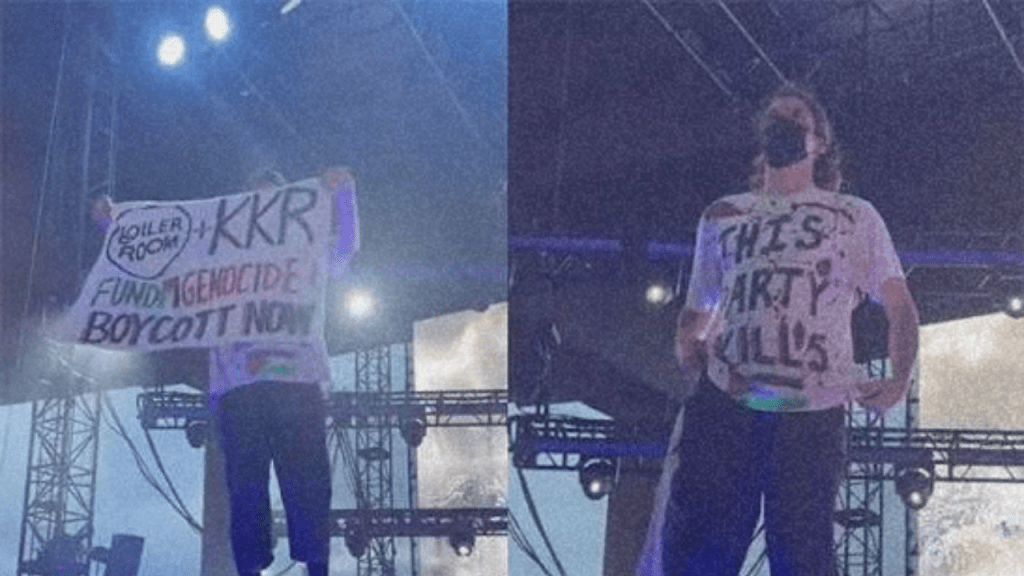
After protesters were pushed and stepped on during Boiler Room’s July 10 Brooklyn event, the campaign against its KKR ownership entered a new phase. The confrontation exposed the private-equity structure beneath one of electronic music’s most influential platforms.
On July 10, 2026, five protesters staged a die-in inside Boiler Room’s event beneath the K Bridge in Brooklyn. Their shirts connected the platform to KKR and accused the crowd of dancing over Palestinian graves. Video circulated by Boycott Room showed attendees pushing the demonstrators and one person jumping onto a protester while the music continued around them.
The disruption resumed the following night. Another activist entered the performance area, disconnected equipment and briefly stopped the music while displaying a message condemning Boiler Room’s ownership. Boiler Room later said the treatment of the protesters had no place at its events, affirmed the right to peaceful protest and said it was reviewing the incident with the venue.
The Brooklyn confrontation was the latest stage of a boycott that began after Boiler Room entered the Superstruct portfolio under KKR ownership. By July 2026, artists had withdrawn from events, alternative parties had replaced cancelled bookings and organizers were challenging Boiler Room’s attempt to separate its declared support for Palestine from the private-equity structure accumulating value above it.
The Boycott Began in Toronto
Superstruct Entertainment acquired Boiler Room from the ticketing company DICE in January 2025. KKR had acquired Superstruct the previous year, later bringing other investors into the ownership group.
Within weeks of the Boiler Room acquisition, Indigenous land defenders and Palestine-solidarity organizers protested outside one of its Toronto events. Writers Against the War on Gaza later identified that January 2025 action as an initiating point for the international grassroots boycott.
The organizers were not protesting one performer, an offensive statement or an event held in Israel. They were asking audiences and artists to follow the company’s ownership chain.
Boiler Room sits beneath Superstruct, an entertainment group controlling more than 80 festivals and event properties. Superstruct sits beneath private-equity ownership led by KKR. A successful Boiler Room event produces ticket revenue, audience data, market access, brand recognition and cultural credibility. Those assets strengthen Boiler Room, increase the value of the Superstruct portfolio and benefit the investors positioned above it.
The boycott translated that structure into a practical demand: stop supplying the platform with the labour, audience and underground legitimacy from which its value is built.
Follow the Money Above the DJ Booth
KKR described its acquisition of Superstruct as an investment in the continued expansion and professionalization of live entertainment. Its announcement emphasized Superstruct’s presence across more than 80 festivals in 10 countries and the sector’s “significant growth opportunities.”
That language identifies Boiler Room’s function inside the portfolio. It is not only a media archive or event promoter. It is an asset positioned inside an expanding international entertainment market.
Boycott organizers traced KKR’s wider financial relationships through defence contractors, Israeli technology companies and businesses connected to occupied Palestinian territory. The campaign also highlighted donations to Friends of the Israel Defense Forces associated with KKR leadership.
The campaign does not depend on pretending that one ticket payment can be followed directly into one weapon. The ownership mechanism is broader. Revenue and cultural prominence make Boiler Room more valuable. A stronger Boiler Room increases the value of Superstruct. That accumulated value belongs to the investors controlling the portfolio.
Private equity does not need to dictate every booking or approve every political statement. It needs the asset to grow.
Boiler Room became valuable by entering local scenes, recording their artists and distributing their performances to a global audience. Black, queer, migrant, working-class and underground communities supplied much of the sound, labour and credibility. Corporate ownership converted that accumulated cultural work into a financial property.
From Palestine to Wet’suwet’en Territory
The Toronto action connected Palestine with the Wet’suwet’en struggle against the Coastal GasLink pipeline in British Columbia.
Coastal GasLink crosses unceded Wet’suwet’en territory. Wet’suwet’en hereditary chiefs opposed construction through their lands without their consent, while Canadian governments and police defended the pipeline project. KKR previously held a substantial interest in the pipeline through an investment partnership.
The connection was not an abstract claim that every colonial struggle is identical. It was a documented relationship between finance, territorial control and state enforcement. Corporate investment benefited from projects imposed on Indigenous land in both places, although the histories, legal conditions and forms of violence differed.
Land was the material object in both struggles. Jurisdiction was the contested power. Corporate financing helped transform contested territory into an investment opportunity, while states supplied the legal and coercive conditions under which those investments could proceed.
This is why organizers used “Tkaronto” and placed Indigenous land defenders at the centre of the campaign. The boycott did not treat Palestine as a distant moral issue imported into Canadian nightlife. It located the protest within an ongoing structure of settler-colonial power on the land where the event was taking place.
Boiler Room’s Pro-Palestine Defence
Boiler Room responded to criticism in March 2025 by declaring that it would remain “unapologetically pro-Palestine.” It said that commitment had survived previous changes in investors and ownership. The platform also endorsed the Palestinian Campaign for the Academic and Cultural Boycott of Israel guidelines covering artist programming and commercial partnerships.
The Palestinian BDS National Committee’s cultural-boycott campaign welcomed that commitment and called on other Superstruct properties to adopt similar positions.
For the grassroots boycott, Boiler Room’s statement left the ownership structure untouched.
Boiler Room may retain authority over particular bookings. Its workers may support Palestinian liberation. The platform may refuse events in Israel and reject partnerships that violate cultural-boycott guidelines. None of those decisions gives Boiler Room the power to remove itself from the financial structure owned by KKR and its investment partners.
Its editorial politics and its financial function therefore move in opposite directions. Pro-Palestine programming produces cultural legitimacy for an asset whose value accumulates inside a private-equity portfolio connected to the systems the programming condemns.
The conflict is not principally about whether individual Boiler Room employees are sincere. It concerns two definitions of solidarity. One operates through programming choices inside the company. The other requires refusing the company because of where the value generated by those choices ultimately accumulates.
The Artists Who Said No
The boycott expanded because artists converted the ownership analysis into collective action.
DJs withdrew from Boiler Room events in Detroit, Los Angeles, Kuala Lumpur and other cities. Events were cancelled or disrupted. Alternative parties and strike funds were organized to compensate performers who declined bookings. The Bay Area Solidarity Strike created a counter-event after artists refused a San Francisco Boiler Room show, helping establish a model later used in New York.
Before the July 2026 Brooklyn event, artists including Sister Zo, Ella Hussle and Noel Spiva publicly rejected or withdrew from Boiler Room bookings. Boycott Room organized a competing rave featuring artists aligned with the campaign. According to the organizers, proceeds supported performers as well as Palestinian and Wet’suwet’en aid efforts.
That counter-event addressed a material problem. Refusal is difficult in an industry built on unstable income. Demanding that artists reject paid work without replacing any of the lost income turns solidarity into a cost carried by workers. Strike funds and alternative events distribute that cost across a community.
Detroit rapper LELO revealed another disagreement when he performed at the Boiler Room event wearing a “Free Palestine New Detroit” shirt. After facing criticism for accepting payment from the company, he said he donated the money.
The dispute was not about whether his message was sincere. It was about what the performance produced for Boiler Room. An artist may redirect the fee, but the appearance still supplies the platform with content, relevance and credibility.
Boiler Room needs culturally significant artists more than those artists need the Boiler Room name. Refusal removes the raw material from which the company manufactures legitimacy.
Israeli State Power Is Embedded in Electronic Music
The Boiler Room conflict did not force electronic music to discover a new connection to Israel. Israeli cultural power was already embedded in the industry, especially within psytrance.
Israeli artists, labels, promoters, festivals and touring networks helped build the genre’s international commercial infrastructure. Acts including Infected Mushroom, Astrix, Vini Vici, Skazi, Ace Ventura and Astral Projection became some of its most visible exports, making Israeli cultural presence ordinary across international festival and club circuits.
That cultural presence exists alongside an Israeli state built around military occupation, conscription and the continuing dispossession of Palestinians. The relevant question is not whether every performer issues an explicit political statement. It is how artists, promoters and institutions reproduce Israeli nationalism, support military mobilization or use the supposedly apolitical dance floor to normalize the state.
Skazi represents the most direct form of participation. He performed for Israeli soldiers, toured military bases, presented himself as a “combat DJ,” appeared in military propaganda and dedicated a Tomorrowland performance to Israeli troops and hostages. His activity did not merely express private national feeling. It supplied cultural support for military mobilization.
Infected Mushroom operated through a different but related mechanism. The duo released music commemorating the Nova attack, used Israeli national imagery and centred Israeli victimhood while Israel was devastating Gaza. Palestine-solidarity organizations also connected the act to Zionist groups and military fundraising.
Festival organizers defended Infected Mushroom as advocates of peace, while the duo denied supporting the war. Those declarations did not erase the political function of their public presentation. Israeli nationalism and victimhood continued to circulate through the international festival system while Palestinian death and displacement remained outside the frame.
Skazi and Infected Mushroom represented different levels of alignment within the same political field. Skazi openly identified with the military. Infected Mushroom circulated nationalist symbolism and a narrative of Israeli innocence through the global entertainment industry. One offered explicit military solidarity. The other helped normalize the state’s preferred cultural image.
The structure extends beyond individual performers. Bookings in Israel, partnerships with Israeli promoters, military fundraising, displays of Israeli nationalism, suppression of Palestinian speech and corporate ownership tied to occupation all carry political power through the music industry.
The scene does not become neutral because that power arrives through an artist biography, a flag in the crowd, a commemorative release or a festival booking rather than an official government statement.
Israeli identity and state narratives have long circulated through electronic music as culture, community and entertainment. Palestinian solidarity is treated as the political intrusion. That asymmetry is one of the structures the boycott exposed.
Who Owns the Underground?
Boiler Room built its influence by presenting itself as a window into scenes that commercial media had ignored. Its camera gave viewers the impression of entering an intimate local space. Once that access became globally marketable, the communities being documented became sources of extractable value.
Private equity did not create those scenes. It purchased a mechanism capable of capturing and monetizing them.
The boycott interferes with that mechanism. When artists refuse, Boiler Room loses access to the people who make it culturally relevant. When audiences attend alternative events, the company loses its claim to be the natural home of electronic music. When organizers make ownership visible, the brand can no longer present the party as politically neutral.
The Brooklyn die-in compressed that argument into a confrontation on the floor. The music continued while protesters were pushed aside and one attendee appeared to jump onto people lying on the ground. The incident showed how an industry organized to keep the event moving absorbs even direct political disruption.
The boycott’s impact is not measured only by whether one show was stopped. It is measured through cancelled bookings, refused fees, alternative parties and the declining ability of a corporate platform to purchase legitimacy from the underground.
The central question is not whether every Boiler Room artist or attendee personally supports Israel. It is who receives the value when artists perform, audiences pay and local communities lend their credibility to the platform.
Boiler Room can place Palestine inside its programming. It cannot remove its owners from the ownership chain. Its political statements may be sincere, but sincerity does not alter the financial structure.
The boycott attacks that structure by asking artists and audiences to withhold the culture from which the asset derives its value.
Sources
- DJ Mag, “Boiler Room New York Event Disrupted by Anti-KKR Protest, Activists Allege Assault,” July 16, 2026.
- Resident Advisor, “Protesters ‘Trampled’ at Boiler Room New York,” July 14, 2026; updated July 15, 2026.
- Unicorn Riot, “NYC Activists Maintain Boycott Against ‘Blood Money Rave’ Boiler Room,” July 13, 2026; updated July 14, 2026.
- Writers Against the War on Gaza, “Letter to Our Friends in Nightlife on the Boycott of Boiler Room.”
- PACBI, “PACBI Welcomes Boiler Room’s Endorsement.”
- KKR, acquisition announcement for Superstruct Entertainment.
- DJ Mag, “Israeli DJ Cancels Tomorrowland Set Amid IDF Support Controversy.”
- Times of Malta, “No Place for Israeli Band ‘Pushing Zionist Message’ at Earth Garden.”

 Spark Solidarity