
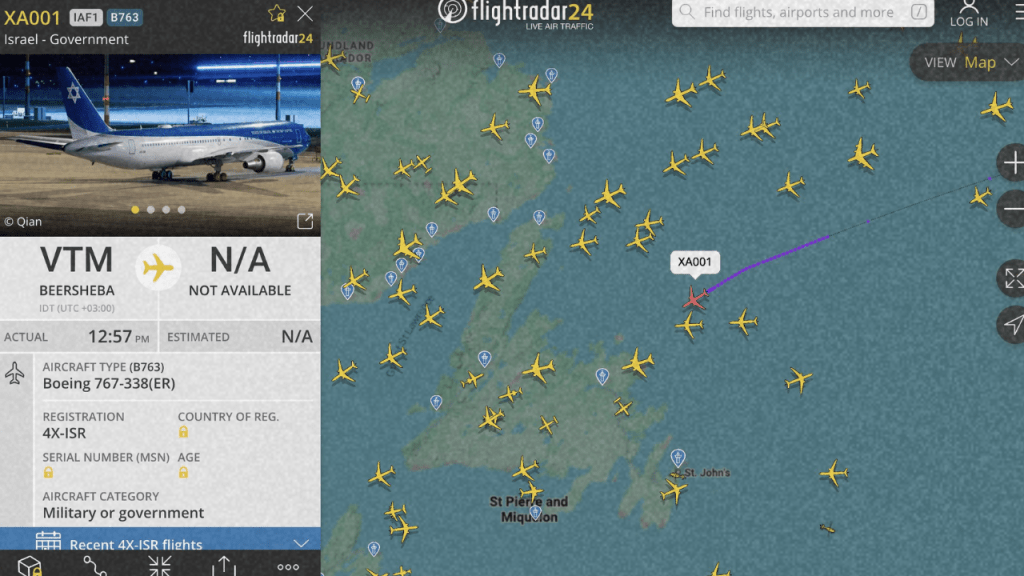
Benjamin Netanyahu flew through Canadian airspace on July 27 while subject to an active International Criminal Court arrest warrant. It was his third Canadian overflight in seven months, and each passage required advance diplomatic clearance from Ottawa.
Benjamin Netanyahu flew through Canadian airspace on July 27 aboard Wing of Zion, the Israeli government’s official aircraft, while subject to an active International Criminal Court arrest warrant. Flight-tracking evidence published by Canadians for Justice and Peace in the Middle East showed flight XA001 inside Canadian airspace near Newfoundland on its way to the United States.
The July 27 crossing was Netanyahu’s third passage through Canadian airspace in seven months. His aircraft crossed Newfoundland and Nova Scotia on December 29, 2025, while travelling to meet Donald Trump at Mar-a-Lago. It crossed Newfoundland, Prince Edward Island and New Brunswick again on February 10, 2026, before landing at Joint Base Andrews.
These flights did not enter Canada by accident. Foreign state aircraft require diplomatic clearance before crossing Canadian airspace. Global Affairs Canada instructs foreign governments to submit requests at least 72 hours in advance so federal departments can review the aircraft, route and purpose of the flight. Carney’s government knew which plane was coming, knew who was aboard and knew the ICC warrant remained active. Ottawa approved the July 27 crossing anyway.
The July 27 Flight Required Canadian Approval
The flight-tracking image published by CJPME identified the aircraft as XA001 and showed it inside Canadian airspace near Newfoundland. Wing of Zion is an Israeli state aircraft, not a commercial passenger flight following an open civilian route. Its entry required the Canadian government to review and approve a diplomatic clearance request before the aircraft reached the country.
That approval was the decisive act. Israel could request access, but it could not grant access to itself. Canada controlled the airspace and decided whether the aircraft carrying Netanyahu could enter. The plane crossed Canadian territory because Ottawa opened the route.
The July flight also removes any claim that the earlier crossings resulted from confusion or an unresolved first encounter. Ottawa had already approved Netanyahu’s aircraft twice. The December crossing had been followed by a second flight in February, and both had been publicly reported. By July, Carney’s government was not discovering the issue. It was repeating an established decision.
Carney Had Promised to Honour the Warrant
In October 2025, Carney was asked whether Canada would honour the ICC warrant if Netanyahu travelled to the country. He answered yes. The Israeli government then publicly urged him to abandon that commitment. Canada nevertheless continued to present itself as a state that respected the Rome Statute and supported the Court.
Netanyahu then entered Canadian-controlled airspace three times. The government’s position separates the promise from the permission by treating arrest as an obligation that begins only when a wanted official lands, while presenting airspace as a neutral corridor. That interpretation lets Ottawa claim support for the warrant while approving the movement that keeps Netanyahu beyond its reach.
Canadian airspace is not politically neutral. Canada controls access to it, and foreign state aircraft require advance authorization. Carney’s government used that authority on July 27 to help Netanyahu reach Washington. The contradiction lies between the commitment Ottawa announced and the route it approved.
The ICC Warrant Remained Active
The ICC issued arrest warrants for Netanyahu and former Israeli defence minister Yoav Gallant on November 21, 2024. The Court found reasonable grounds to believe they bore responsibility for the war crime of starvation as a method of warfare and for the crimes against humanity of murder, persecution and other inhumane acts.
The judges also found reasonable grounds to believe that Netanyahu and Gallant bore responsibility as civilian superiors for intentionally directing an attack against the civilian population. An arrest warrant is not a conviction. It is a judicial order requiring the accused to be brought before the Court so the allegations can be heard.
Netanyahu remained subject to that order when XA001 crossed Canada on July 27. Canada remained a state party to the treaty that created the ICC. The Rome Statute requires member states to cooperate with the Court and act on requests for arrest and surrender. Granting diplomatic clearance preserved Netanyahu’s freedom of movement instead.
Ottawa Could Have Denied the Flight
The government did not need fighter jets, a forced landing or police officers attempting to board a Boeing 767 at cruising altitude. Those scenarios begin after the central decision had already been made. The Canadian government controlled whether Wing of Zion could enter its airspace in the first place.
Global Affairs Canada could have denied diplomatic clearance. Israeli officials would then have been required to choose another route, just as Netanyahu’s aircraft has done when governments along a preferred path might enforce the warrant. No interception or confrontation was necessary. Ottawa only had to refuse permission.
That refusal would have imposed a practical consequence by making Netanyahu’s travel longer, more expensive and more difficult. An arrest warrant is supposed to end the ordinary diplomatic treatment of a wanted official. Canada instead preserved that treatment by granting Netanyahu the same access he would have received without the warrant.
Ottawa then treated the difficulty of making an arrest aboard an aircraft as evidence that nothing could be done. The sequence runs in the opposite direction. Canada first approved the conditions that kept Netanyahu beyond immediate reach and then cited those conditions as the reason enforcement was impossible.
Safe Passage Protected Netanyahu’s Movement
Political protection does not require a formal immunity agreement. It can take the form of permissions and services that allow a wanted official to continue travelling and conducting state business as though no warrant exists. Canadian diplomatic clearance provided that protection on July 27.
The overflight shortened and simplified Netanyahu’s route to the United States. It helped carry Israel’s official aircraft toward a government that rejects the ICC’s authority, has sanctioned Court officials and has made clear that Netanyahu will not be arrested on American soil. Canada could not force Washington to cooperate with the Court, but it could decide whether Canadian territory would assist the journey.
Each uneventful crossing also weakened the practical force of the warrant. Netanyahu travelled through the airspace of a country that presents itself as a defender of international justice, met the U.S. president and returned to state business. The warrant remained formally active, but Canada helped ensure that it imposed no consequence during the trip.
Ottawa’s role was limited but concrete. Israel supplied the aircraft, the United States supplied the protected destination and Canada supplied part of the route. On July 27, Carney’s government again made Netanyahu’s travel easier.
Canada Applies International Law Selectively
Canada has spent decades presenting itself as a supporter of international courts and treaty-based accountability. Ottawa helped establish the ICC, incorporated the Rome Statute into Canadian law and continues to describe the Court as an important institution. That commitment becomes flexible when enforcement reaches a close U.S. ally.
Canada recognizes the warrant in public, but its consequences disappear when acting on it would disrupt Western diplomatic and military relationships. International rules are treated as firm when they are directed against an adversary or a weaker state. When a protected ally is involved, Ottawa finds a procedural exception, a practical obstacle or a narrower interpretation of its obligations.
That gap between public principle and political practice sustains Canada’s global justice mask. International law remains part of Canada’s political identity, but its enforcement is shaped by alliance relationships and the position of the state being judged.
Canadian airspace also serves the country’s military relationship with the United States. American flights move through it under arrangements that receive little public scrutiny. Netanyahu’s overflights followed the same hierarchy described in airspace under alliance control: Canada retained the power to decide, then used that power in Washington’s preferred direction.
Canada Can Close the Route
Canada should adopt a clear policy denying diplomatic clearance to any foreign state aircraft carrying a person subject to an active ICC arrest warrant. The rule should apply equally to Netanyahu, Yoav Gallant and every other official wanted by the Court. A universal policy would prevent cabinet ministers from improvising a new exception whenever a politically protected official files a flight plan.
Under that policy, Global Affairs Canada would reject the request and the foreign government would reroute the aircraft. Canada would not need to manufacture another debate about an impossible mid-air arrest because it would address the issue before the flight entered Canadian airspace.
Ottawa should also disclose who approved the December, February and July crossings, when the applications were received, which departments reviewed them and whether anyone objected. Canadians should not have to reconstruct major foreign-policy decisions from flight-tracking websites and statements issued after the aircraft has left.
The July 27 flight established that the earlier overflights were not isolated exceptions. Carney promised to honour the ICC warrant, and his government then allowed Netanyahu to cross Canadian airspace for a third time in seven months. The next request should be refused.
Sources
- Canadians for Justice and Peace in the Middle East, social-media post reproducing FlightRadar24 tracking of Wing of Zion flight XA001 inside Canadian airspace near Newfoundland, July 27, 2026.
- Reuters, “Netanyahu says Iran is top agenda in meeting with Trump,” July 27, 2026.
- Anadolu Agency, “Netanyahu flight to US again crosses ICC member states’ airspace,” July 27, 2026.
- CBC News via Yahoo Canada, “Netanyahu again flies through Canadian airspace en route to Washington,” February 11, 2026.
- Justice in Conflict, “Middle Power Problems: What if Canada had arrested Netanyahu when he flew over the country?” February 24, 2026.
- Global Affairs Canada, “State, military or scientific overflight authorization.”
- International Criminal Court, “Situation in the State of Palestine: ICC issues warrants of arrest for Benjamin Netanyahu and Yoav Gallant,” November 21, 2024.
- United Nations, Rome Statute of the International Criminal Court, Articles 86 and 89.
- Reuters, “Israel urges Canadian PM Carney to drop pledge to arrest Netanyahu,” October 21, 2025.
- Reuters, “Trump administration imposes fresh sanctions on four ICC officials,” August 20, 2025.
- Reuters, “Why New York’s Mamdani cannot have Israel’s Netanyahu arrested,” July 22, 2026.






 Spark Solidarity