RCMP officers reportedly used a conducted-energy weapon before a fatal police shooting at Westview Plaza. BC’s IIO is investigating.
As reported first by Killer Cops Canada, North Vancouver RCMP officers shot a man during a police response at Westview Plaza on July 21, 2026. He was transported to hospital and later died.1
The man has not been publicly identified. British Columbia’s Independent Investigations Office is examining the police actions that preceded his death. Case 2026-167 remains open.3
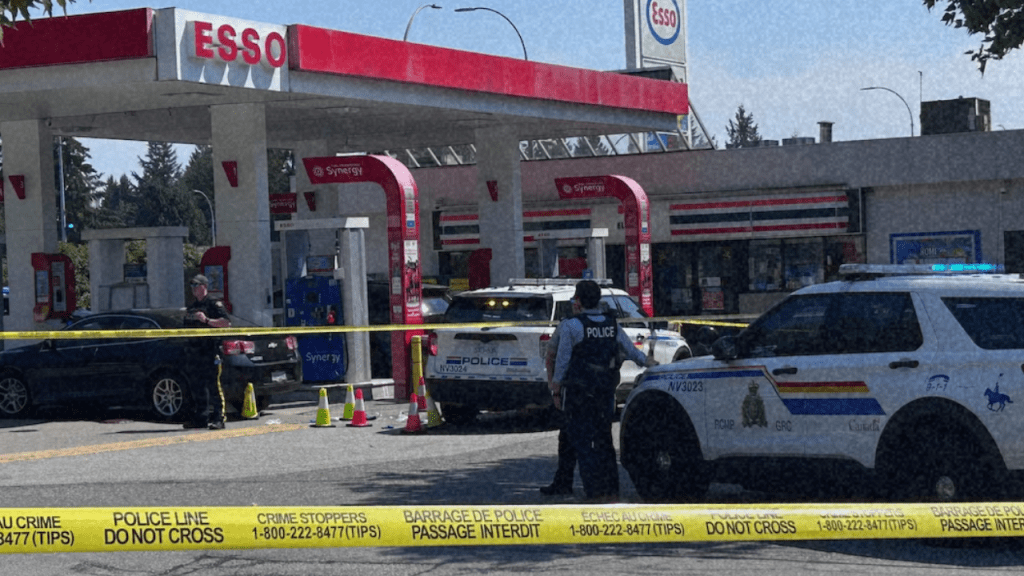
The confirmed public record is limited. Police responded to reports of a man with an edged weapon inside a business, encountered him again near a gas station, deployed a conducted-energy weapon and then fired after he entered or attempted to enter an unoccupied police vehicle.
That sequence describes a dangerous incident. It does not establish that every police action was lawful, necessary or unavoidable. The RCMP account is the beginning of the investigation, not its conclusion.
Police Responded to Reports of an Armed Man
According to the RCMP, officers were called to Westview Plaza at approximately 1:12 p.m. after reports that a man with an edged weapon was threatening people inside a business.2
Police say the man left the business, entered a vehicle in the parking lot and collided with several parked vehicles. He then exited near the gas station in the same plaza, where multiple officers confronted him.
Witnesses interviewed by Global News said the earlier incident occurred inside a McDonald’s and involved a knife. One witness said he intervened, removed the weapon and fought with the man before he left the restaurant.4
Those details remain civilian accounts rather than completed investigative findings. The IIO must determine which parts are supported by video, physical evidence and other testimony.
A Conducted-Energy Weapon Came Before Gunfire
The RCMP says the man entered the driver’s seat of an unoccupied police vehicle. The IIO uses more cautious wording, stating that he reportedly attempted to enter the vehicle before an interaction in which police fired.2 3
The RCMP says officers deployed a conducted-energy weapon and then fired their guns. The release does not explain whether the electrical weapon made contact, whether it affected the man or how much time passed before the gunfire.
It also does not describe what the man did immediately before officers fired. The public does not know whether he was attempting to start the vehicle, move it, reach for equipment or remain inside it.
The IIO has asked witnesses and anyone possessing cellphone, dashboard-camera or other footage to contact investigators.3
The Police Vehicle Is a Central Fact
A person entering a police vehicle can create serious risks. The vehicle may be capable of movement, contain communications equipment or provide access to police tools. Those possibilities are relevant to the officers’ decisions.
They cannot be assumed. The public record does not disclose whether the vehicle was running, whether its keys were accessible, whether the man attempted to operate it or whether equipment was within reach.
The location and movement of every officer also matter. Investigators must establish whether officers were beside the vehicle, positioned in its possible path or able to move behind cover. The legal assessment depends on the immediate threat officers reasonably perceived when they fired.
Spark Solidarity’s coverage of the Brooks RCMP shooting raised the same evidentiary problem. Earlier allegations may be relevant, but they do not remove the requirement to establish what officers saw at the moment of lethal force.
The Initial Account Leaves Major Gaps
The RCMP’s release provides a broad sequence but not enough detail to determine whether the gunfire was necessary.
The public does not know how many officers fired, how many shots were discharged or whether the man still possessed an edged weapon at the gas station. Police have not said whether a weapon was recovered near him or inside the vehicle.
The release does not identify the commands officers gave, the time between the conducted-energy weapon and gunfire, or whether officers considered containment, distance or withdrawal. It does not disclose what police communications, security cameras, vehicle cameras or civilian recordings captured.
Edited or partial clips may clarify individual moments. They cannot substitute for synchronized recordings, dispatch information, device data, firearms evidence and a complete chronology.
Police Allegations Are Not Final Findings
Reports that the man threatened members of the public, struck parked vehicles and entered a police vehicle are relevant to evaluating the officers’ decisions. They do not automatically establish that every subsequent police action was lawful.
The IIO investigates incidents where police action or inaction may have contributed to death or serious harm. Its involvement does not mean an officer committed an offence. It does mean the RCMP’s account cannot be treated as the final determination.3
The same principle applies to the Abbotsford police shooting. Oversight begins because police used lethal force or were connected to a death. The investigation must test the police account against independent evidence.
Forty-three days earlier, the IIO had opened another death investigation after Vancouver police shot and killed a man near Commercial Street and East 20th Avenue. That was a separate incident involving the Vancouver Police Department, not North Vancouver RCMP. But both cases entered the same institutional sequence: lethal force first, police explanation second, independent evidence later. The earlier killing does not establish whether the Westview Plaza shooting was justified; it shows how quickly another Lower Mainland police death returned to the same unresolved question of necessity.
The IIO Must Reconstruct the Entire Encounter
The investigation should begin with the first emergency call and end with the man’s arrival at hospital. Dispatch records must establish what officers were told about the alleged weapon, the reported threat and the man’s movements through the plaza.
The chronology should identify whether the man remained armed after leaving the business, what officers could see when they arrived, how the conducted-energy weapon was used and what immediate threat officers perceived when they fired.
Investigators should account for police communications, business security cameras, cellphone footage, dashboard cameras and any recording systems associated with responding officers.
They must also determine whether officers had time or space to contain the area, whether the vehicle could be driven and whether the man had access to any weapon or equipment inside it.
As Spark Solidarity argued when Vancouver police claimed no choice, necessity cannot be established by repeating the final seconds of a police narrative. The public needs the decisions, distances and alternatives that produced those seconds.
Whether Lethal Force Was Necessary Remains Open
The confirmed public record remains narrow. Police responded to reports of an armed man, encountered him near the gas station, deployed a conducted-energy weapon and then shot him after he entered or attempted to enter an unoccupied police vehicle. He later died.
The man’s alleged conduct before the confrontation does not erase the obligation to independently examine the fatal use of force. Nor does the existence of an IIO investigation establish police guilt.
The central question is whether officers faced an immediate threat that made gunfire necessary after the conducted-energy weapon was used. That can be answered only by reconstructing what the man possessed, what the vehicle could do, where the officers stood and what happened before they fired.
Until that evidence is disclosed, the RCMP’s account remains an allegation under investigation. Case 2026-167 is open because the fatal sequence has not yet been independently established.
Sources
- Killer Cops Canada, “BC RCMP Shoot and Kill Man at Westview Mall in North Vancouver (July 21, 2026),” July 22, 2026.
- British Columbia RCMP, “BC RCMP Notifies IIO BC of Incident in North Vancouver,” July 21, 2026.
- Independent Investigations Office of British Columbia, “IIO Is Seeking Witnesses to an Officer-Involved Shooting in North Vancouver,” case 2026-167, July 21, 2026.
- Amy Judd and Angela Jung, “North Vancouver Daytime Mall Shooting Caught on Video,” Global News, July 22, 2026.