
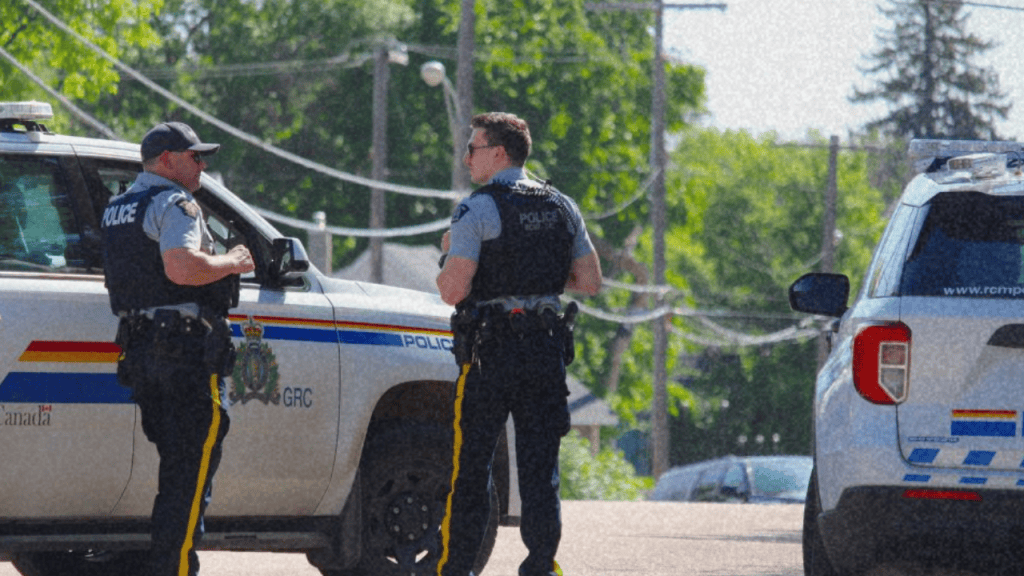
Brooks RCMP Shooting: Police say the man ran at an officer with a knife, but the distance, shots fired and knife locations remain undisclosed.
As reported first by Killer Cops Canada, an RCMP officer shot and killed a man in Brooks, Alberta, on July 15 during an attempted arrest at a home in Greenbrook Village.
The Alberta Serious Incident Response Team is investigating the officer’s use of force and the circumstances surrounding the death. Its account remains preliminary. The man has not been publicly identified, and no completed forensic findings have been released.
The official story asks the public to begin with an arrest warrant, an alleged break and enter and a claimed knife. The material sequence begins with police entering a home to make an arrest, pursuing a man into an alley and killing him before the public has been shown the evidence needed to test the police justification.
Police Started With the Warrant
According to ASIRT’s preliminary account, Brooks RCMP officers went to the Greenbrook Village home at approximately 4:15 p.m. to arrest the man in connection with a break and enter reported earlier that day.
Another person answered the door and told police the man was inside. ASIRT said officers waited outside for several minutes before being invited into the residence. The man then came from the back of the home, saw the officers and left through a side door.
He ran toward a nearby alley while one officer followed him. In the alley, ASIRT says the officer ordered the man to drop a knife. The agency alleges that the man ran toward the officer and that the officer fired during the encounter that followed.
Officers provided first aid until paramedics arrived, but the man died at the scene. Investigators later reported finding two knives during an examination of the area.
Those details are not completed findings. They are the investigative agency’s early reconstruction of an encounter in which the surviving armed participant was a police officer and the other participant was killed.
The RCMP Release Concealed the Pursuit
The RCMP’s first release said officers were conducting “warrant apprehension efforts” at approximately 4 p.m. It described the man as a “wanted male” who attempted to flee and “produced a weapon” during a confrontation.
The release did not identify the alleged weapon as a knife. It did not say that an officer followed the man out of the home and into an alley. It did not explain how far the officer pursued him, what tactical options were available or whether other officers were close enough to contain the area rather than continue the chase.
The RCMP reduced the killing itself to an officer who “discharged their service weapon.” That passive institutional language removes the decision-maker from the sentence. An officer did not merely discharge a firearm. An officer shot a man, and the man died.
The initial release gave the public a warrant, a fleeing suspect and a weapon before providing any meaningful account of the officer’s conduct. The result is a familiar police narrative: criminality is attached to the dead person immediately, while lethal force is described as an event that simply occurred.
The Pursuit Turned an Allegation Into a Killing
The arrest was reportedly connected to a property offence. No public source establishes that the man had been convicted of the alleged break and enter. The contents of the warrant and the evidence connecting him to the reported offence remain undisclosed.
Police nevertheless converted an attempted arrest into a foot pursuit and a fatal shooting. The official account places the decisive responsibility on the man’s alleged movement toward the officer, but the public record does not yet establish the distance between them, the speed of the movement or the time available for the officer to reposition, disengage or use another tactic.
Flight is routinely treated as evidence of dangerousness after police create the conditions of pursuit. That framing erases the power imbalance at the centre of the encounter. Police decide when to enter, when to chase, when to issue commands and when to fire. The person being pursued carries the consequences of every escalation.
The same narrative structure appeared in the Abbotsford police shooting: police foregrounded allegations against the men involved while withholding a public explanation for an officer’s gunfire. In both cases, the institution supplied characterizations of the person before supplying evidence capable of independently testing the shooting.
The Evidence Needed to Test the Story Is Missing
Neither ASIRT nor the RCMP has disclosed the distance between the man and the officer when the shooting began. They have not stated how many shots were fired, where the bullets travelled or whether the officer’s body-worn camera captured the encounter.
The public record does not identify the exact locations where the two knives were found. It does not establish through completed forensic findings whether either knife was in the man’s hand when he was shot, whether one was recovered elsewhere in the alley or whether fingerprints, blood or other evidence connected a particular knife to the fatal encounter.
No civilian, residential or police video has been released. The man’s age and identity remain undisclosed. Autopsy and toxicology findings are not public. The record also does not state whether the officer fired while moving backward, standing still or advancing.
These are not peripheral details. They determine whether the police account describes an immediate threat, an avoidable confrontation or a reconstruction shaped around justifying the only person who survived the shooting.
Brooks RCMP Already Had an Accountability Case
The current shooting is separate from a recent case involving another Brooks RCMP member, but that case still matters as institutional context.
In December 2025, the RCMP announced that Brooks Cpl. Michael Hagel had been charged with assault and assault by choking following an investigation into alleged off-duty conduct. The force suspended him with pay.
In March 2026, the charges were withdrawn after Hagel entered a 12-month peace bond. A Postmedia court report said the conditions included counselling related to PTSD and anger management and a no-contact order. No facts were entered to support the peace bond, and his paid suspension reportedly remained in place.
That case does not identify the officer in the July shooting and does not prove misconduct in it. It shows the limits of the accountability language the detachment now invokes. A serious violence allegation against a Brooks officer moved from criminal charges to a conditional peace bond while the officer remained on paid suspension.
Alberta RCMP Repeats the Same Script
The Brooks killing was the third fatal Alberta RCMP shooting publicly announced in twenty days. RCMP officers killed people in Cold Lake on June 25 and near Irricana on July 3 before the July 15 shooting in Brooks.
The releases use nearly identical institutional language. Each emphasizes that no officers were injured. Each announces cooperation with ASIRT. Each promises an internal RCMP review of training, policy, police response and the involved officer’s duty status.
That repetition reveals more than communications discipline. Police killings are processed through a standard legitimacy script: establish the alleged threat, reassure the public that officers survived, invoke an oversight body and promise that the force will review itself.
The incidents are different, and a shared press-release template does not determine whether any individual shooting was criminal. It does show how the institution presents repeated killings as isolated confrontations rather than as a pattern requiring scrutiny of RCMP tactics, training and authority across Alberta.
Police Reviewing Police Is Not Independent
The RCMP announced a separate internal review into its training, policy, response and the officer’s duty status. A police organization examining whether its own members followed its own rules is an administrative process, not independent public accountability.
ASIRT is institutionally separate from the RCMP, but its mandate remains narrow. It investigates possible criminal offences and serious incidents involving police. The opening of an investigation does not establish wrongdoing, and a decision not to recommend charges would answer only whether the available evidence meets a criminal-law threshold.
The Police Review Commission, which has housed ASIRT since December 2025, states that its role includes strengthening public confidence in policing. An oversight system partly organized around preserving confidence is not the same thing as an adversarial institution organized to challenge the necessity of police power.
A criminal review may assess whether the officer could lawfully claim an immediate threat. It does not necessarily decide whether entering the home, following the man into the alley or continuing the pursuit created an avoidable path to lethal force.
The Initial Read
The official account asks the public to begin with the warrant, the alleged break and enter and the claimed knife. The material sequence begins with police pursuing a man over an alleged property offence and ends with an officer killing him in an alley.
ASIRT may eventually release evidence that supports the officer’s claim of an immediate threat. That evidence is not public now. What exists is a preliminary state account built from a police encounter in which one participant was killed and the other belongs to the institution whose force is being investigated.
Until the distance, video, ballistics, knife locations and complete tactical record are public, police have offered a justification narrative without releasing the evidence required to test it.
Verification date: July 30, 2026.
Sources
- Killer Cops Canada, “Brooks, Alberta, RCMP Shoot and Kill Man in Greenbrook Village (July 15, 2026),” July 16, 2026.
- Police Review Commission and Alberta Serious Incident Response Team, “ASIRT Investigating Death After Brooks RCMP Shooting,” July 24, 2026.
- Alberta RCMP, “Alberta RCMP Officer Involved Shooting in Brooks,” July 15, 2026.
- Alberta RCMP, “Off-Duty RCMP Officer Charged After Investigation,” December 3, 2025.
- Kevin Martin, “Brooks Mountie Cleared of Criminal Charges After He Agrees to Enter Peace Bond for 12 Months,” Postmedia, March 11, 2026.
- Alberta RCMP, “Alberta RCMP Officer Involved Shooting in Cold Lake,” June 26, 2026.
- Alberta RCMP, “Alberta RCMP Officer Involved Shooting in Irricana,” July 4, 2026.
- Police Review Commission, mandate and institutional overview, accessed July 30, 2026.



 Spark Solidarity