
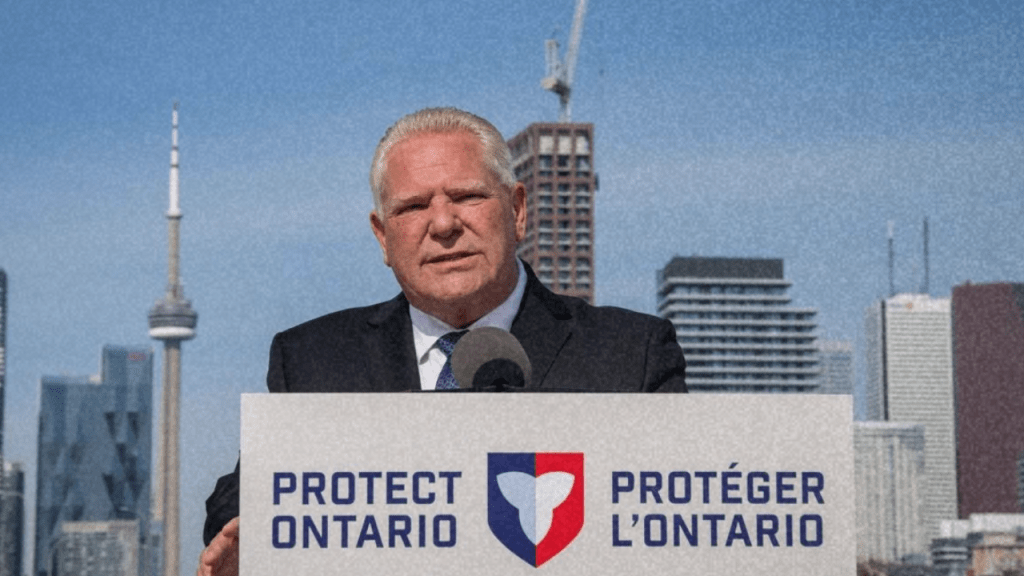
Ford celebrated 42,000 new jobs while Ontario advertised parks without encampments. Both messages reveal what Protect Ontario protects.
On June 5, Statistics Canada reported that Ontario had added 42,000 jobs in May, bringing the province’s cumulative employment gains over April and May to 84,000. Doug Ford quickly turned the monthly report into a verdict on his government. In a post celebrating the numbers, the premier declared that his “plan to protect Ontario is working” and promised to keep building what he called the most competitive, resilient and self-reliant economy in the G7.
By then, another version of Protect Ontario was already appearing in provincial advertising. A full-page government ad showed a worker in a high-visibility vest holding a radio beneath the slogan, “A safer Ontario means parks without encampments.” The page directed readers to the province’s safer-Ontario campaign and identified itself as paid for by the Government of Ontario.
Read separately, one message is about economic growth and the other is about public safety. Read together, they describe a single governing logic. The state takes credit when employment numbers rise, then treats the visible consequences of economic and social failure as disorder to be removed from public space.
One Slogan, Two Political Images
The strength of the Protect Ontario slogan is that it can hold different meanings for different audiences without changing its basic political function. In the jobs post, protection means employment, manufacturing, investment and competitiveness. The government presents itself as a shield against tariffs, uncertainty and economic decline. The proof is numerical: jobs have been created, factories are hiring, investment is arriving, and the province is moving in the right direction.
In the encampment advertisement, protection means something else. The image does not show housing construction, a shelter opening or an outreach team helping someone move indoors. It shows authority and communication equipment. Safety is represented as a park after the encampment is gone. The political subject is the housed resident who wants public space restored to visual order. The unhoused person appears only through the thing to be removed.
The two messages are not connected because every person living in an encampment is unemployed, and they are not connected because job creation causes homelessness. Neither claim would be true. They are connected because the government separates economic success from social outcomes. A good employment report belongs to the economic plan. Mass homelessness belongs to another file, where police powers, trespass law and encampment removal can take over.
The Jobs Number Produces Legitimacy
The May employment gain was real. Statistics Canada reported that Ontario employment increased by 42,000, while the provincial unemployment rate fell to 7.0 per cent. Ford’s political move was not inventing the increase. It was using one favourable measure to certify a much larger claim: the plan is working.
That transformation is the work of government messaging. A monthly labour report becomes evidence of competent rule. The uncertainty surrounding jobs, wages, rents, household debt, public services and housing is pushed outside the frame because the headline number is easier to communicate than the conditions in which people actually live.
This is why the language in Ford’s post matters. Competitive, resilient and self-reliant are not descriptions of whether a worker can pay rent at the end of the month. They are descriptions of an economy as an investment environment. The province is being presented as a platform that can attract capital, absorb shocks and keep production moving. Workers appear inside that story mainly as evidence that the platform is functioning.
The Encampment Ad Produces a Threat
The encampment campaign performs the opposite operation. Instead of turning people into evidence of economic success, it turns people into evidence of disorder. The phrase “parks without encampments” removes the unhoused person from the sentence and leaves only the visible structure that interrupts the desired image of public space.
The legal structure behind the advertisement makes the message concrete. Ontario’s Safer Municipalities Act expanded the state’s enforcement framework around illegal drug use in public places and amended trespass sentencing. The government’s own safer-Ontario material groups clearing encampments with auto theft, jails, bail and drug enforcement under the heading of protecting neighbourhoods.
There are real safety problems in and around some encampments. Fires occur. Violence occurs. People overdose. Neighbours can experience conflict and fear. But none of those realities turns the disappearance of a tent into proof that the person who lived there is safer. Enforcement can move visible poverty without reducing the number of people who have nowhere secure to live.
That is the political usefulness of the frame. Once homelessness is defined primarily by its visibility in parks, the state can demonstrate action by making the visible object disappear. The standard of success shifts from housing people to clearing space.
The Same Economy Produces Both Stories
Ontario’s homelessness crisis cannot be kept outside the economic story simply because it does not appear in the Labour Force Survey. The Association of Municipalities of Ontario reported that nearly 85,000 people experienced homelessness in 2025, an increase of more than eight per cent in one year and 50 per cent since 2021.
Those people did not arrive in parks from outside the economy. Homelessness grows through the same material world the government celebrates when the indicators move upward: wages, rents, employment stability, income supports, health care, disability benefits, tenant protections and the supply of deeply affordable housing. Some unhoused people work. Some cycle between employment and unemployment. Some cannot work. None of those categories makes homelessness a separate economic universe.
The province therefore produces two different political accounts of the same society. When a worker is hired, the job can be counted as proof that the plan is succeeding. When a person loses housing and becomes visible in a park, the government does not count that outcome against the same plan. The person is transferred into the language of safety, addiction, trespass and municipal enforcement.
Visibility Is What Gets Punished
Housing insecurity can remain politically manageable for years while it stays private. People take on debt, skip meals, crowd into smaller apartments, move back with family, delay medical care, accept worse jobs or cycle through temporary housing. None of that necessarily interrupts the visual order of a commercial district or public park.
Once the crisis reaches the sidewalk, the political response changes. Poverty becomes impossible to keep inside household budgets and private suffering. The tent makes the failure visible. At that point the government can treat visibility itself as the emergency, because removing the visible evidence is faster than repairing the systems that produced it.
Spark Solidarity has already examined how the province’s parks without encampments campaign converts homelessness into a public-order problem. Put beside Ford’s jobs celebration, the deeper mechanism becomes clearer. The successful economy is announced through aggregate numbers. The people whose lives do not fit that success story are governed through another apparatus.
Protect Ontario Has a Class Audience
The government does not need every Ontarian to receive these messages in the same way. The jobs post speaks most directly to employers, investors, business organizations and voters who understand provincial success through growth, competitiveness and industrial activity. The encampment ad speaks to the housed public as residents whose neighbourhoods and parks are being protected from disorder.
Both messages reassure people who already possess some claim to stability that the state is managing the province on their behalf. Capital will be attracted. Jobs will be created. Parks will be cleared. Streets will be made orderly. The economy will remain competitive and the signs of breakdown will be contained.
The people living the contradiction are not addressed in the same way. The worker whose paycheque no longer covers rent is useful as a job statistic but inconvenient as evidence of declining security. The unhoused person is not the audience for the encampment advertisement. They are the object being acted upon so someone else can be shown that government is in control.
Protecting the Story
The Ford government is not simply contradicting itself when it celebrates job creation while advertising parks without encampments. The contradiction exists in the material reality, but the political messaging is coherent. Good economic numbers are attached to the government’s competence. Social failures that survive those numbers are detached from the economy and recoded as separate problems of disorder, individual crisis and enforcement.
That division protects more than parks. It protects the story the government tells about what the economy is for. Success can be measured through employment, investment and competitiveness without being judged by whether people can remain housed. Failure can then be managed at the level of appearance, after it has already produced tents, shelters, food-bank lines and people sleeping outside.
Protect Ontario works as a slogan because it never has to specify one object of protection. In the jobs post, Ontario is protected as an economy. In the encampment ad, Ontario is protected as an ordered landscape. The missing question is whether the people who cannot afford the province being built around them are included in the thing being protected at all.
Sources
- Labour Force Survey, May 2026 — Statistics Canada
- Ontario Leads in Job Creation for Second Month — Doug Ford
- A Safer Ontario Means Parks Without Encampments — Government of Ontario advertisement
- A Safer Ontario — Government of Ontario
- Bill 6, Safer Municipalities Act, 2025 — Legislative Assembly of Ontario
- More than 85,000 Ontarians Were Homeless in 2025 — Association of Municipalities of Ontario
- Parks Without Encampments Is Ontario Homelessness Policy — Spark Solidarity






 Spark Solidarity