
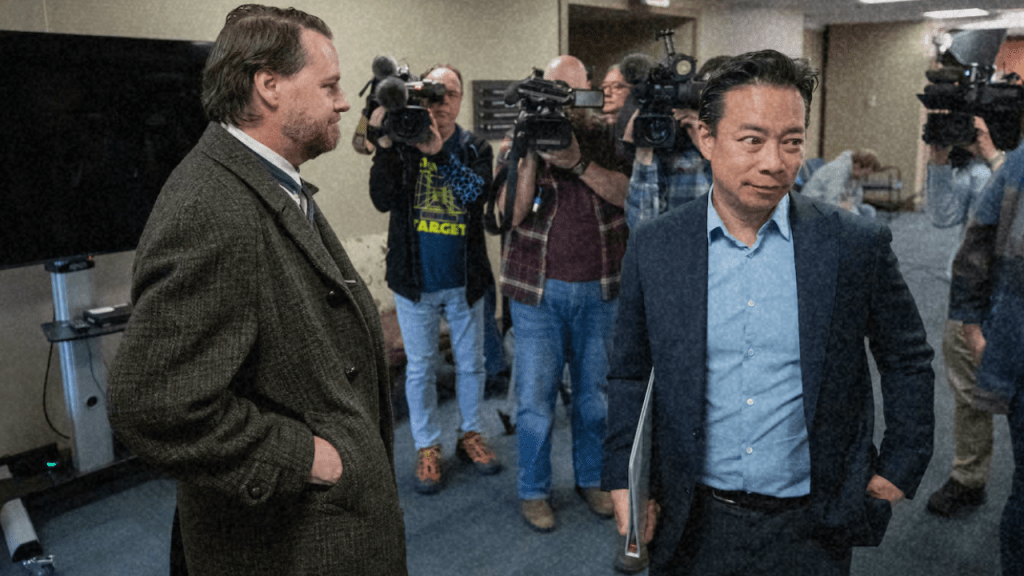
Ken Sim repeatedly cast Sean Orr as dangerous. An investigator found harassment, then ABC used its council majority to block consequences.
On June 2, Vancouver City Council was asked what should happen after an independent investigation found that Mayor Ken Sim had violated the city’s Code of Conduct and harassed Councillor Sean Orr. The investigation had concluded that Sim misused the influence of his office and personally attacked Orr through public allegations that associated him with antisemitism and support for a designated terrorist organization.
Council had the power to impose consequences. The investigator had recommended options including a written apology, a reprimand, training, committee removal, or public censure. Instead, an ABC Vancouver majority voted not to sanction Sim at all. Sim was absent from the vote after determining that his participation would create a conflict of interest. His party still had the votes to protect him.
The vote completed a political sequence that had unfolded over more than a year. A newly elected left councillor was repeatedly represented not simply as wrong, radical, or politically objectionable, but as socially dangerous. First came public allegations around antisemitism. Then an accusation connecting him to a protest allegedly associated with a designated terrorist group. Months later, in a separate controversy, Sim falsely claimed that Orr had distributed illegal drugs on Christmas Day.
These accusations were not identical, and collapsing them into one category would reproduce the same kind of careless politics this article is criticizing. But the recurring mechanism is visible. Instead of containing disagreement within ordinary political conflict, Orr was repeatedly pushed toward categories that make a person appear unfit for legitimate civic life. The argument stopped being only about what he believed. It became about whether he was someone the public should fear.
That is what makes the June vote larger than another City Hall conduct dispute. Order politics does not operate only through police budgets, encampment clearances, drug panic, and public-safety campaigns. It also works by defining the boundary between legitimate and illegitimate political actors, then using institutional power to make those definitions travel further than ordinary political speech ever could.
The Finding Came Before the Protection
The independent investigation concerned two episodes. The first followed Vancouver’s April 2025 council by-election, in which Orr won a seat for COPE alongside OneCity’s Lucy Maloney. According to the investigation findings reported by CityNews, Sim held a City Hall press conference days later with representatives of local Jewish organizations and publicly accused Orr of having made antisemitic comments before he entered office.
The investigator did not find that every allegation Orr made about Sim was substantiated. She did not conclude that city resources had been improperly used, did not treat the press conference as part of an election campaign, and did not rule on whether Sim had defamed Orr. Those limits are important because the strongest structural argument does not require exaggerating the report.
What the investigator did find was serious enough. She concluded that Sim had violated the Code of Conduct by using the influence of the mayor’s office for a public intervention outside his mayoral duties and by personally attacking Orr in a way that portrayed him as antisemitic and potentially connected to hate or violence. A later social media post, which associated Orr with a protest Sim described through the presence of Samidoun, was found to continue the harassment by suggesting that Orr supported both antisemitism and a designated terrorist organization.
The report therefore identified more than a failure of tone. It identified a power relationship. Sim was not simply another person arguing with Orr online. He was the mayor of Vancouver, using the visibility and authority attached to that office to define a newly elected political opponent before Orr had even established himself inside council.
The chronology should not be turned into a causal claim the evidence cannot support. Orr’s by-election victory does not prove that ABC launched a coordinated campaign against him because he had helped defeat its candidates. But the sequence still changes the political terrain. Orr entered council after a citywide defeat for ABC candidates, and almost immediately became the subject of a mayoral intervention designed to tell the public what kind of political actor he was.
The Drug Smear Was a Separate Escalation
The Code of Conduct investigation did not cover the allegation that produced the most obvious factual collapse. In February 2026, Sim told Chinese-language media that Orr had distributed illegal drugs on Christmas Day. The claim later spread through comments by ABC Councillor Lenny Zhou, who apologized after repeating inaccurate information.
Sim was then revealed as the source. CityNews reported that Orr denied the allegation and said he had not even been in Vancouver on Christmas Day. Councillor Pete Fry said he had exchanged messages with Orr and received photographs from him on the Sunshine Coast. Sim later acknowledged that his comments were wrong, apologized, and said he had relied on a photograph he had not verified.
By March 10, Orr had filed a civil defamation claim over the false allegation. The lawsuit is separate from the integrity investigation and should not be treated as proof of legal liability before a court has ruled. Politically, however, the damage did not depend on a completed lawsuit. The mayor of Vancouver had publicly attached a left councillor’s name to the distribution of illegal drugs before establishing whether the allegation was true.
The accusation landed inside one of the most politically charged conflicts in the city. Vancouver’s debates over the toxic drug supply, homelessness, the Downtown Eastside, supportive housing, policing, and harm reduction are already organized through competing ideas of danger. A politician associated with housing activism and structural responses to poverty could suddenly be represented not merely as permissive toward disorder but as personally participating in criminality.
The retraction could correct the factual record. It could not erase the political association that had already been created.
Threat Construction Replaces Political Argument
There is a temptation to treat the sequence as a collection of unrelated controversies. One concerned antisemitism. Another concerned a protest and an alleged connection to Samidoun. Another concerned illegal drugs. The content differs substantially, and each claim has to be evaluated on its own evidence.
The shared political operation is not the allegation itself. It is the transformation of an opponent into a threat category.
Ordinary political disagreement leaves room for argument. A councillor can be wrong about housing, policing, Gaza, taxation, harm reduction, public spending, or the role of the state, and the dispute can remain a contest over policy and power. Threat construction changes the question. The opponent becomes someone allegedly too dangerous, hateful, criminal, or irresponsible to be treated as an ordinary participant in politics.
That move is especially powerful when it comes from an office with institutional prestige. Most people cannot call a City Hall press conference and expect the media to assemble. Most people do not speak with the authority of the mayoralty behind them. Most political attacks do not begin with a communications apparatus, official visibility, party infrastructure, and immediate access to the city’s dominant news cycle.
The investigation recognized this imbalance when it focused on Sim’s misuse of the influence of his office. The problem was not simply that two politicians disliked each other. The office itself amplified the attack.
The Mayor’s Office Is an Instrument of Power
Liberal accounts of political misconduct often reduce the issue to civility. The mayor should have been more careful. The language should have been less inflammatory. The parties should lower the temperature. Those observations can be true while missing the material structure that made the conduct significant.
A mayor’s office is not merely a microphone. It is a concentration of institutional access. It shapes which statements become news, which controversies become citywide events, which communities are summoned into public conflict, and which political actors are required to respond defensively to an agenda somebody else has already set.
When that office is used to portray an opponent as socially dangerous, the opponent has to spend political energy disproving the category before returning to the underlying argument. Housing disappears behind a character accusation. Policing disappears behind a public-safety panic. Criticism of Israel disappears behind allegations about antisemitism or terrorist association. Harm reduction disappears behind a false claim about drug distribution.
The institutional advantage lies in setting the first frame. Evidence can arrive later. Corrections can arrive later. Apologies can arrive later. The target still has to fight through the meaning produced by the original accusation.
This is why the integrity finding matters more as a description of power than as a procedural footnote. The investigation concluded that Sim had used the influence of his office improperly. The next question was whether the institution surrounding that office would impose any cost for doing so.
ABC Protected Its Own Political Machinery
On June 2, the answer became clear. Council could have accepted one of the recommended sanctions. Instead, ABC Councillor Brian Montague moved that no sanctions be imposed, and the party’s majority carried the motion.
The debate did not simply reject one recommended punishment. ABC councillors questioned the investigation itself. As The Tyee reported on June 3, Montague pressed the investigator over her methods and raised concerns about the integrity commissioner’s office being “weaponized.” The governing majority shifted scrutiny from the mayor’s conduct toward the mechanism that had found misconduct.
This does not make the integrity system neutral, infallible, or beyond criticism. Investigative bodies are institutions too, and their procedures can be challenged. But in this case the political effect was straightforward. An independent process found that the mayor had violated the Code of Conduct and harassed an opponent. The mayor’s own party possessed enough votes to prevent formal consequences.
The sequence reveals why accountability systems cannot be understood apart from political control. Rules exist. Investigations happen. Findings are issued. But the distribution of votes determines whether the finding changes anything materially.
The office amplified the attack. The party majority absorbed the consequence.
Order Politics Extends Beyond the Street
ABC Vancouver’s rise has been closely tied to the language of safety, disorder, policing, mental-health crisis, and visible urban decline. After taking office, the party advanced its promised expansion of policing and mental-health response capacity. The political story was familiar: the city had become unsafe, existing institutions had lost control, and restoring order required stronger enforcement and managerial authority.
Some of the problems inside that story are undeniably real. Vancouver has a toxic drug crisis. People are dying. Residents experience violence, disorder, fear, and untreated illness. Businesses and workers deal with conditions created by a social crisis that governments at every level have failed to resolve. A material analysis does not require pretending that public disorder is invented by conservative politicians.
The political question is how those conditions are explained and who receives power in response.
Order politics takes structural failures and converts them into populations to be managed. Housing scarcity becomes an encampment problem. A toxic supply becomes a street-disorder problem. Poverty becomes a visibility problem. Mental illness becomes a policing problem. The institutions that own land, set rents, underfund care, regulate drugs, and distribute wealth can recede while the people living through the crisis become its public face.
The attacks on Orr show that the same political grammar can move inside City Hall. A political opponent associated with structural explanations of crisis can himself be represented through categories of danger. The boundary between managing disorder and managing dissent becomes thinner than the rhetoric of public safety suggests.
The 2025 By-Election Changed the Terrain
Orr’s presence on council matters because he did not arrive through appointment or insider succession. In the April 5, 2025 by-election, Vancouver voters elected Orr for COPE with 34,448 votes and Lucy Maloney for OneCity with 33,732. The city officially declared both candidates elected four days later.
The result did not create a unified Vancouver left, and it should not be romanticized as a citywide mandate. Turnout was only 15.1 per cent. A two-seat by-election has different dynamics from a general election. But the result demonstrated that ABC could lose citywide contests and that candidates running to its left could assemble enough support to enter council despite the party’s institutional dominance.
Orr therefore became significant before he had accumulated much formal power. He represented a political current that ABC had failed to keep outside the chamber. His later motions, including a June 3 proposal urging exploration of a deeply discounted transit pass for low-income residents, illustrated the kind of conflict underneath the personal controversies. The substantive argument was about who should receive public resources and how a brutally expensive city should distribute the cost of daily life.
That material politics is easy to lose once a councillor is forced to spend months answering whether he is antisemitic, connected to terrorism, or distributing drugs. Threat construction does not have to defeat a policy proposal directly. It can consume the political terrain around the person proposing it.
Housing and Poverty Remain Underneath the Fight
Vancouver’s politics of order cannot be separated from its property system. The city remains one of the most expensive housing markets in the country, and the consequences of that system are visible everywhere: rent pressure, displacement, overcrowding, homelessness, long commutes, precarious work, and neighbourhoods reorganized around land value rather than social need.
Those conditions do not explain every conflict involving Orr, and housing should not be turned into a universal answer that erases antisemitism, racism, drug policy, or public safety as distinct political questions. But housing remains one of the material structures underneath Vancouver’s crisis politics because it determines who can remain in the city, who becomes precarious, and how much instability other institutions are then asked to manage.
Police can clear an encampment without creating a home. Bylaws can move people without lowering rent. Public-safety campaigns can reorganize where poverty is visible without changing the property relations producing insecurity. Political attacks on councillors associated with tenant and anti-poverty politics do not have to mention landlords or developers at all. They can move the argument to whether those councillors are responsible enough to be trusted with the crisis.
This is why the false drug allegation was politically potent. It collapsed the distinction between defending harm reduction and participating in criminality. It invited the public to judge the politician through the fear attached to the crisis rather than the policies he was proposing in response to it.
Legitimacy Is the Battlefield
Ken Sim’s false drug allegation mattered because it was false. The integrity findings matter because an independent investigation concluded that earlier attacks had crossed the city’s own conduct rules. The June vote matters because the governing majority demonstrated that an adverse finding does not automatically produce an institutional consequence.
Together, those events reveal a form of political power that is easy to miss when each controversy is treated separately. An office can define an opponent. A media system can carry the definition. An accountability process can challenge it. A governing majority can then decide how much the challenge matters.
The point is not that every criticism of Orr is illegitimate or that left politicians should be protected from scrutiny. The point is that scrutiny has to remain attached to evidence and actual political conflict. When a mayor uses institutional authority to associate an opponent with danger, the burden shifts. The accused person is forced to prove that he belongs inside legitimate politics before the public ever reaches the policy question.
Order politics therefore does more than police streets. It polices categories. It decides which people are understood as residents in need, which are understood as threats, which politicians are treated as legitimate representatives, and which can be pushed toward the edge of civic life through accusation.
Vancouver’s June council vote showed the institutional end of that process. The mayor had been found to have harassed a political opponent and misused the influence of his office. His party had the power to impose a consequence. It chose not to.
That is how order politics protects itself.
Sources
- Vancouver Council Won’t Sanction Mayor for Harassing Councillor, The Tyee, June 3, 2026.
- Mayor Sim Will Not Be Sanctioned After Investigation Concluded He Harassed Coun. Sean Orr, CityNews, June 2, 2026.
- Integrity Commissioner Investigation Reports, City of Vancouver, including the May 11, 2026 complaint report concerning Mayor Ken Sim.
- Mayor Sim Violated Code of Conduct and Harassed Coun. Orr With Allegations of Antisemitism, Finds Investigation, CityNews, May 14, 2026.
- Vancouver Councillor Sues Mayor as Backlash Over False Drug Allegations Continues, CityNews, March 10, 2026.
- Vancouver Mayor Sends Apology to Chinese Media Over Drug Slur, The Canadian Press via CityNews, March 4, 2026.
- Fallout From Vancouver City Hall After Mayor Linked to False Accusations, CityNews, February 26, 2026.
- Chief Election Officer Declares Candidates Elected, City of Vancouver, April 9, 2025.
- Council Approves Motion in Support of Low-Income Transit Pass, CityNews, June 3, 2026.

 Spark Solidarity