
The Shawinigan rally gave Quebec’s establishment a perfect manageable enemy: explicit enough to condemn, marginal enough to contain, and useful enough to justify a wider architecture of monitoring and public-order power.
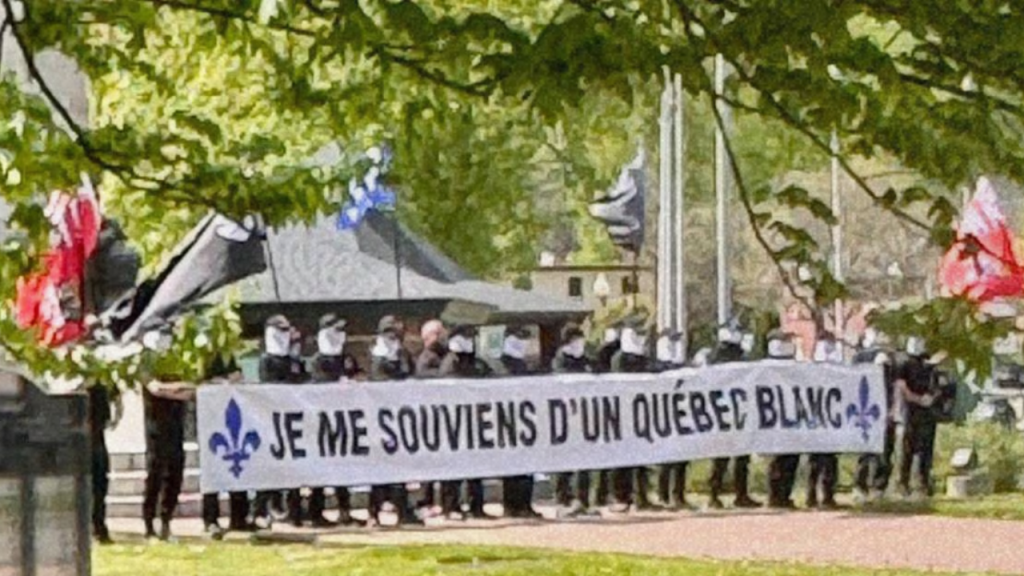
On May 30, 2026, roughly fifteen masked people dressed in black gathered at Parc des Vétérans in Shawinigan. They posed near the city’s war memorial with Quebec flags and a banner reading Je me souviens d’un Québec blanc.
The spectacle was built to travel. It took Quebec’s most familiar national motto and attached whiteness to it, turning historical memory into a claim of racial ownership. The message was not simply that the participants disliked immigration. It was that Quebec had once been authentically white and that demographic change represented the loss of something that properly belonged to them.
Within hours, political leaders condemned the gathering. Quebec Premier Christine Fréchette called the racist messages unacceptable. Parti Québécois leader Paul St-Pierre Plamondon pointed toward the Active Club movement. Quebec Liberal leader Charles Milliard said the rally did not represent the openness of Quebecers. The City of Shawinigan stressed that no official request had been filed for the event and that municipal authorities had not been informed in advance.
Then the organizers became clearer. Second Sons Canada president Jeremy MacKenzie confirmed that members of his organization were behind the Shawinigan action. The rally was not an unexplained eruption of anonymous racism. It was a public action tied to a broader organizing model that uses physical training, combat sports, male fraternity and white nationalism to build an offline political network.
The gathering deserved condemnation. But condemnation is where political analysis should begin, not where it should end.
The banner was a recruitment device
The Shawinigan banner worked because it did not begin with an obscure ideological manifesto. It began with a phrase almost every Quebecer already knows.
Je me souviens carries the weight of collective memory, survival and national continuity. By adding d’un Québec blanc, the organizers attempted to racialize that memory. Whiteness became the thing supposedly remembered and therefore the thing supposedly lost.
This is a recruitment strategy as much as a slogan. The contemporary far right does not need every potential recruit to begin with a complete white-supremacist worldview. It can start with a grievance, a fear, a feeling of decline or a desire for belonging, then supply a racial explanation.
The Active Club model is built for that transition. The Institute for Strategic Dialogue describes the movement as a decentralized white-supremacist organizing model that uses male camaraderie, physical fitness and combat sports as conduits into extremist activism. The political community can be experienced first as a training group, a network of friendships or a place to acquire discipline. The ideology is embedded in the social structure around it.
That matters because loneliness, atomization and political powerlessness are not abstract conditions. They create a market for organizations that offer identity, purpose and fraternity. The far right does not resolve those conditions. It weaponizes them by attaching belonging to racial exclusion and directing frustration toward migrants, minorities and other designated outsiders.
The far right radicalizes existing terrain
Second Sons Canada did not invent every anxiety its propaganda exploits.
Quebec politics already contains sustained debates about immigration, language, housing, public services and the province’s capacity to integrate newcomers. The government’s own 2026 to 2029 immigration orientations call for reducing overall temporary and permanent immigration in order to ease pressure on Quebec’s capacity to receive and integrate immigrants. Government messaging around the planning process has also connected immigration levels to pressure on housing, public services and French-language integration.
There is a real distinction between debating immigration levels and advocating a white ethnostate. Mainstream politicians who argue for lower immigration are not therefore equivalent to masked white nationalists.
The difference is real. So is the terrain they share.
When social problems are repeatedly narrated through demographic pressure, it becomes easier for the far right to offer a more explicit racial conclusion. Housing scarcity becomes proof that outsiders are taking what belongs to the nation. Strained services become evidence that newcomers are consuming resources that should belong to an established population. Anxiety about the future of French becomes a story about racial replacement.
The far right radicalizes this terrain by replacing political economy with racial competition. It takes crises created through decisions about housing, investment, public capacity, wages and regional development, then gives those crises a visible human target.
This is why treating white nationalism as something alien to Quebec is politically comforting but analytically weak. The people behind the Shawinigan rally do not represent most Quebecers. Their politics are still produced inside the same society, and their recruitment strategy works by converting recognizable grievances into a racial theory of decline.
A perfect enemy for respectable politics
Masked white nationalists make unusually convenient political antagonists.
Their message is explicit enough that politicians across party lines can condemn it without ambiguity. Their numbers are small enough that they can be presented as marginal. Their imagery is disturbing enough to generate public attention. And opposing them requires no immediate challenge to the property interests, employers or policy choices that shape everyday insecurity.
This produces a familiar performance of institutional unity. Whatever the parties disagree about, they can stand together against a banner demanding a white Quebec. The establishment gets to present itself as the guardian of tolerance and democratic order.
That condemnation can be sincere and still be institutionally useful. No conspiracy is required.
The political benefit comes from the contrast. Racism is located in a photograph of masked men at the edge of respectable society, while the institutions condemning them are relieved of any obligation to examine how their own policies, rhetoric and failures create the grievances that far-right organizers exploit.
A government can condemn white nationalism without building enough non-market housing. A party can denounce racial hatred while continuing to describe social scarcity primarily through demographic pressure. A political class can praise social cohesion while presiding over increasingly expensive shelter, insecure work and weakened collective institutions.
The far right then returns to those unresolved conditions and says it has found the cause.
The spectacle benefits more than one side
The Shawinigan action was tiny in numerical terms. The image was not.
A handful of masked participants produced provincial news, statements from party leaders and a public debate about the growth of the far right. The banner travelled far beyond Parc des Vétérans.
That visibility has different value for different institutions. Second Sons Canada demonstrates to potential recruits that a small organized group can force itself into the political conversation. Politicians receive an unmistakable enemy against which they can define themselves. Media organizations receive a dramatic conflict with recognizable villains. Security and anti-extremism institutions receive another example supporting the need for surveillance, research, classification and intervention.
None of this means the rally should have been ignored. Public reporting on organized white nationalism is necessary, especially when groups are building networks around combat training and exclusionary politics.
But amplification is not politically neutral. A far-right spectacle is designed to collapse a complex social conflict into an image simple enough to reproduce. When coverage repeats the image and the slogan without explaining the organizing network or the conditions being exploited, the public receives the threat as spectacle rather than as a political process.
The result is a closed informational loop. The far right generates the image. Media distributes it. Politicians condemn it. Security institutions classify it. The underlying conditions remain largely untouched.
Classification runs on two tracks
There is nothing wrong with accurately identifying a white-nationalist organization as a white-nationalist organization. The problem begins when classification becomes a substitute for politics and when the powers built around one category of extremism expand beyond their original target.
On one track, organizations such as Second Sons Canada and other Active Clubs become legible objects of the security system. They can be monitored, mapped, reported on and categorized. That is the same institutional pattern examined in Spark Solidarity’s earlier investigation, Hamilton NS13 and How the Far Right Benefits Zionism.
On another track, anti-hate and public-order frameworks can be extended toward movements whose relationship to state power is completely different. Palestine solidarity is a current example.
In May, Montreal police opened a hate-crimes investigation after a Palestine-solidarity demonstration displayed effigies representing Benjamin Netanyahu, Itamar Ben-Gvir and Donald Trump. Organizers said the figures represented specific political leaders and denied that the display targeted Jews as a religious or ethnic community. CIJA and Federation CJA described the scene as depicting Jews hanging from ropes and filed a complaint with police.
The existence of an investigation does not by itself establish that police acted improperly, and a political protest is not automatically protected from scrutiny simply because its organizers describe its intent differently from its critics. The important point is structural: political symbolism connected to Palestine can move rapidly from contested speech into an antisemitism and security framework.
Permits turn politics into public order
After the Shawinigan rally, the city emphasized that no official request had been submitted and that officials had not been informed in advance.
That is administratively relevant. It is not what made the gathering white supremacist.
The political content would not become acceptable if Second Sons Canada had completed the correct paperwork. Conversely, an unauthorized Indigenous blockade, picket line, anti-war action or Palestine-solidarity demonstration does not become equivalent to fascism because it disrupts normal activity or violates a permit rule.
Public-order systems prefer categories they can administer: permitted and unpermitted, orderly and disruptive, legal and illegal. Those distinctions matter in law, but they do not tell us what a movement wants, whom it threatens, what interests it serves or how it relates to existing power.
When the moral case against the far right becomes fused with the administrative case for more control over demonstrations, the most emotionally compelling example can become the justification for rules that govern much broader forms of dissent.
Quebec has already widened the machinery
The Shawinigan rally did not create Quebec’s expanding public-order framework. The timeline runs the other way.
On April 2, 2026, Quebec sanctioned a law explicitly aimed at promoting public safety and the population’s sense of security. Among other measures, the new framework restricts certain objects and substances at demonstrations, prohibits demonstrations within 50 metres of elected officials’ residences and creates rules against publicly displaying insignia associated with designated criminal-purpose entities.
Before the bill passed, the Commission des droits de la personne et des droits de la jeunesse warned that parts of the proposal threatened protest rights. The commission specifically raised concerns about proposed warrantless searches of demonstrators, warning of risks involving discriminatory profiling, freedom of expression, peaceful assembly, privacy and protection from abusive searches.
The point is not that the Shawinigan rally caused those measures. It did not. The point is that the rally arrived inside a political environment where the state was already expanding its capacity to regulate public space in the name of security, order and the subjective feeling of safety.
A photograph of masked white nationalists offers that machinery its least controversial justification. Almost nobody wants to be seen defending the people under the masks. That is precisely why the hardest questions concern what happens after the powers, precedents and categories are established.
Managing fascism is not defeating it
Monitoring organized white-nationalist networks may be necessary. Investigating credible threats may be necessary. Exposing recruitment networks may be necessary.
None of those activities is a political program capable of eliminating the conditions that make far-right recruitment possible.
Economic insecurity does not mechanically turn people into fascists. Neither does loneliness, housing stress or declining public services. Most people experiencing those conditions do not join white-nationalist organizations.
But insecurity and social fragmentation create openings for organizations that offer simple explanations and immediate belonging. When democratic institutions appear unable to improve material life, a movement promising fraternity, discipline, identity and a named enemy gains something to work with.
The answer is not to accept the far right’s diagnosis. Workers are not locked out of housing because another working-class family crossed a border. Housing scarcity reflects decades of commodification, underbuilding and policy choices that protect property as an investment vehicle. Public services are not strained because ordinary people use them. Capacity is a political decision involving taxation, staffing, infrastructure and the allocation of social resources.
The far right survives by translating these class and institutional relationships into racial ones. It tells people who have lost control over important parts of their lives that the problem is not concentrated economic power or political abandonment, but the presence of outsiders.
A security apparatus can identify the organizations that emerge from that process. It cannot substitute for the work of building social security, democratic power and forms of collective belonging that make the far right’s offer less persuasive.
No conspiracy is required
The phrase “managed threat” does not mean the Quebec government created Second Sons Canada, directs it or secretly wants it to succeed. There is no public evidence for those claims.
The argument is about institutional incentives.
A visible far right can be politically useful even to officials who genuinely despise it. It validates vigilance. It strengthens professional mandates. It produces moments of cross-party moral unity. It gives institutions a threat that can be photographed, classified and monitored.
What the system is much less equipped to do is confront the conditions beneath the recruitment pipeline, especially when doing so would require challenging property relations, rebuilding public capacity, strengthening labour power and giving communities more democratic control over the decisions shaping their futures.
That is the distinction between defeating fascism and managing it.
Managing it means keeping the threat visible, legible and contained while the conditions it exploits continue. Defeating it means disrupting organized white-supremacist networks while also making racial nationalism a less available explanation for insecurity and a less accessible source of belonging.
The Shawinigan rally deserved the condemnation it received. But the political establishment should not be allowed to use that condemnation as proof that the problem exists somewhere outside itself.
The far right remains dangerous precisely because it can translate real social breakdown into false racial explanations. A political system that leaves the breakdown intact while expanding the machinery used to classify its symptoms will keep reproducing the same cycle.
A state that only knows how to classify fascism will keep finding new categories of extremists. A society that actually defeats fascism has to remove the conditions that make racial nationalism feel like an answer.
Sources
- Beaudoin, Yannick. “Second Sons Canada et Active Clubs: qui sont ceux derrière le rassemblement raciste à Shawinigan?” TVA Nouvelles, June 1, 2026. https://www.tvanouvelles.ca/2026/06/01/second-sons-canada-et-active-clubs-qui-sont-ceux-derriere-le-rassemblement-raciste-a-shawinigan
- The Canadian Press. “Quebec political leaders condemn white supremacists’ weekend rally in Shawinigan.” CityNews Montreal, May 31, 2026. https://montreal.citynews.ca/2026/05/31/quebec-leaders-condemn-white-supremacists-rally-shawinigan/
- Ville de Shawinigan. “La Ville de Shawinigan condamne la tenue d’une manifestation à caractère raciste sur son territoire.” June 1, 2026. https://www.shawinigan.ca/affaires-municipales/2026/06/01/la-ville-de-shawinigan-condamne-la-tenue-dune-manifestation-a-caractere-raciste-sur-son-territoire/
- Rai, Steven. “‘Tribe and train’: Examining Canada’s new model of white supremacist mobilization.” Institute for Strategic Dialogue, March 17, 2026. https://www.isdglobal.org/digital-dispatch/tribe-and-train-examining-canadas-new-model-of-white-supremacist-mobilization/
- Gouvernement du Québec. “Tabling of orientations on immigration for 2026–2029 and of the Immigration Plan for 2026 and complementary measures.” November 6, 2025. https://www.quebec.ca/en/news/actualites/detail/tabling-orientations-immigration-2026-2029-plan-2026-complementary-measures-66844
- Gouvernement du Québec. “À propos de la Loi visant à favoriser la sécurité et le sentiment de sécurité de la population et modifiant diverses dispositions.” Updated April 29, 2026. https://www.quebec.ca/gouvernement/ministeres-organismes/securite-interieure/cadre-legal-transparence/lois-reglements/a-propos-loi-visant-a-favoriser-securite-sentiment-securite-population
- Commission des droits de la personne et des droits de la jeunesse. “La Commission des droits s’inquiète des brèches que le projet de loi n°13 pourrait entrainer sur le droit de manifester au Québec.” February 5, 2026. https://www.cdpdj.qc.ca/fr/actualites/nouvelle-memoire-pl13-securite
- CityNews Montreal. “Montreal police investigating mock-hangings at pro-Palestinian protest.” May 27, 2026. https://montreal.citynews.ca/2026/05/27/montreal-police-investigating-mock-hangings-pro-palestinian-protest/

 Spark Solidarity