
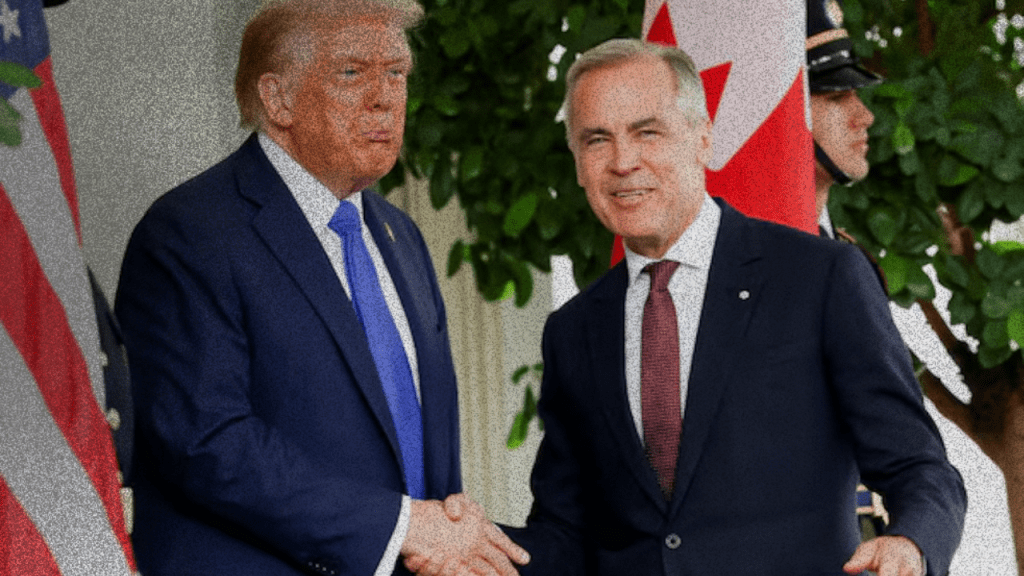
Trump Canada annexation strategy is not erratic foreign policy — it is a spectacle-based power system built to normalize coercion before a single formal act occurs.
The King Charles Story Reveals the Whole Architecture
A new book by a prominent royal commentator, reported by CBC on April 5, 2026, claims that Trump was primarily interested in annexing territory just above the U.S.-Canada border — and that his personal respect for King Charles may have quashed that interest. The claim has been received as a curiosity, a revealing biographical detail about a president whose impulses are treated as the primary unit of political analysis. That framing misses what the story actually demonstrates. If one constitutional monarch’s personal relationship with a sitting president is what stands between Canadian sovereignty and American annexation, then Canadian sovereignty is not resting on international law, democratic norms, or institutional architecture. It is resting on affect. And affect — unlike law, unlike norms, unlike institutions — is not a stable guarantee. It is, however, a perfect illustration of how spectacle-based power works: the threat never needed to be executed. It only needed to be real enough that its absence required an explanation.
The “Governor Carney” Signal Was Never a Joke
Trump called Mark Carney “the future Governor of Canada” in a Truth Social post, then deployed it again — “If Governor Carney thinks he is going to make Canada a ‘Drop Off Port’ for China” — as a policy threat wrapped inside an insult. The degradation is the message. Stripping a sitting prime minister of his title, in public, repeatedly, is not rhetorical sloppiness. It is a rehearsal of the annexation premise in miniature: Canada’s sovereignty is contingent, its leadership provisional, its statehood a formality the U.S. can revoke through language before it revokes it through anything else. The architecture of narrative control does not require tanks. It requires repetition. “Governor Carney” runs on every news cycle, every panel, every opposition response — and each one extends the premise that there is something to debate about whether Canada is a country. There isn’t. But the debate now exists.
The annexation talk itself followed the same structure. Trump raised it before the inauguration and it was received as a tasteless joke by liberal commentators who were wrong about what jokes do politically. He then ruled out military force — but not the goal — substituting “economic force” as the mechanism. Then came the theatrical pivot: when told that King Charles III remains Canada’s head of state, the tone softened. Respect for the monarchy intervened. The threat appeared to dissipate. This is the tell. A genuinely impulsive president does not pause to ask about constitutional monarchy before recalibrating his aggression. The pause is structural. The threat was never about annexation. It was about establishing annexation as a live coordinate in the political field.
Permanent Instability Is Not a Governing Failure — It Is the Governing Logic
The Cold War strategy of tension was covert. Violence was engineered in the background; populations were made afraid of threats they couldn’t name so they would accept stronger state control. That model depended on secrecy because its legitimacy collapsed the moment the mechanism was visible. What is operating now is the opposite. The instability is the product. It is televised, memeable, and performed in public precisely because visibility is an asset, not a liability. The deep material integration of North American supply chains, energy infrastructure, and continental trade architecture gives the U.S. structural leverage it does not need to deploy — the threat of deploying it is enough. But that threat only functions inside a political environment where nothing ever settles, where every resolution is immediately contradicted by the next statement, where the tension never fully collapses into an outcome.
Trump said in one breath that a conflict was nearly resolved and in the next that escalation would continue. This is not confusion. Contradiction is the continuity. It ensures attention remains fixed, that opponents cannot coordinate around a stable target, that the media ecosystem is permanently in reactive mode. The system does not resolve crises. It maintains them because a maintained crisis is a controlled one. Every diplomatic “softening” — the monarchy pause, the walk-back on military force — resets the cycle without ending it. The floor never drops all the way. The ceiling never closes. The space in between is where the strategy lives.
Shock Does Two Things at Once — Both Serve the Same System
Extreme statements are not designed to be internally consistent. They are designed to produce reaction. When Trump says the border was drawn wrong, that Canada could be absorbed, that its leader is a governor — these claims disorient opponents who cannot respond within normal parameters because the statements themselves violate those parameters. You cannot counter-argue a geopolitical premise that has been introduced as a joke and then escalated as policy and then softened through monarchism and then repeated as an insult. There is no stable target. The disorientation is the point. Traditional political actors are trained for coherence and deliberation: develop a position, construct an argument, maintain message discipline. This system makes that training a liability. It forces opponents into viral moments, emotional reactions, and continuous crisis management — all of which amplify the spectacle rather than countering it.
Simultaneously, the same statements consolidate the support base through a countercultural identity logic. Inside the anti-institutional frame, norm violation is authenticity. Breaking diplomatic conventions reads as honesty. Mocking allies reads as strength. Ignoring rules reads as liberation. The more chaotic the behavior appears to institutional actors — the Canadian government, the press gallery, the liberal commentariat — the more genuine it appears to those who experience those institutions as hostile. The feedback loop is self-reinforcing: the system escalates, institutions react with outrage, the outrage confirms the anti-system narrative, the escalation becomes further justified. Resistance and endorsement are not opposites inside this structure. They are both inputs into the same machine. The Panama Canal and China rhetoric ran the identical playbook months earlier — extreme territorial claim, media panic, framing shift, normalized pressure — and the lesson was not learned.
Once Annexation Is Plausible, Economic Coercion Becomes Moderate
This is where the floor drops. The Overton shift produced by shock rhetoric does not require the extreme claim to be executed — it requires the claim to be taken seriously long enough to redefine the range of acceptable alternatives. If annexing Canada is a live coordinate in the political field, then tariffs, economic pressure, diplomatic humiliation, and trade coercion are not aggressive acts. They are restrained ones. They are what happens when the U.S. chooses not to do the thing it suggested it might do. The threat does not need to materialize. It only needs to exist as a possibility long enough for the baseline to shift around it. This is not negotiation in the traditional sense — leverage applied toward a defined outcome. It is negotiation through destabilization: the terms of what is acceptable are rewritten before any formal negotiation begins.
Canada is already inside this dynamic. The sovereignty of a G7 country has become a recurring punchline in the dominant media cycle. The border is being discussed as a suggestion rather than a fact. None of this required a single formal escalation. The productive forces of economic integration — supply chains, energy infrastructure, the continental trade architecture — were always the real mechanism. The spectacle makes them invisible by replacing the material with the symbolic. As long as the discourse is about whether Canada might be annexed, it is not about the structural dependency that makes formal annexation unnecessary.
Debord Named This System in 1967 — the Image of Power Substitutes for Its Exercise
Guy Debord’s The Society of the Spectacle, published in 1967, described a world where social relations are mediated through images and representations that people consume rather than directly experience. The spectacle is not just media coverage of politics. It is the dominant form through which political reality is constituted. What is operating in the Canada annexation cycle is politics fully absorbed into that logic. The annexation becomes a storyline with a premise, a conflict, a twist, and continuity. It has recurring motifs — insults, jokes, symbolic degradation — and it never fully resolves because resolution would end the cycle. The media does not just report this. It circulates it, packages it, extends it. Every reaction, every panel, every opposition statement becomes part of the same narrative loop.
Canada is not annexed. Nothing formally changes. But the perception of dominance circulates as political reality. The image of power substitutes for its exercise. This is Debord’s spectacle operating as a social relation — not a representation of power but power’s actual form. Victory is no longer defined by material outcomes. It is defined by control over interpretation. The King Charles book confirms this precisely: the threat was introduced, theatrically managed through a monarchist pause, and then sustained as a background condition. That sequence does not demonstrate confusion. It demonstrates control over reality itself — the capacity to introduce a premise, manage its reception, and leave it in place without ever having to execute it. King Charles delivering the Speech from the Throne in Ottawa in May 2025 was a dignified and symbolically rich response. It was also, structurally, a concession that the monarchy reference had required a counter-move — which means the spectacle had already set the terms of engagement.
Resistance Inside the Spectacle Reproduces It
This is the trap that closes the argument. Every conventional form of opposition available to Canadian political actors — condemnation, counter-messaging, appeals to international norms, displays of national unity — requires engaging the annexation premise on its own terms. Condemning the remarks confirms they are worth condemning. Rallying national sentiment around sovereignty confirms the sovereignty is in question. Even the King Charles throne speech is a data point: a powerful symbol of Canadian identity deployed precisely because the annexation framing had made such a symbol necessary. The system does not need universal support. It only needs universal attention. Every headline extends the spectacle. Every analysis deepens the narrative. Even this article is a data point in the same cycle — which does not make the analysis wrong, but it does name the constraint.
Meaningful opposition to this system cannot be organized at the level of reaction. It requires naming the material structure the spectacle is designed to obscure: the continental economic integration that makes Canadian sovereignty formally intact and structurally contingent at the same time. The same narrative infrastructure that runs the annexation cycle runs every other pressure point — trade, energy, defence, immigration. As long as Canadian political discourse is organized around managing the spectacle, it is conceding the terrain where the actual power is exercised. The annexation of Canada is not the point. It never was. It is the demonstration — of how quickly attention can be captured, how easily a floor can be dropped, and how effectively a threat can do its work without ever becoming real.
Sources
- CBC — Trump’s respect for King Charles possibly quashed desire to annex Canada, says royal commentator, April 2026
- CBC — Trump’s annexation remarks and “Governor Carney” language
- CBS News — King Charles says Canada faces critical moment in Ottawa speech, May 2025
- Axios — Trump inaugural address on territorial expansion, January 2025
- Guy Debord — The Society of the Spectacle, 1967






 Spark Solidarity