Canada calls homeless encampments a crisis while governments preserve the housing, income and shelter failures that force people outdoors.
On April 1, 2026, Ottawa announced another $125 million for the Unsheltered Homelessness and Encampments Initiative. The federal release described encampments as an “urgent challenge” and promised transitional housing, shelters, outreach and support services. Those resources may keep people alive and help some residents secure housing. But the announcement also reproduced the political frame surrounding homelessness across Canada: the visible encampment is treated as the emergency.
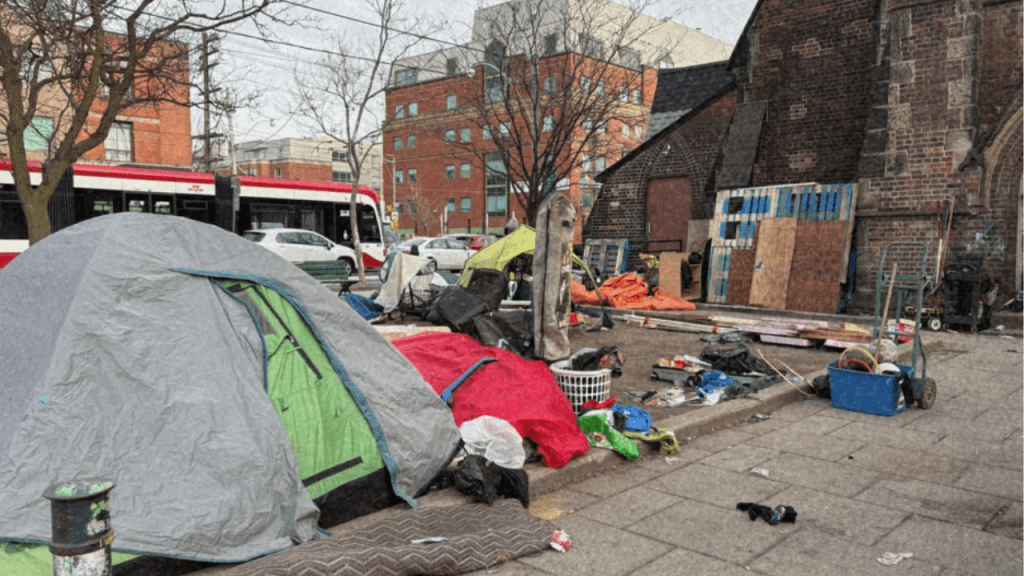
This framing reverses cause and effect. Tents do not produce homelessness. People establish encampments after rents outrun incomes, social housing disappears, shelters fill, institutions discharge people without support and landlords evict tenants who have nowhere else to go. The encampment is evidence of a housing system functioning for property owners and investors while failing people who need homes.
Governments rarely describe that system as a public-order crisis. They reserve the language of urgency for its most visible victims. Municipal briefings count tents, complaints and police calls. Provincial politicians speak about restoring parks and sidewalks. The policy question becomes how quickly authorities can remove people from view, not why governments permitted mass housing insecurity to become permanent.
Canada’s Housing Advocate Named the Crisis
Federal Housing Advocate Marie-Josée Houle reached a different conclusion after a national review of encampments. Her February 2024 report described a two-part human-rights crisis. Encampment residents face immediate danger because governments fail to protect their basic rights. Encampments exist because those same governments have systematically failed to uphold the right to adequate housing.
The report called for an end to forced evictions, access to water and sanitation, respect for Indigenous rights and rapid offers of permanent housing. It rejected the idea that governments can dismantle a community first and locate housing later. Moving people between parks, shelters and street corners does not end homelessness. It redistributes suffering while destroying possessions, relationships and access to services.
Houle’s findings also challenged the premise that encampment residents are obstacles to a solution designed elsewhere. A rights-based response requires governments to involve residents in decisions affecting their lives. The people surviving the crisis understand which shelters are unsafe, which rules separate partners, which services are inaccessible and why an offered placement may be temporary or unusable.
Ontario Chose Enforcement
Ontario moved in the opposite direction. The Safer Municipalities Act, passed in June 2025, created new powers connected to public drug use and strengthened penalties under trespass law. The Ford government presented the legislation as a response to disorder in public spaces. During legislative debate, supporters said municipalities needed tools to dismantle encampments.
The act did not create a right to housing. It did not guarantee an accessible shelter bed, a rent-geared-to-income apartment or permanent supportive housing before enforcement began. It expanded the state’s capacity to direct, arrest, seize and punish people who were already living without secure shelter.
This is how the manufactured crisis operates. Provincial policy leaves disability benefits and social assistance below the cost of rent. Municipalities lack enough deeply affordable housing and shelter beds. The resulting encampments become proof that governments need stronger enforcement powers. A policy-created emergency is converted into a mandate to police the people harmed by that policy.
Funding Without Structural Change
The federal government’s encampment initiative is more humane than Ontario’s punitive approach. It funds outreach, transitional housing, supportive housing and shelter expansion through community response plans. Ottawa initially committed $250 million over two years and extended the initiative with another $125 million in April 2026.
But emergency funding cannot substitute for permanent structural change. Canada’s National Housing Strategy has distributed billions through programs that rely heavily on private developers, loans and market mechanisms. The Federal Housing Advocate has urged Ottawa to prioritize non-market and Indigenous housing providers, acquire existing buildings and attach non-market housing conditions to federal infrastructure money.
The distinction is practical. A shelter bed manages homelessness for a night. Transitional housing may create breathing room. A portable rent supplement helps only when affordable units exist and landlords accept tenants. Permanent public, cooperative and Indigenous-controlled housing removes property from speculative markets and guarantees homes according to need rather than profitability.
Governments announce short-term funds because they can present movement without confronting landlords, developers, landowners or the financial institutions profiting from scarcity. The underlying distribution of housing remains intact. Encampments may shrink in one location while the conditions producing them spread across the country.
Who Is Forced Outdoors
Encampment populations reflect the violence embedded in Canadian institutions. Indigenous people are dramatically overrepresented because dispossession did not end with the seizure of land. Child-welfare removals, residential-school trauma, discriminatory policing, inadequate on-reserve housing and jurisdictional abandonment continue to push Indigenous people into homelessness.
Disabled people face benefits that do not cover market rent and housing stock that does not meet accessibility needs. People leaving prisons, hospitals, treatment programs and foster care are frequently discharged without stable homes. Women, queer and trans people may avoid shelters where they face harassment, violence or rules that separate them from partners and support networks.
Encampments can provide collective protection, information and mutual aid that isolated street homelessness cannot. Residents share food, naloxone, warmth, transportation and knowledge about services. Sweeps destroy those survival systems. Authorities then cite the injuries caused by displacement as further evidence that residents cannot manage their own lives.
Clearance Does Not Create Housing
A tent disappearing from a park is easy to photograph. The person displaced from it is harder to track. Municipal governments can report that an encampment has been “resolved” even when residents have moved to another outdoor location, entered an overcrowded shelter temporarily or disappeared from official contact.
This administrative disappearance is treated as success because the objective is often control of public space rather than an end to homelessness. Business districts, property owners and housed residents regain the appearance of order. Police and bylaw departments demonstrate activity. Political leaders claim responsiveness. The person without housing remains without housing.
Forced removal can make securing a home more difficult. People lose identification, medication, phones, tents and documents needed for applications. They are separated from outreach workers and neighbours who know how to locate them. Fines and charges create new barriers. Enforcement consumes public money while deepening the instability it claims to solve.
The Housing Crisis Requires Housing
An honest government response would stop measuring success by the number of tents removed. It would measure permanent housing placements, rent reductions, evictions prevented, accessible units created and homes transferred out of speculative markets. It would guarantee that nobody is displaced without an adequate permanent alternative they can actually use.
That requires large-scale public and cooperative construction, Indigenous-controlled housing, stronger tenant protections, rent controls with real enforcement and incomes high enough to live on. It also requires immediate services chosen with encampment residents, not imposed through police operations.
Canada’s encampments are not an invasion of public space by people who refuse order. They are the visible result of an economic order that protects property values more reliably than human life. Governments manufacture the encampment crisis when they conceal that cause, criminalize its victims and call the disappearance of a tent a housing policy.
Sources
- Federal Government Strengthens Homelessness Support — Government of Canada — April 1, 2026. Announcement extending the Unsheltered Homelessness and Encampments Initiative by $125 million.
- Progress on the National Housing Strategy — Housing, Infrastructure and Communities Canada — December 31, 2025. Federal program and expenditure summary.
- Bill 6, Safer Municipalities Act — Legislative Assembly of Ontario — 2025. Statutory provisions expanding public-drug and trespass enforcement.
- Federal Housing Advocate’s Annual Report — Canadian Human Rights Commission — June 12, 2025. Follow-up on the encampments review and federal response.
- Upholding Dignity and Human Rights — Canadian Human Rights Commission — February 13, 2024. Final review of homeless encampments and recommendations to governments.
- Final Encampments Review — Federal Housing Advocate — February 2024. Full national report establishing the two-fold human-rights crisis.