From Murray-Hill to the convoy, disorder and state abuse repeatedly became the raw material for new Canadian security powers.
On March 17, 2026, the federal government asked the Supreme Court of Canada to review a ruling that its first-ever use of the Emergencies Act had been unreasonable and beyond Cabinet’s legal authority.
The request extended a conflict that began in downtown Ottawa four years earlier. Police allowed trucks to establish an occupation around Parliament. Governments argued over jurisdiction while residents endured weeks of noise, harassment and blocked streets. Cabinet then reached for federal emergency powers that had never been used before.
Nothing in the record proves that police deliberately created the crisis to expand state power. The pattern is institutional rather than conspiratorial. A policing failure produces disorder. Disorder widens the political space for exceptional measures. Abuse generates an inquiry or court case. The review constrains some practices while leaving a larger security apparatus in place.
A Police Strike Turned a Labour Conflict Into Military Deployment
Montreal police and firefighters walked off the job on October 7, 1969. The police wanted higher wages and gathered at the Paul Sauvé Arena for what they called a study session. Police stations emptied while the provincial government assembled Sûreté du Québec officers and prepared back-to-work legislation.
That evening, taxi drivers demonstrated against the Murray-Hill limousine company’s monopoly over service to Dorval Airport. The dispute joined labour conditions to the economic and national structure of Montreal: a largely francophone taxi workforce confronted a politically connected anglophone company controlling a valuable public concession.
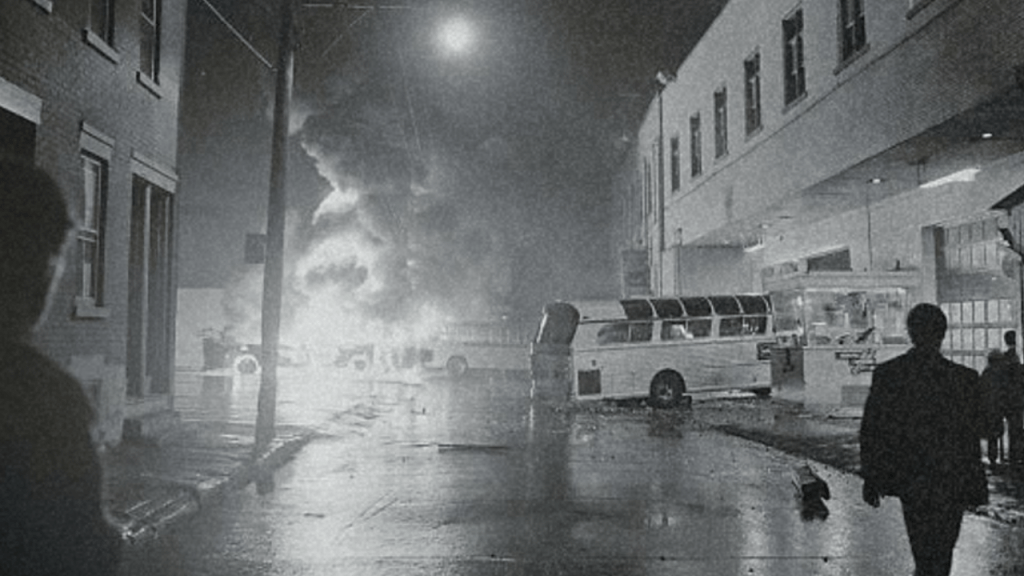
The convoy drew bikers, Quebec nationalists and FLQ members. At the Murray-Hill garage, rocks, firebombs and gunfire followed. Sûreté officer Robert Dumas was killed. Elsewhere, stores were looted and banks robbed during roughly 16 hours without the city’s regular police force.
Quebec ordered the police back to work and requested military assistance. Soldiers from the Royal 22nd Regiment entered Montreal under the federal aid-to-civil-power framework.
Murray-Hill was not a rehearsal secretly organized by the state. It demonstrated how quickly a municipal labour dispute could be converted into a public-order emergency and military deployment. The absence of ordinary policing did not reduce coercive power. It moved coercion upward.
The October Crisis Expanded the Target Beyond the FLQ
One year later, FLQ cells kidnapped British trade commissioner James Cross and Quebec labour minister Pierre Laporte. The federal government invoked the War Measures Act on October 16, 1970, after requests from Quebec’s government and Montreal officials. Laporte was found dead the following day. Cross was released in December.
The kidnappings were specific criminal acts carried out by small clandestine cells. The state’s response was much broader. The War Measures regulations outlawed the FLQ, authorized detention without ordinary criminal-law protections and gave police an enlarged field of suspects.
Police arrested hundreds of people, including trade unionists, writers, artists, lawyers and activists with no role in the kidnappings. Most were released without charge. The operation treated a much wider current of Quebec nationalism and left politics as the social environment from which a security threat might emerge.
The FLQ’s politics cannot be understood only through the Canadian state’s later terrorism label. Its manifesto attacked anglophone corporate power, named exploited workers and placed Quebec independence inside a class struggle. Its methods also separated clandestine militants from the mass organizations capable of contesting power openly. The state used the violence of a few cells to police a constituency much larger than the cells themselves.
The RCMP Treated Illegality as Intelligence Work
The October Crisis intensified criticism of the RCMP Security Service. Its answer to intelligence failure was not restraint. During the 1970s, the service conducted break-ins, intercepted mail, stole political membership lists and carried out disruptive operations against organizations it considered subversive.
In 1972, RCMP officers burned a barn used for a meeting between members of the FLQ and the Black Panthers. The operation was intended to prevent the meeting, not investigate a completed offence. Other units stole a Parti Québécois membership list and entered offices without legal authority.
These acts were not isolated misconduct by officers who misunderstood the rules. The McDonald Commission documented an intelligence service whose mandate, secrecy and political direction had allowed illegality to become operational practice.
The commission rejected the idea that national security placed the RCMP outside the law. It recommended removing security intelligence from a police force and assigning it to a separate civilian agency governed by statute.
CSIS Was Reform and Institutional Expansion at Once
Parliament created the Canadian Security Intelligence Service in 1984. The CSIS Act defined threats to the security of Canada, established warrant procedures and created the Security Intelligence Review Committee to examine the new agency’s activities.
That was not merely cosmetic. Moving intelligence out of the RCMP separated investigation from arrest, placed the service under a public statute and created specialized review. Those constraints reflected the exposure of real abuse.
The reform also secured security intelligence as a permanent, specialized function of the federal state. A scandal that discredited the RCMP Security Service did not shrink the field of national-security activity. It produced a new institution dedicated to it.
Later governments expanded that institution’s reach. CSIS moved beyond collecting and reporting intelligence when Parliament granted it threat-reduction powers in 2015. Review structures changed again in 2019, when the National Security and Intelligence Review Agency replaced SIRC and took on a broader government-wide mandate.
The history is more complicated than an inquiry simply laundering abuse. Review imposed legal limits and made parts of the apparatus visible. It also helped reconstruct public legitimacy around a security function the state had no intention of abandoning.
Ottawa’s Police Failure Created the Space for Emergency Power
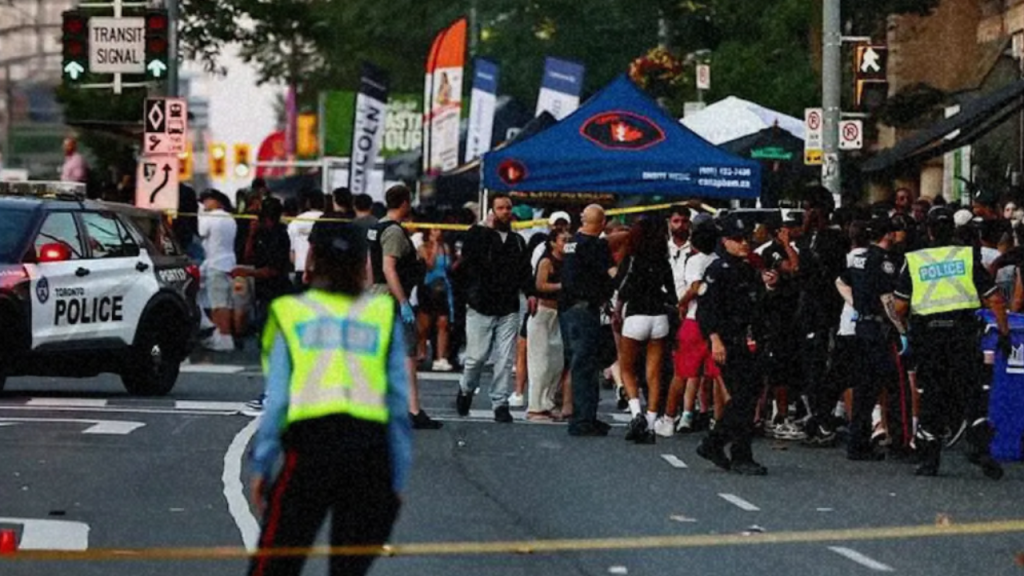
The convoy arrived in Ottawa on January 28, 2022. Police permitted large vehicles to occupy streets around Parliament and expected protesters to leave after the first weekend. Instead, organizers built supply lines, fuel distribution and an encampment at 200 Coventry Road while the downtown occupation hardened.
The Public Order Emergency Commission later documented fractured command, inadequate planning and conflict between the Ottawa Police Service, Ontario Provincial Police, RCMP and different levels of government. Police possessed ordinary authorities to enforce traffic laws, seek injunctions and make arrests, but lacked an executable plan and integrated command.
Other blockades intensified the pressure. Protesters obstructed border crossings, including the Ambassador Bridge in Windsor, disrupting trade. Police cleared that bridge before the federal emergency declaration took effect. At Coutts, arrests connected to a weapons investigation preceded the blockade’s end.
Cabinet invoked the Emergencies Act on February 14. Regulations restricted assemblies in designated areas and authorized measures against property supporting prohibited activity. The economic order required financial institutions to identify and freeze assets linked to participants without first obtaining individual court orders.
Police cleared the Ottawa occupation over the following days. Cabinet revoked the emergency on February 23. The temporary measures ended, but the invocation established a practical precedent: federal emergency law could be applied to a disruptive political occupation after ordinary policing had failed.
Rouleau and the Courts Produced Opposite Answers
The Emergencies Act automatically required a public inquiry. Commissioner Paul Rouleau concluded in February 2023 that Cabinet had reasonable grounds to believe the statutory threshold was met. He called the conclusion close and acknowledged that reasonable people could reach a different view.
The Federal Court reached that different view in January 2024. Justice Richard Mosley ruled that no national emergency justified the declaration, that the decision was unreasonable and that parts of the regulations and economic order infringed freedom of expression and protection against unreasonable search and seizure.
On January 16, 2026, the Federal Court of Appeal unanimously dismissed the government’s appeal. It upheld the finding that Cabinet lacked reasonable grounds to believe a national emergency existed and that the declaration was outside the authority Parliament had granted.
The contradiction prevents an easy claim that every review body exists to ratify state action. Rouleau accepted the invocation after reconstructing the crisis through an inquiry. Two courts rejected it under judicial review. Each process operated under a different mandate and legal test.
The courts constrained the precedent, but only after the emergency powers had been used, the occupation cleared and financial information disclosed. Review can define the limits of future action. It cannot reverse the demonstration that such powers are administratively available.
The Apparatus Learns From Every Crisis
The line from Murray-Hill to CSIS and the convoy is not a single plan moving across five decades. It is a recurring institutional response. Authorities fail to manage conflict through existing arrangements. Exceptional measures become politically imaginable. Exposure of abuse produces new rules, review bodies and agencies. The security state emerges altered but rarely smaller.
Some reforms impose real limits. The McDonald Commission forced intelligence work into a statutory structure. The 2026 appeal ruling narrowed Cabinet’s interpretation of the Emergencies Act. Those gains came from treating state claims as claims requiring evidence, not as facts supplied by the language of national security.
The federal government’s March 17 request for Supreme Court review showed why that scrutiny remains necessary. Even after two courts rejected the invocation, the state continued seeking a wider understanding of its emergency authority. Institutions remember the powers they have exercised.
Sources
- “Murray-Hill Riot” — The Canadian Encyclopedia
- “The October Crisis: Liberty Repressed” — Canadian Museum of History
- “Commission of Inquiry Concerning Certain Activities of the RCMP” — Library and Archives Canada
- “Canadian Security Intelligence Service Act” — Justice Laws Website
- “Emergencies Act” — Justice Laws Website
- “Report of the Public Inquiry into the 2022 Public Order Emergency” — Public Order Emergency Commission
- “Canadian Frontline Nurses et al. v. Attorney General of Canada, 2024 FC 42” — Federal Court
- “Canada (Attorney General) v. Canadian Civil Liberties Association, 2026 FCA 6” — Federal Court of Appeal
- “Feds appealing Emergencies Act ruling at Supreme Court” — CityNews, March 17, 2026