
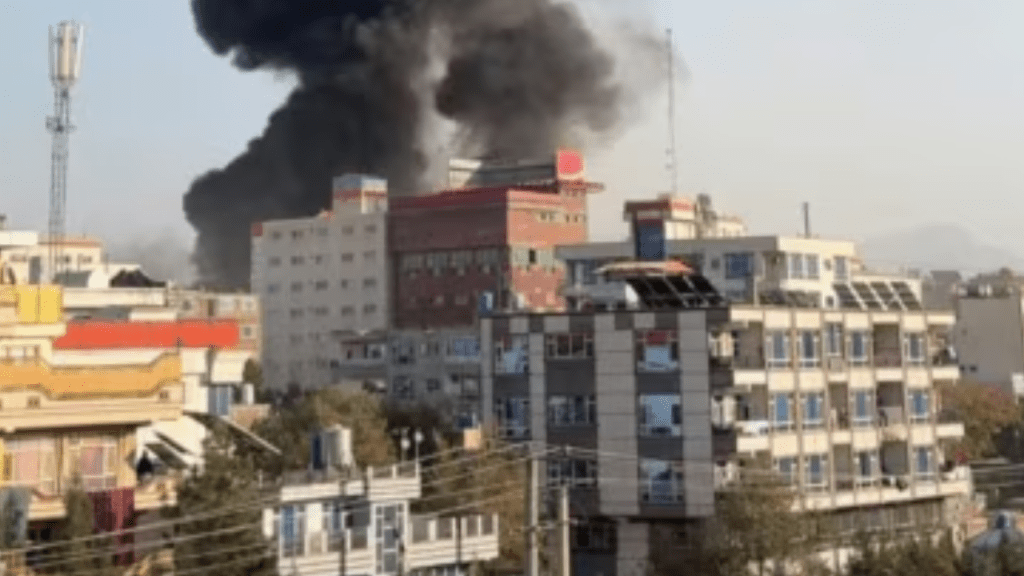
Pakistan Afghanistan airstrike Kabul — on 16 March 2026, a building was destroyed. What followed was two wars: one kinetic, one over the numbers.
A Hospital Was Destroyed. The Dispute Begins There.
The Omid Addiction Treatment Hospital in Kabul no longer exists. That is the one fixed point in an event that both states have since pulled in opposite directions. Pakistani airstrikes hit the compound on 16 March 2026. The building came down. People inside it died. That physical reality — concrete, bodies, rubble — is where the analysis has to begin, before either government is allowed to speak, because everything that followed was constructed on top of it.
Pakistan’s military framed the compound as a militant installation. Its Ministry of Information stated publicly that the strikes “precisely targeted military installations and terrorist support infrastructure.” Pakistan’s information minister added that secondary detonations after the strikes “clearly indicate the presence of large ammunition depots.” Afghanistan said Pakistan bombed a drug treatment centre full of patients who had just broken the Ramadan fast. The Norwegian Refugee Council, whose staff visited the site the following morning, reported finding hundreds of civilians dead and injured. Both accounts reference the same building. Neither account is neutral. The building is the last thing both sides agree on.
The Strike Is the TTP Accusation Made Kinetic
Pakistan’s justification for the strike did not originate on 16 March. It has been building for years. Islamabad has consistently accused Kabul of tolerating — or actively sheltering — Tehrik-e-Taliban Pakistan militants who cross the border and carry out attacks inside Pakistan. The TTP is organizationally distinct from the Afghan Taliban but ideologically allied, and Pakistan has watched its domestic casualty figures from TTP attacks climb steadily since the Afghan Taliban’s return to power in 2021. In February 2026 alone, the UN documented at least 76 civilian deaths from Pakistani airstrikes across Afghanistan — a conflict already in escalation before the hospital strike. Kabul has rejected the TTP accusation throughout. The diplomatic channel has produced nothing.
The airstrike is what happens when a state runs out of patience with a grievance it cannot resolve through negotiation. It is not a departure from the TTP accusation — it is the accusation expressed through ordnance. Pakistan selected a target it characterized as militant infrastructure and struck it, transforming a years-long diplomatic deadlock into a unilateral enforcement action. Understanding the strike as impulsive or disproportionate misses the structure. It was the logical terminus of a posture Pakistan had been building toward since 2021 — and the accumulated weight of every TTP attack Pakistan could not stop through Kabul’s cooperation is the origin of this conflict, not the hospital.
400 vs. 143 vs. Zero: The Information Battlefield Opens
Afghan authorities put the death toll at 408 killed and 265 wounded — the highest single-incident figure in the conflict since fighting began. The United Nations Assistance Mission in Afghanistan confirmed at least 143 dead and 119 wounded with an ongoing investigation. Pakistan rejected any responsibility for civilian deaths entirely. Three numbers. One event. The gap between them is not a measurement problem. It is the information battlefield, and every actor in this conflict needs a specific figure to justify its next move.
Pakistan needs a number low enough — or ideally zero — to survive international scrutiny and preserve the counterterrorism framing it has invested years constructing. A civilian death toll of 400 is catastrophic in any international forum; it transforms a counterterrorism operation into a massacre and strips Pakistan of the moral language it has been using to legitimize the campaign. Afghanistan needs 400 — or higher — because that figure mobilizes international condemnation, frames Kabul as the aggrieved party, and pressures third-party states and institutions to take a position. The UNAMA figure at 143 sits between them: credible enough to anchor the international conversation without fully validating either claim. Both sides are managing the numbers the way states manage every instrument of conflict — as force multipliers in a war being fought simultaneously on the ground and in the information space.
The Ceasefire Is Also a Weapon
Pakistan and Afghanistan announced a temporary pause in hostilities timed to Eid al-Fitr, brokered at the request of Saudi Arabia, Qatar, and Turkey. It was framed as de-escalation — a gesture of restraint, an opening for diplomacy. It is none of those things in any structural sense. The casualty dispute over the Kabul hospital strike remains completely unresolved. Pakistan has not acknowledged civilian deaths. Afghanistan has not withdrawn its account. The UN investigation is ongoing. The ceasefire is a surface — it covers the wound without closing it.
The Eid timing is itself a calculation. Both states get to signal restraint to domestic and international audiences without conceding anything on the substantive questions: who died in Kabul, what the building actually was, and whether Pakistan’s strike was a legitimate counterterrorism action or a war crime. Analysts observing the pause noted it does not appear likely to produce a lasting ceasefire — because the conditions that generated the escalation have not changed. The TTP accusation stands. The casualty figures remain disputed. The narrative war continues beneath the surface of the truce. A ceasefire that does not touch the information battlefield is not de-escalation. It is a tactical repositioning that leaves both states exactly where they were — each holding a number, each building a case, each preparing for the moment the pause ends.
The Numbers Outlast the Pause
Modern conflict operates on two battlefields simultaneously. The physical one — where airstrikes happen, where hospitals collapse, where people die — is bounded by time. Ceasefires can interrupt it. The informational one is not. The dispute over what happened on 16 March in Kabul will persist long after any truce holds or collapses, because both states need their version of events to be the operative reality for everything that follows. If Pakistan’s framing prevails — militant compound, legitimate strike, minimal civilian harm — then the next enforcement action is pre-justified. If Afghanistan’s framing prevails — civilian massacre, sovereign violation, 400 dead — then international pressure accumulates in ways that constrain Pakistan’s operational freedom and potentially compel third-party intervention.
This is why the body count is not an afterthought to the conflict. It is one of its primary weapons. The gap between 400 and 143 and zero is not an epistemological accident produced by the fog of war. Both states released sharply different casualty figures throughout the conflict — Pakistan claiming 684 Afghan Taliban forces killed, Afghanistan saying Pakistan has lost over 100 soldiers, neither figure independently verified — and each side weaponized those figures to shape domestic opinion, influence international response, and position itself for future military and diplomatic action. The ceasefire pauses the bombs. It does not pause that. When the Eid window closes, the same structural conditions — the TTP grievance unresolved, the hospital strike unaccounted for, the narratives unreconciled — will reassert themselves. The information battlefield has no ceasefire. It never did.
Sources
- Wikipedia — 2026 Kabul hospital airstrike
- Wikipedia — 2026 Afghanistan–Pakistan conflict
- Al Jazeera — Afghanistan accuses Pakistan of killing 400 in attack on Kabul hospital, March 2026
- CNN — Afghanistan says Pakistan hit Kabul rehab center killing 408, March 2026
- NPR — Afghanistan says 400 people killed in Pakistan strike on Kabul hospital, March 2026
- Al Jazeera — Pakistan and Afghanistan agree to temporary Eid al-Fitr pause in conflict, March 2026
- Time — Pakistan and Afghanistan Announce Pause in Fighting Over Eid, March 2026




 Spark Solidarity