
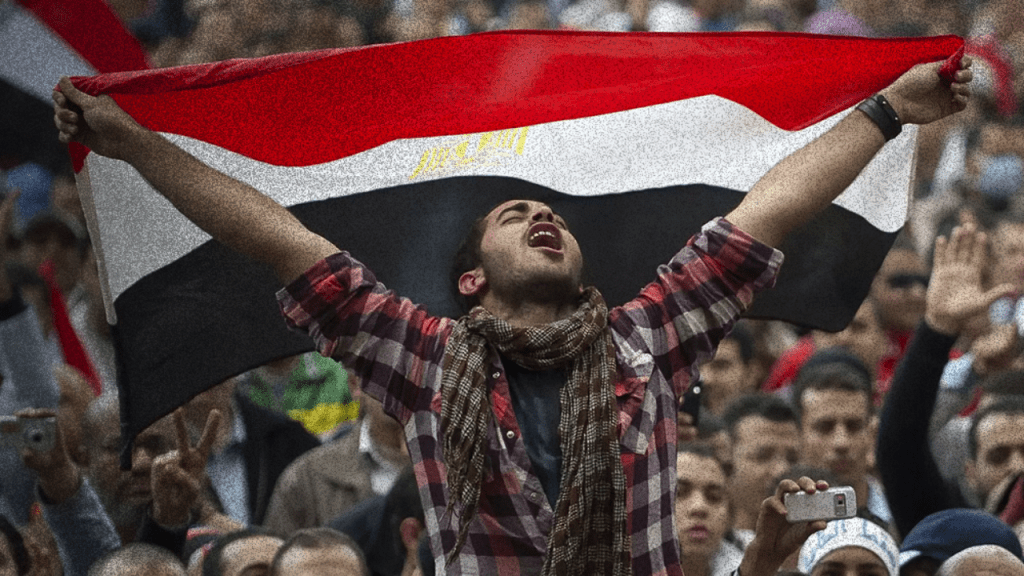
The Arab Spring failed because leaderless uprisings cannot fill the vacuums they create — and something always does.
What the Arab Spring Actually Was
Between December 2010 and the end of 2011, popular uprisings forced out the heads of state of Tunisia, Egypt, Libya, and Yemen. Protest movements of varying intensity shook Bahrain, Syria, Jordan, Morocco, and beyond. The speed and scale were genuinely unprecedented in the modern Arab world. Western media framed it as a democracy wave — spontaneous, social-media-powered, universally legible as a demand for liberal governance. That framing was wrong, and its wrongness determined what came next.
The uprisings were driven by concrete material conditions: decades of autocratic governance backed by Western governments, youth unemployment rates across the Arab world running at 25–30%, food price spikes driven by global commodity speculation, police brutality as routine policy, and the structural humiliation of populations whose economic futures had been foreclosed by the neoliberal restructuring their governments had implemented at IMF direction. These were not abstract demands for procedural democracy. They were rebellions against specific material conditions produced by specific political arrangements.
What they mostly lacked — with one partial and instructive exception — was the organizational infrastructure to define what came next. As Vincent Bevins documents in If We Burn, horizontally organized, leaderless uprisings are effective at creating political vacuums. They are almost structurally incapable of filling them. The Arab Spring is the sharpest demonstration of that principle in recent history.
Tunisia: Where Organization Made the Difference
The Tunisian revolution began with Mohamed Bouazizi’s self-immolation in Sidi Bouzid on December 17, 2010 — a street vendor who set himself on fire after police confiscated his produce cart and beat him when he tried to file a complaint. His act ignited protests that spread from the interior regions to the capital within weeks. On January 14, 2011, after a general strike paralyzed the country, President Zine el-Abidine Ben Ali — who had ruled for 23 years with consistent Western backing — fled to Saudi Arabia.
What distinguished Tunisia from every other Arab Spring country was the UGTT — the Tunisian General Labour Union, founded in 1946, with 750,000 members across factory workers, civil servants, teachers, lawyers, and the unemployed. The UGTT was not a bystander to the revolution. It authorized regional unions to call strikes, offered its offices as organizing spaces and refuges from state violence, and helped transform protests from economic grievances into an explicit political demand for Ben Ali’s removal. When Ben Ali fled, the UGTT did not declare victory and dissolve. It kept pushing.
When political assassinations in 2013 threatened to push Tunisia into civil war, the UGTT formed the National Dialogue Quartet with three other civil society organizations — a negotiating body that produced the 2014 democratic constitution and held the transition together. Scholar Joel Beinin described the UGTT as “the single most important reason that Tunisia is a democracy today.” The Quartet won the Nobel Peace Prize in 2015.
Tunisia’s democratic gains were real, and they eroded. President Kais Saied dissolved parliament and suspended the constitution in 2021, rolling back what the UGTT had helped build. That erosion is not incidental — it reflects what happens when organizational capacity is insufficient to defend gains against institutional counterattack. But the gains existed in the first place precisely because organized labor provided structure that no other Arab Spring country had. Tunisia proves the rule by being the exception.
Egypt: The Military Waited
In Egypt, 2 million people filled Tahrir Square. After 18 days of mass protest, Hosni Mubarak — who had ruled since 1981 with $1.3 billion in annual US military aid — stepped down on February 11, 2011. The Supreme Council of the Armed Forces, SCAF, assumed control.
The SCAF’s posture toward the protests during those 18 days is essential to understand. The military did not actively defend Mubarak. It waited. As analysts of the Egyptian military have documented, the generals stood aside and calculated their interests — only announcing support for “the legitimate demands of the people” once it became clear that Mubarak was finished. The Egyptian military is a deeply embedded economic and political institution with six decades of continuous power since 1952. It had no intention of surrendering that power because crowds occupied a public square.
Under SCAF rule from February 2011 to June 2012, more civilians were tried before military courts than in the entire thirty years of Mubarak’s rule. Protesters who returned to Tahrir Square in March 2011 were beaten and arrested. The SCAF simultaneously managed the political transition — setting election timetables, issuing constitutional declarations, manipulating the institutional landscape. When Mohamed Morsi won the presidential election in June 2012 as the Muslim Brotherhood candidate, the military had already positioned itself to limit his authority: a constitutional declaration issued the day before the final election results stripped the presidency of significant powers.
Morsi’s government was unstable, authoritarian in its own right, and politically isolated. When mass protests returned on the first anniversary of his inauguration in June 2013, the military issued an ultimatum. On July 3, 2013, General Abdel Fattah el-Sisi removed Morsi in a coup. What followed was the worst state massacre in Egypt’s modern history: at least 904 people killed when security forces dispersed the Rabaa sit-in on August 14, 2013 — a single day deadlier than anything under Mubarak. The activists who had filled Tahrir Square in 2011 watched as their movement was used twice: first to remove Mubarak, then to provide the pretext for a coup against his elected successor.
The Egyptian uprising had no UGTT. It had no organizational structure capable of negotiating a transition, defining demands beyond Mubarak’s removal, or filling the political vacuum that removal created. The military had all of those capacities. There was no political vacuum in Egypt. The protesters just couldn’t see who was already standing in it.
Libya: When the West Fills the Vacuum
Libya follows a different logic. The 2011 uprising against Muammar Gaddafi’s 42-year rule was never purely a protest movement — it escalated into armed conflict within weeks. What transformed it from a civil war into a regime-change operation was NATO.
UN Security Council Resolution 1973, passed on March 17, 2011, authorized member states to use “all necessary measures” to protect Libyan civilians and established a no-fly zone. Within days, a NATO-led coalition began military operations. The stated humanitarian mandate — protection of civilians — was abandoned almost immediately. NATO attacked Libyan government forces indiscriminately, including units in retreat, assisted rebel forces in offensive operations, provided weapons, training, and hundreds of covert troops from Qatar, and continued military operations even when the government offered ceasefire. A Harvard Kennedy School analysis concluded that NATO’s intervention prolonged the conflict by roughly six months and increased the death toll at least sevenfold compared to what the war’s trajectory suggested before intervention began.
The UK parliament’s own Foreign Affairs Committee investigated in 2016 and concluded that the government “failed to identify that the threat to civilians was overstated” and that the intervention was founded on incomplete intelligence and erroneous assumptions. NATO’s primary aim, the evidence indicates, was regime change — not civilian protection. Gaddafi was captured and summarily executed by rebel fighters on October 20, 2011, after NATO airstrikes destroyed his escape convoy.
What NATO did not do was plan for the day after. Libya’s post-Gaddafi transition produced a government with no state capacity, hundreds of armed militias refusing disarmament, and a security vacuum that external powers — particularly Gulf states and Egypt — filled with competing proxy support for rival factions. By 2014, Libya was in a second civil war. The conflict lasted until a ceasefire in 2020, leaving Libya rated as the most-worsened country in the Fragile State Index for the entire decade. Libya is the clearest case of what happens when an uprising’s vacuum is filled not by a domestic counterrevolutionary institution like the Egyptian military, but by external imperial intervention with no post-conflict obligation.
Yemen and Syria: Managed Collapse
Yemen and Syria represent the furthest extreme of the vacuum problem — countries where the absence of organizational coherence in the protest movements, combined with foreign intervention, produced not regime change but state destruction.
In Yemen, protests against President Ali Abdullah Saleh in 2011 eventually produced his resignation, but no organized political force capable of governing replaced him. The resulting power vacuum drew in the Houthi movement from the north, Saudi-UAE military intervention from the outside, and US drone strikes throughout. The humanitarian catastrophe that followed — widely described as the world’s worst — was not the product of the protest movement’s demands. It was the product of what filled the space those demands created.
In Syria, Bashar al-Assad’s government responded to protests with immediate armed repression, and the uprising became a multi-sided armed conflict within months. What distinguished Syria was the scale and directness of external intervention: the US, UK, France, Turkey, Saudi Arabia, and Qatar all funded, armed, and trained opposition factions. The resulting conflict — which has killed hundreds of thousands and displaced millions — was not an organic escalation of a protest movement. It was the internationalization of an internal political crisis by states with their own strategic interests in Assad’s removal. The Syrian state’s survival, backed by Russian and Iranian support, ultimately reflected the balance of external interests rather than the balance of domestic political forces.
The Lesson the Arab Spring Actually Teaches
The standard Western account of the Arab Spring’s failure attributes it to cultural factors — Islamic politics, tribal divisions, authoritarian traditions — that made Arab societies unsuited for democratic governance. This is an ideological account that serves to naturalize Western intervention and deflect structural analysis. It does not survive contact with the actual history.
The structural account is simpler and better supported: popular uprisings that create political vacuums require organized political forces to fill them with the demands that drove the uprising in the first place. When those forces don’t exist domestically, something else fills the vacuum — the military, the existing political elite, armed factions backed by foreign powers, or direct imperial intervention. This is not a contingent observation about one region. It is the consistent pattern across every country in the Arab Spring, and across the broader mass protest decade that Bevins documents.
Tunisia’s partial exception — the country where organized labor’s pre-existing institutional capacity made a difference — confirms rather than contradicts the rule. The UGTT was not a spontaneous product of the uprising. It was founded in 1946, rooted in the anti-colonial struggle, and had spent decades building the organizational infrastructure that made it capable of acting in a revolutionary moment. Tunisia got a democratic transition, however fragile and ultimately reversed, because the UGTT existed before the revolution began. Egypt, Libya, Yemen, and Syria had no equivalent. What they had was legitimacy in the streets and no capacity to hold what the streets had won.
The lesson is not that protest doesn’t matter. It is that protest alone — leaderless, horizontally organized, structureless by design — cannot substitute for the organizational work that has to happen before the streets fill. As Bevins documents through the activists who were there: movements that cannot speak for themselves will be spoken for. The Arab Spring was spoken for by armies, by NATO, by Gulf monarchies, by the IMF, and by the same Western governments that had backed the autocrats the protests were trying to remove. Popular rage without organizational infrastructure is fuel without an engine. It burns, and then something else drives.
For the full structural argument on leaderless protest and the missing revolution, read If We Burn Explains Why the Mass Protest Decade Failed.
Sources
- Spark Solidarity. “If We Burn Explains Why the Mass Protest Decade Failed.” sparksolidarity.ca
- The Square Centre. “The Power of Labor: Tunisia’s Trade Union and the Arab Spring.” August 1, 2024. thesquarecentre.org
- Wikipedia. “Tunisian General Labour Union.” wikipedia.org
- Yale Journal of International Affairs. “The Egyptian Army and the Status Quo After the Current Revolution.” yalejournal.org
- Arab Center Washington DC. “Ten Years Later: Reflections on Egypt’s 2011 Uprising.” arabcenterdc.org
- Belfer Center, Harvard Kennedy School. “Lessons from Libya: How Not to Intervene.” belfercenter.org
- Wikipedia. “2011 Military Intervention in Libya.” wikipedia.org
- Fund for Peace. “Libya State Fragility: 10 Years After Intervention.” November 2, 2021. fundforpeace.org

 Spark Solidarity