
China’s strongest soft power is ordinary life contradicting Western propaganda. Managed influencer testimonials only weaken the evidence.
A Foreigner Was Asked to Validate Marxism
On March 3, China Daily published part of a video series called “Shining Wisdom.” Its central figure was Austin Hunter, presented as a young American who had travelled more than 12,000 kilometres through China. He described Marxism as a living science and said that in China “freedom is being made real.”
The message was designed to reverse the usual direction of ideological judgment. China is routinely placed on trial by Western politicians, journalists and tourists. Here, an American looked at Chinese development, compared it with his own country and delivered a favourable verdict. The foreign observer became evidence that socialism could be seen working rather than merely defended in theory.
There is a real political argument underneath the production. Chinese cities, trains, public spaces and poverty-reduction programs contradict the picture of an inert totalitarian society reproduced across Western media. But placing a foreign admirer at the centre of the case also reveals a weakness in official communication. China’s accomplishments are made to appear more credible because an American recognizes them.
IShowSpeed Made the Stronger Case by Accident
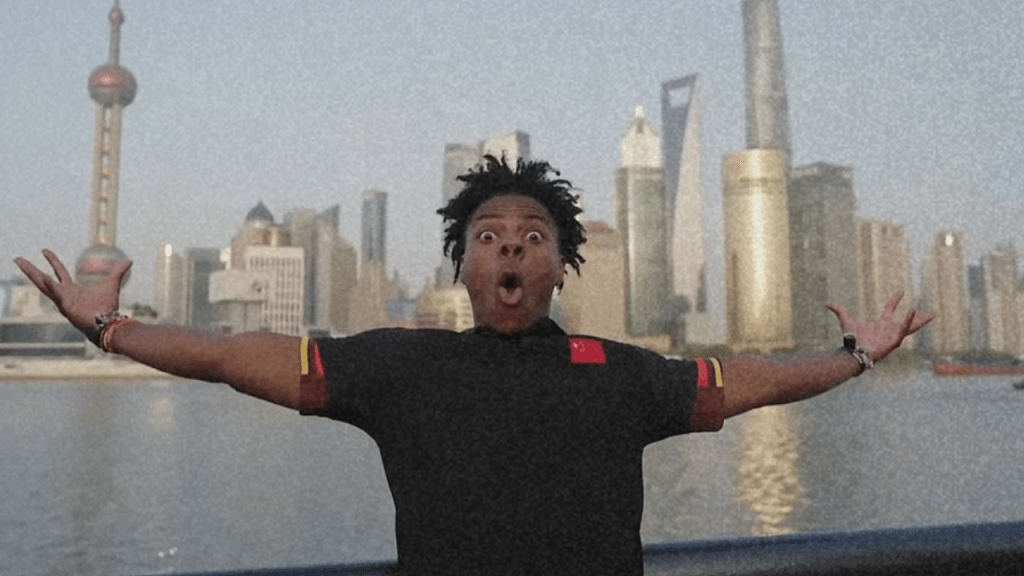
IShowSpeed’s 2025 tour demonstrated why unscripted exposure can be more persuasive than an ideological testimonial. Darren Watkins Jr. spent roughly two weeks livestreaming across China to an audience of tens of millions. He rode high-speed trains, encountered robotics and delivery technology, visited major cities, tried local food and interacted with people who had not been introduced to his viewers as political representatives.
His streams were not a seminar on scientific socialism. That was their political strength. Viewers watched an excitable American encounter infrastructure and urban life that many had been taught to associate with poverty, repression or backwardness. The contradiction appeared through experience before anyone supplied a theory for it.
The Lowy Institute called the trip a soft-power win because its largely unscripted character showed a China normally absent from Western coverage. Chinese state media understood the value immediately. CCTV, Xinhua, China Daily and the Global Times amplified the tour as evidence of an “unfiltered China.” The state did not create the credibility, however. It recognized credibility generated elsewhere and tried to attach itself to it.
Western Surprise Is Politically Manufactured
The repeated influencer headline “I didn’t expect China to be like this” should raise an obvious question: who produced the expectation? China did not hide its high-speed rail network, dense cities or technological development. Western audiences were trained to treat those material accomplishments as secondary to an abstract story in which China exists primarily as an authoritarian threat.
News coverage can acknowledge an engineering project while preventing it from altering the larger ideological frame. A railway becomes evidence of central control. Public safety becomes surveillance. Industrial planning becomes unfair competition. Poverty reduction becomes a disputed statistic. Every outcome is translated back into the premise that produced the original hostility.
Travel content disrupts that translation by filling the screen with ordinary contradictions. The visitor leaves an American city where transit is slow, housing is unaffordable and public infrastructure is decaying, then enters a society described as economically dysfunctional and finds trains arriving at 350 kilometres per hour. The political question emerges from comparison, not instruction.
Hasan Piker Triggered the Propaganda Reflex
Hasan Piker’s first trip to China in late 2025 produced a more explicitly political version of the same conflict. He livestreamed his travels, praised development and high-speed rail, and later argued that Americans are taught to see China as a closed and hostile society. He told the South China Morning Post that China had generated real prosperity for its citizens.
The response quickly collapsed into a familiar binary. Either Piker had exposed Western misinformation or he had become an instrument of Beijing. Positive observation itself was treated as evidence of capture. The label “propaganda” allowed critics to avoid evaluating what viewers could see: the infrastructure existed regardless of who arranged an interview or reposted a clip.
Chinese state media also made the accusation easier. Piker sat for a lengthy CGTN interview discussing poverty alleviation and Western misrepresentation. None of that invalidated his observations, but every official amplification allowed opponents to shift attention from the material subject to the conditions of presentation. The train disappeared behind an argument over who held the camera.
Unscripted Does Not Mean Unmediated
No influencer tour offers an objective account of a country. Livestreamers select destinations, companions and moments. Local authorities can provide access, manage crowds or prepare attractions. Platforms reward spectacle. A visitor moving rapidly through major cities encounters a different China from a migrant worker, rural resident or political dissident.
IShowSpeed’s tour also included racist encounters that cannot be removed from the record. People presented him with a banana, cotton and watermelon, made monkey noises and used anti-Black slurs. China Digital Times documented Chinese online criticism of the incidents and the damage they caused to the carefully celebrated soft-power moment.
A serious defence of China does not require pretending those events were fabricated or irrelevant. Racism exists within Chinese society, as it does across societies structured by colonial imagery, commodity media and global hierarchies. The value of less-managed travel is precisely that it can reveal accomplishments and contradictions together. Sanitizing the visit would destroy the credibility that made it politically useful.
Foreign Approval Is a Colonial Measure
Official productions built around friendly Western visitors risk accepting the hierarchy they seek to defeat. China becomes the object being interpreted, while the foreigner remains the person whose recognition converts Chinese reality into global truth. The format says that development becomes legible only after an American announces that it is real.
This is a residue of the imperial information order. Western institutions claim a universal right to classify other societies. Their correspondents decide whether elections are authentic, whether modernization is coercive and whether public consent counts as consent. Non-Western states then spend enormous resources seeking favourable witnesses from the same system.
Austin Hunter’s views may be sincere. His travels may have changed how he understands Marxism and freedom. His testimony still cannot prove that socialism works for China, much less provide a model for humanity. That case must be built through historical development, class relations, public institutions and the distribution of material gains. A foreign visitor can describe what he saw. He cannot authenticate an entire social system.
Reality Is Stronger Than the Testimonial
China’s communication problem is not a shortage of slogans or sympathetic foreigners. It is an international media structure capable of filtering almost every Chinese accomplishment through the language of threat. The answer is not to manufacture a competing set of perfectly affirmative images. It is to widen the field of encounter until the old caricature becomes impossible to maintain.
That requires access, translation and confidence. Let visitors ride the trains, walk the neighbourhoods, talk to workers, encounter criticism and document failures alongside achievements. Some will leave hostile. Others will reproduce their own prejudices. But a society that has materially transformed itself has more to gain from sustained observation than from tightly managed praise.
IShowSpeed’s tour worked because viewers felt events were unfolding before official interpretation could close around them. Hasan Piker’s trip mattered because millions of people saw the fury produced when an American leftist described Chinese prosperity as visible. “Shining Wisdom” contains a real argument, but China does not need an American youth to certify it. The strongest evidence is the country Western media has spent decades teaching its audiences not to see.
Sources
- Shining Wisdom: Austin Hunter in China — China Daily — March 3, 2026. Original video series that formed the article seed.
- Hasan Piker Discusses His China Trip — South China Morning Post — February 17, 2026. Interview about development, propaganda accusations and Western perceptions.
- Hasan Piker: Why Understanding China Matters — CGTN — November 18, 2025. Official interview on poverty alleviation and China-US relations.
- How One Influencer’s China Visit Turned the Tables — Lowy Institute — May 6, 2025. Analysis of IShowSpeed’s unscripted tour and soft-power impact.
- IShowSpeed Tour Hailed as Soft-Power Win — China Digital Times — April 9, 2025. Detailed account of official amplification, staging concerns and racist incidents.






 Spark Solidarity