
Weaponized diaspora explains how Cuba, Iraq, Vietnam, and Iran exile communities serve imperial objectives — regardless of individual intent or sincerity.
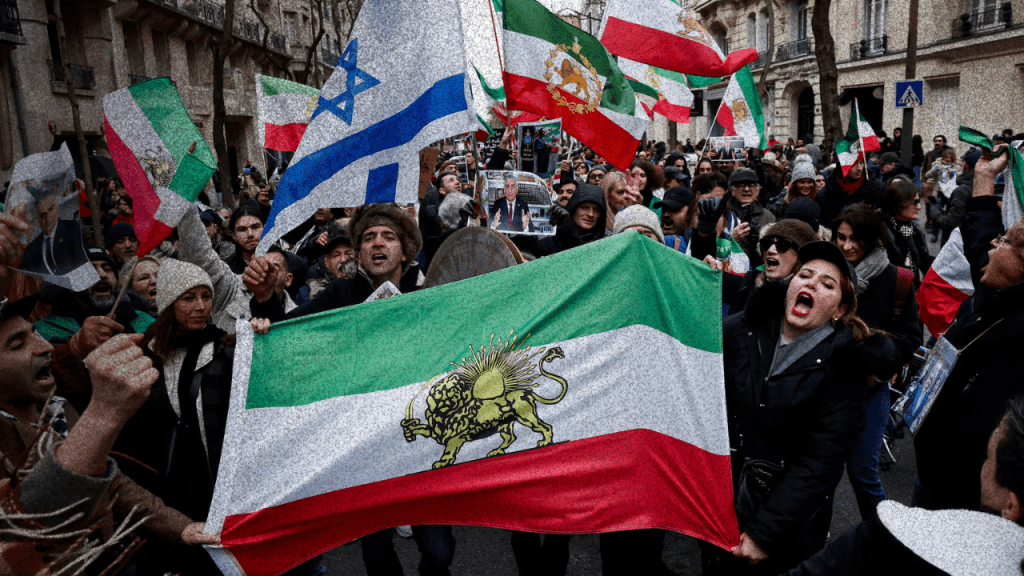
When strikes hit Tehran this morning and crowds gathered outside Iranian embassies across North America — some in grief, some in celebration — a familiar infrastructure came into view. People with genuine histories of persecution, holding flags, providing moral cover, shaping the frame through which Western publics understand what is happening and why. The emotion is real. The function is structural. Understanding the difference between those two things is not an attack on the people involved. It is the minimum requirement for political clarity.
Diaspora communities are not propaganda operations. They are human communities shaped by displacement, loss, and the material conditions of their arrival in new countries. But those same communities, precisely because of their histories, their class compositions, and their cultural legibility to Western states, become available for use. That use is not always conscious. It does not require coordination or bad faith. It requires only that interests align — that what a diaspora wants and what an empire needs overlap enough to be mutually reinforcing.
This is not a new phenomenon. It has a pattern. And the pattern is visible, right now, in real time.
What Weaponization Actually Means
Weaponized diaspora does not imply that exiled communities are fabricating their politics. It does not mean they are uniformly paid operatives or foreign agents, though some undoubtedly are.
It names something more precise and more unsettling: the capture, shaping, and amplification of the political energies of displaced communities by states pursuing interests that extend far beyond the welfare of those communities, or the populations invoked in their name.
The mechanism has several consistent features. First, class filtering: who gets to leave, and how, is never random. Immigration systems in wealthy countries select for the credentialed, the propertied, the professionally mobile.
In doing so, they concentrate people who lost status under redistributive or anti-imperial governments, and who regained that status within liberal capitalist frameworks. Their grievances are real.
Their politics, shaped by those material conditions, tend toward interventionism — not primarily because they have been manipulated, though some are, but because experience has taught them that Western power once protected or restored what mattered to them.
Second, amplification: within diaspora communities, the loudest and best-funded voices tend to be those most aligned with host-country state interests. Alternative currents — those skeptical of sanctions, opposed to military intervention, or simply more interested in material support for people inside the country — exist but are structurally disadvantaged. Media platforms, political access, and funding flows toward the voices that are useful.
Third, deployment: at moments of crisis, these amplified voices provide what raw state power cannot supply for itself — authenticity. A diaspora community marching on an embassy, testifying before parliament, appearing on broadcast media as the human face of a foreign policy objective, performs a function no government spokesperson can replicate. The sincerity of individual participants makes the performance more effective, not less. Authentic emotion travels further than prepared remarks.
The cases where this pattern has operated most visibly span decades and continents.
Cuba: Class, Property, and the Embargo
The Cuban exile community that took shape in Florida after 1959 is the template. When Fidel Castro’s government nationalized American and Cuban elite holdings, the immediate losers were the wealthy families whose property was seized, the professionals whose status depended on the pre-revolutionary order, and the political class connected to the Batista regime. These were the people with the resources and the connections to get out. Working-class Cubans who benefited from the revolution’s expansion of healthcare, education, and literacy — or who simply lacked the capital to relocate — largely stayed.
The result was a diaspora concentrated in its class grievances in a way that mapped precisely onto U.S. Cold War objectives. The Cuban American National Foundation, founded in 1981 by Jorge Mas Canosa with close ties to the Reagan administration, became one of the most effective ethnic lobbying organizations in American history. It played a central role in drafting the 1996 Helms-Burton Act, which codified and entrenched the embargo in ways that subsequent administrations could not easily reverse. Helms-Burton specifically made it easier for Cuban Americans to sue entities doing business with property the revolution had expropriated — property, in many cases, that diaspora families wanted returned.
The analysis is not subtle here. A Foreign Policy examination of U.S.-Cuba relations described the embargo directly as the political weapon of choice for Cubans who lost assets and social positions and joined forces with the United States. The embargo outlasted the Cold War, outlasted the Soviet Union, outlasted every strategic rationale for its existence, because the diaspora political infrastructure had entrenched itself in Florida’s electoral math deeply enough that both parties calculated the cost of changing course as higher than the cost of keeping a failed policy in place.
What it did not do was help ordinary Cubans. Decades of evidence show the embargo immiserates the population while strengthening the government’s narrative of external siege. The diaspora interest and the Cuban population’s interest diverged completely. The U.S. state interest — maintaining pressure on a government that had defied it, demonstrating that defiance carries consequences — was served throughout.
The structural analysis of how that siege logic operates against Cuba specifically — and why the embargo functions as a weapon against the population it claims to be for — is examined in the analysis of how Cuba exposes the limits of liberal democracy.
Vietnam: The Architecture of Anticommunism
The Vietnamese diaspora in the United States offers a different version of the same structure, and one with unusual internal clarity about how it was built.
The 1954 Operation Passage to Freedom — a U.S. Navy operation with a CIA-backed propaganda component — transported more than 300,000 people from North to South Vietnam following the Geneva Accords. The U.S. government was explicit at the time that the migration was a public relations asset, generating coverage of Vietnamese fleeing communist rule. The campaign specifically targeted northern Catholics, framing departure as flight from religious persecution. Around 60 percent of the north’s Catholic population moved south. The program was designed to build a demographic and political base for the U.S.-backed Diem government.
When Saigon fell in 1975, the people who left for the United States were not a random cross-section of Vietnamese society. They were overwhelmingly from the military, the civil service, the professional class, the urban educated elite — people whose social position was tied to the Republic of South Vietnam and whose losses from unification were total. The boat people who followed in subsequent years carried the same structural profile: people who had the most to lose and the resources or desperation to attempt the crossing.
Community media in Vietnamese America began publishing immediately in 1975, built and run by what researchers describe as “established figures who were refugees and members of the power elites.” These outlets became powerful voices maintaining the currency of the originating act — the founding trauma of 1975 — as the political identity of the community. Anticommunism was not just a political position; it became the social glue of diaspora life, the test of authenticity, the framework within which all other political questions were interpreted.
The political consequence was that Vietnamese American communities became reliable constituencies for hardline U.S. policy toward Vietnam long after the Cold War ended, long after any coherent strategic rationale remained. Generational change has begun shifting this, but slowly and against significant internal pressure. The community that arrived in 1975 had its politics selected for it by the facts of who could leave and what they were leaving behind.
Iraq: The Exile as Intelligence Conduit
The Iraqi case is the most technically sophisticated and most catastrophically consequential example of weaponized diaspora in recent history. It is also the most documented, which makes the pattern unusually legible.
Ahmad Chalabi had not lived in Iraq since 1958, when his family was forced out following the revolution that ended the monarchy. By the time the CIA identified him in the early 1990s as the center of gravity for an Iraqi opposition in exile, he had spent decades in Lebanon, the U.K., Jordan, and Washington. He was, in formal terms, precisely the kind of exile the agency was looking for: educated, Western-oriented, Shia (which served certain geopolitical calculations), and deeply motivated by the desire to return to a post-Saddam Iraq in a position of power.
The Iraqi National Congress, which Chalabi headed, received an estimated $100 million in CIA funding through the 1990s. Its primary function, by the early 2000s, was the production of defectors — Iraqis who would appear before U.S. intelligence services and journalists with accounts of Saddam Hussein’s weapons programs, his ties to Al Qaeda, and his plans for future attacks. These accounts were false. The CIA itself concluded that virtually all of the INC’s defectors were impostors and charlatans. But a right-wing network in the Pentagon and Vice President Cheney’s office promoted them relentlessly, and Judith Miller of the New York Times used Chalabi as her primary source for a series of front-page articles that became the evidentiary foundation for public support for the invasion.
Chalabi was explicit about what he was doing and unrepentant afterward. Told that the WMD stockpiles had not been found, he responded: “We are in Baghdad now. What was said before is not important.” Later, in February 2004, he told the London Daily Telegraph that he and his organization were “heroes in error.” The invasion he helped produce killed hundreds of thousands of people, generated a civil war, and produced conditions that led directly to the emergence of ISIS. The exile got what he wanted. The country he claimed to represent did not.
The lesson is not that Chalabi was uniquely cynical. It is that the structure of the relationship — a Western power with regime change objectives, an exile community with restoration objectives, both parties with interests that aligned at a specific moment — is capable of producing catastrophe without anyone needing to be a cartoon villain. The logic of the relationship does the work.
Venezuela: The Exile Effect, Documented
Researchers have a name for what happens to political activists when they go into exile. The American Political Science Review published a study in 2022 calling it the “exile effect” — a consistent pattern in which activists who leave Venezuela become significantly more likely than those who stayed to advocate for external solutions: sanctions, international pressure, military intervention.
The paper’s finding was straightforward: exile shapes political positions in predictable ways. People who have left are no longer calculating the costs of the policy they are advocating within the country they left. They are calculating within the political environment of their host country, where the posture of maximum pressure tends to win more support and access. One Venezuelan activist put it this way: “It’s like cream and milk. When cream forms, it doesn’t look different from milk, but it’s not milk, you know? The same happens with the radicalization of the diaspora.”
The Venezuelan opposition diaspora became the mechanism through which the Trump administration’s “maximum pressure” campaign gained moral legitimacy. Juan Guaidó, recognized as interim president by the United States and nearly 60 other countries in January 2019, was largely a Washington-backed exile project. The Venezuelan American community provided the authentic face — Venezuelans themselves affirming the legitimacy of the external intervention — while the policy infrastructure was built in Washington, coordinated with elite diaspora figures, and presented to the world as a democratic opposition movement.
Maduro remained in power. The Venezuelan economy continued to deteriorate, in part because of the sanctions the diaspora had lobbied for — a U.S. Government Accountability Office report found that sanctions imposed since 2017 had contributed directly to that economic decline. The seven million Venezuelans who fled the country did not find their lives improved by a regime change that never came. What the maximum pressure campaign accomplished, functionally, was to demonstrate U.S. willingness to use economic warfare, to consolidate diaspora political networks as reliable instruments, and to provide domestic audiences with a morality play about democracy that served electoral purposes in Florida and beyond.
The broader pattern of democratic rhetoric functioning as regime-change infrastructure in Latin America — and Canada’s specific role in ratifying that framework — is examined in the analysis of Canada’s condemnation of Venezuela and the democracy it doesn’t apply at home.
Iran: The Pattern, Live
What is visible today, in the Iranian diaspora’s response to the Khamenei killing, is not anomalous. It is the pattern operating in real time, with the full apparatus on display.
The Iranian diaspora in North America is among the most educated and economically successful in the world — a product, in significant part, of the class filtering that immigration systems perform. Those who left after 1979 were disproportionately from the families that lost property, status, and political power when the revolution replaced the Shah’s secular monarchy with clerical rule. The trauma of that loss, compounded by the subsequent decades of war, repression, and international isolation, is real and legitimate. It has also been thoroughly available for capture.
During the 2022-23 Woman, Life, Freedom uprising, sparked by the death of Mahsa Amini in morality police custody, Pahlavi called for rallies across North America and Europe. Diaspora communities mobilized. Western media covered the rallies. Pahlavi was invited to the Munich Security Conference. He appeared in Washington. He met with Israeli Prime Minister Netanyahu in April 2023.
That last detail matters. The uprising inside Iran was rooted in Kurdish feminist politics — the slogan Jin, Jîyan, Azadî (Woman, Life, Freedom) came from Kurdish liberation movements. It explicitly rejected both the Islamic Republic and monarchist restoration; one of the prominent protest chants was “Neither Shah nor Supreme Leader.” The Georgetown Coalition that briefly united diaspora opposition figures in early 2023 collapsed within weeks, with Pahlavi’s exit from the alliance followed immediately by his trip to Israel. Researchers analyzing the Iranian diaspora media ecosystem note that satellite channels like Iran International — funded, according to The Guardian, by a Saudi businessman close to Riyadh — amplified pro-Pahlavi narratives while systematically underrepresenting the Kurdish, Baluch, and working-class currents that were actually driving the protests inside Iran.
What is happening today, as diaspora communities celebrate the killing of Khamenei outside embassies and in city squares, follows this structure exactly. The grief and rage of the people inside Iran — including the 108 children and adults killed at a girls’ school in Minab this morning in the same strikes — does not find its way into Western coverage through those communities. What finds its way through is the celebration: the flags, the tears of relief, the validation of what Western governments have done. That is the function the diaspora serves at this moment, regardless of what any individual participant intends.
The Iranian diaspora is not the Iranian people. The monarchist current is not the democratic movement inside Iran. The communities celebrating outside embassies in Toronto and Los Angeles are not the Baluch families counting their dead or the Kurdish activists who spent years building the political infrastructure that made the 2022 uprising possible. The gap between the diaspora as political instrument and the population as actually existing social formation is precisely where weaponization lives.
The Structure, Not the People
None of this is an argument that diaspora political activity is illegitimate or that exiled communities have no right to advocate for change in their countries of origin. People who have been forced from their homes by state violence have every right to political voice. The question is not whether diaspora communities have legitimate grievances. They do. The question is who benefits from the specific political expressions those grievances get channeled into, and whether those expressions serve the populations they claim to represent.
In Cuba, six decades of embargo served the property interests of a wealthy diaspora and the geopolitical interests of the U.S. state while immiserating the Cuban population. In Iraq, an exile intelligence operation produced a war that killed hundreds of thousands of people and destabilized an entire region. In Venezuela, a maximum pressure campaign backed by diaspora advocacy produced economic devastation without regime change. In Vietnam, anticommunist diaspora politics shaped U.S. policy toward a country that had defeated American military power, at the expense of any possibility of normalization for decades.
The pattern is not a conspiracy. It is a structure. It emerges from who gets to leave, how they are received, what voices get amplified, and whose interests align at moments of crisis. The people inside exile communities who are raising different questions — who are skeptical of sanctions, opposed to military intervention, interested in the material welfare of people still living inside the country — exist but are disadvantaged at every structural level. They receive less funding, less media access, less political legitimacy within the diaspora itself, where the test of authenticity is often how hard you advocate for the interventionist position.
The people inside Iran who are dying right now include people who wanted the Islamic Republic gone, people who had no political position at all, and children at a school in Minab who had nothing to do with any of it. What the diaspora celebration in Western cities accomplishes, functionally, is to make the deaths of the latter available as the cost of business — grief that can be suspended, mourning that can be deferred, suffering that can be framed as collateral to a larger liberation.
The contradiction that framing is designed to foreclose — that Khamenei was a tyrant and his killing still isn’t justice, and that both things must be held simultaneously — is examined in the analysis of why Khamenei’s killing doesn’t make it justice.
This framing has a long, documented, and brutal history. It has identifiable beneficiaries. And each time it is deployed, it serves those beneficiaries far better than the people it claims to defend.
Sources
- Foreign Policy — “Cuba’s Long-Distance Civil War” (U.S.-Cuba relations, CANF, Helms-Burton): https://ciaotest.cc.columbia.edu/olj/fp/fp_99jaa01b.html
- Defense Priorities — “Move on from Washington’s outdated Cuba policy” (Florida electoral influence): https://www.defensepriorities.org/explainers/move-on-from-washingtons-outdated-cuba-policy/
- USA History Timeline — “The Cuban Exile Community and the Cold War” (CANF founding, Mas Canosa): https://www.usahistorytimeline.com/pages/the-cuban-exile-community-and-the-cold-war-e4617692.php
- Wikipedia — “Operation Passage to Freedom” (CIA propaganda, 300,000 transported, Catholic targeting): https://en.wikipedia.org/wiki/Operation_Passage_to_Freedom
- Taylor & Francis — “Race and Ethnicity as Foundational Forces Structuring Information Disorder Within the Vietnamese Diaspora” (power elite media ownership): https://www.tandfonline.com/doi/full/10.1080/10584609.2023.2201940
- Medill Reports — “Historically Republican Vietnamese American community shifting left” (generational shift): https://news.medill.northwestern.edu/chicago/historically-republican-vietnamese-american-community-shifting-left-according-to-aapi-data/
- Wikipedia — “Ahmed Chalabi” ($100M CIA funding, INC, defectors): https://en.wikipedia.org/wiki/Ahmed_Chalabi
- Common Dreams — “America’s Chalabi Legacy of Lies” (CIA defector assessment): https://www.commondreams.org/views/2015/11/05/americas-chalabi-legacy-lies
- Democracy Now — “Ahmed Chalabi, Chief Peddler of False Iraq WMD Intelligence” (Judith Miller sourcing): https://www.democracynow.org/2015/11/3/ahmed_chalabi_chief_peddler_of_false
- World Socialist Web Site — “Who was Ahmed Chalabi?” (“heroes in error” quote, Daily Telegraph): https://www.wsws.org/en/articles/2015/11/04/iraq-n04.html
- American Political Science Review — “How Exile Shapes Online Opposition: Evidence from Venezuela” (exile effect, cream and milk quote): https://www.cambridge.org/core/journals/american-political-science-review/article/how-exile-shapes-online-opposition-evidence-from-venezuela/68653BB1429AA6A5FF644A47FB017C21
- Congressional Research Service — “Venezuela: Background and U.S. Relations” (Guaidó recognition, 60 countries): https://www.congress.gov/crs-product/R44841
- Congressional Research Service — “Venezuela: Political Crisis and U.S. Policy” (GAO sanctions economic decline finding): https://www.congress.gov/crs-product/IF10230
- The Conversation — “The rise of Reza Pahlavi: Iranian opposition leader or opportunist?” (SAVAK, Netanyahu meeting, Munich): https://theconversation.com/the-rise-of-reza-pahlavi-iranian-opposition-leader-or-opportunist-273423
- Free Iran Scholars Network — “Behind the Crown” (“Neither Shah nor Supreme Leader” chant): https://freeiransn.com/behind-the-crown-a-documented-critique-of-reza-pahlavis-political-role-2/
- Clingendael Institute — “Opposition politics of the Iranian diaspora” (Georgetown Coalition collapse): https://www.clingendael.org/publication/opposition-politics-iranian-diaspora-out-many-one-not-just-yet
- New Arab — “Media, monarchists, and the new battle for Iran’s narrative” (Iran International Saudi funding, Kurdish erasure): https://www.newarab.com/analysis/media-monarchists-and-new-battle-irans-narrative
- CNBC liveblog — Minab school strike, death toll, Feb. 28, 2026: https://www.cnbc.com/2026/02/28/trump-iran-strikes-live-updates.html

 Spark Solidarity