
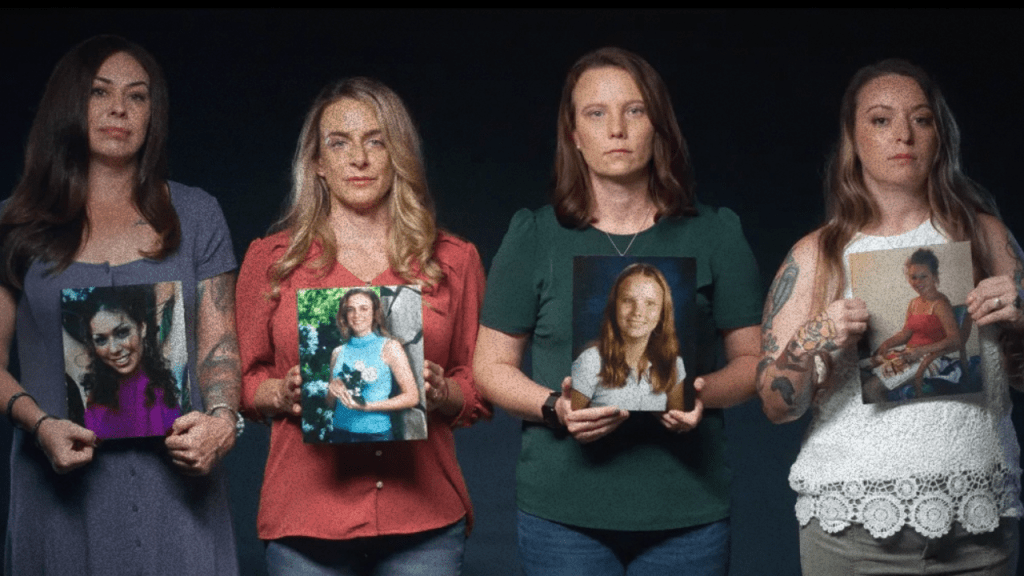
Epstein survivors used a Super Bowl ad to demand DOJ transparency because courts and institutions failed. Spectacle became the last lever.
On February 9, 2026, eight women stood in front of a Super Bowl broadcast audience and made a demand that should not have required a multi-million-dollar advertising slot. Holding photographs of themselves as children — at the ages they were trafficked by Jeffrey Epstein — they named the Attorney General, cited a federal law, and asked for documentation. The ad, produced by World Without Exploitation, a project of the Tides Center, showed some of the survivors with black marks redacting their mouths, visually transposing the DOJ’s failed redaction process onto the bodies of the women it was supposed to protect. “You don’t ‘move on’ from the largest sex trafficking ring in the world,” the ad stated. “You expose it.”
The surface demand was transparency. But the structural logic of the ad — and why it had to take the form it did — is worth examining at length.
The Ritual of Containment
There is an old folk practice, documented in parts of rural Britain and Wales, called sin eating. A designated figure — typically impoverished, marginal, socially expendable — would be brought to the home of the recently dead and fed a meal placed on the corpse. In consuming that meal, the sin eater was understood to absorb the accumulated guilt of the deceased, allowing the community to proceed without the weight of unresolved moral debt. The community was cleansed. The sin eater was contaminated. The transaction was efficient and tidy.
Jeffrey Epstein functions precisely this way.
He is dead. He was convicted. He cannot be destabilized by further accusation. He can be condemned at any volume, in any register, without any consequence to the living systems that produced him and sustained him for decades. This makes him an extraordinarily useful ritual vessel. Any prominent person who circulated through his networks — finance, political fundraising, elite philanthropy, academia, media, law — can point at the decomposing body and say: that was the wrong. The sin has been located. The community of power is restored.
This is not conspiratorial in its mechanism. It does not require a secret summit or an explicit coordination. It requires only that the institutions involved have a shared interest in narrative closure — and they do.
The mechanics of how institutions manufacture narrative closure after moments of rupture — managing exposure to restore legitimacy rather than produce accountability — are examined in the analysis of perception management and how states control the narrative after violence
The Network That Persisted
Epstein’s significance was never primarily about his individual depravity. It was about his position. He circulated inside some of the most densely connected elite networks on earth, and he did so for decades, across multiple federal investigations, a state-level plea deal that a Miami prosecutor had wanted to charge as a 60-count indictment, and a 2008 conviction that resulted in eighteen months served under conditions — work release, a private wing of the county jail — that his own victims’ attorneys called a travesty.
The Epstein Files Transparency Act, signed by Donald Trump on November 19, 2025, passed the House of Representatives 427 to 1. That near-unanimity is itself a political fact worth holding. Whatever tactical reasons individual members had for voting yes — and they varied considerably — the legislative result was that the federal government was legally required to release its investigative files on Epstein within thirty days, in a searchable and downloadable format, with redactions limited to victim privacy and active prosecutorial interests.
The DOJ missed its December 19 deadline. When the first batch arrived, hundreds of pages were entirely blacked out. Sixteen files disappeared from the public website without explanation within twenty-four hours of posting. By early January 2026, less than one percent of the files had been released, according to a DOJ letter to a federal judge. The final tranche, released January 30, amounted to over three million pages — but the DOJ had collected more than six million in total, and survivors’ attorneys immediately noted the inversion: victims’ names were appearing unredacted throughout the documents while the names of alleged perpetrators remained hidden.
“This latest release of Jeffrey Epstein files is being sold as transparency,” survivors wrote in a joint statement, “but what it actually does is expose survivors. Once again, survivors are having their names and identifying information exposed, while the men who abused us remain hidden and protected.”
The inversion was not incidental. It reproduced, at the level of bureaucratic process, the same structure that protected Epstein for decades: those with access to institutional levers could shape who gets exposed and who gets covered. The victims, again, bore the cost.
Why Spectacle Becomes the Only Lever
When The Intercept’s Dylan Gyauch-Lewis observed in February 2026 that elite accountability in the United States operates through selective deterrence — consequences for those already outside the network, deference for those still inside it — she was describing a structural condition, not a series of individual moral failures. The Clintons resisting subpoenas as legally unenforceable. Harvard reviewing its former president’s ties to Epstein only under media and legislative pressure. Larry Summers, who according to Jacobin’s reporting spent years maintaining access to Epstein’s networks, finally resigning positions only after written correspondence became public. The pattern is consistent: consequence arrives only when documentation reaches a threshold that makes continued membership in the network more costly than departure from it.
This is the architecture that makes the Super Bowl ad legible as a political act rather than merely a public relations strategy.
The ad was not produced because survivors expected the courts to respond to television advertising. It was produced because attorneys representing hundreds of survivors told ABC News that the formal channels — the DOJ, the Transparency Act, the reading room at the Justice Department where lawmakers were allowed to review unredacted files beginning February 9 — had failed to produce accountability. Deputy Attorney General Todd Blanche had stated at a press conference that “partying with Epstein is not a crime,” effectively announcing that the DOJ’s review of the files would not result in new prosecutions. UN human rights experts issued a formal statement warning that components of the documented patterns “may reasonably meet the legal threshold of crimes against humanity” — and that statutes of limitations preventing prosecution of these crimes must be lifted.
Against that backdrop, the survivors turned to spectacle — the apex of American commercial power, the most expensive advertising slot available — not because it was likely to produce legal outcomes but because it was the only remaining lever capable of sustaining public pressure. That is a damning structural fact. It means that institutional pathways for accountability had narrowed to the point where women who were trafficked as children needed to buy time between football games to request paperwork.
The broader logic of why spectacle becomes the only available lever when institutional pathways close — how the Super Bowl broadcast functions as a site where concentrated corporate and state legitimacy is managed rather than challenged — is examined in the analysis of how Super Bowl ads became corporate legitimacy theater.
What the Files Threaten
The sin eater mechanism depends on guilt staying located. Once it disperses — once the contamination moves from a single body into a network of named, living individuals and the institutions that protected them — the purification ritual fails.
This is what makes the documentation structurally threatening in a way that exceeds the criminal specifics of any individual file. Jacobin noted that Epstein’s trafficking operation depended on offshore wealth management structures — shell corporations, mysterious beneficial ownership, mechanisms that are entirely legal and entirely standard among the ultra-wealthy — to hide transactions, control victims through financial dependency, and insulate the network from scrutiny. The criminal enterprise was parasitic on the legal infrastructure of elite capital. That infrastructure remains intact.
When Representative Ro Khanna spent two hours in the DOJ’s reading room reviewing unredacted files and then read six names from the House floor, the significance was not primarily about any one individual. It was about the demonstration that names had been redacted not because of victim protection requirements — those individuals were not victims — but because the DOJ had applied its discretion to protect the reputational interests of people connected to Epstein’s networks. Senator Cynthia Lummis, after reviewing the files, stated: “Now I see what the big deal is. And the members of Congress that have been pushing this were not wrong.”
The DOJ subsequently acknowledged that it had redacted the name of Les Wexner, a prominent businessman listed as an Epstein co-conspirator in FBI documents, and unredacted it only after pressure from Thomas Massie. The redaction had no legal basis under the Transparency Act. It was discretionary. Whose discretion, serving whose interests, is the question the files keep forcing into the open.
The Sin May Not Have Transferred
The Super Bowl ad interrupts the ritual at a specific point. It does not claim to reveal anything spectacular. It does not promise that the files contain proof of some shadowy coordination. What it insists on — the thing that makes it politically disruptive — is that the narrative is not finished. That Epstein’s death did not resolve the moral ledger. That the sin has not been fully transferred.
The specific attempt to use the Epstein files to locate guilt in a single historical figure — and what the Castro photograph reveals about how that framing has been deployed — is examined in the analysis of the Fidel Castro–Epstein photo and what it really shows.
The Democracy Now! interview with investigative journalist Vicky Ward, who has covered the case for years, captured something of this: what the files reveal, cumulatively, is a world in which access to Epstein was treated as a social credential, in which his continued operation was understood by his social circle to require a certain active discretion, and in which the mechanisms of wealth — private aviation, offshore foundations, access to legal insulation — made the network self-sealing.
The sin eater dynamic depends on the community of power being able to say, in good faith or bad, that the wrong was isolated and addressed. That claim becomes increasingly untenable as names continue to surface, as congressional members describe what they’ve seen in unredacted files in terms that make clear the redacted version was actively misleading, and as survivor attorneys document what the botched release has meant for the women it re-exposed.
There are genuine open questions about what full disclosure would prove and what it would not. The DOJ’s own internal memos, as reported by the Associated Press, found limited evidence of a sex trafficking ring serving powerful men in the specific legal sense required for prosecution. But that finding reflects prosecutorial evidentiary standards, not the question of what was known, by whom, and what was done with that knowledge. Evidence of criminal liability and evidence of structural complicity are not the same thing.
What the survivors standing in front of a Super Bowl audience on February 9th were demanding was the second kind of accounting. Not just prosecution — though that too — but exposure of the ecosystem: who had access, who exercised discretion, who benefited from protection. That demand is not satisfied by a body. It requires living institutions to account for what they built, maintained, and insulated.
That is precisely what makes it so difficult to deliver.
Sources
- Al Jazeera. “Tell the Truth: Epstein Survivors Demand Justice in Super Bowl Ad.” Al Jazeera, February 9, 2026. https://www.aljazeera.com/news/2026/2/9/tell-the-truth-epstein-survivors-demand-justice-in-super-bowl-ad
- The Hill. “Super Bowl Ad Slamming Bondi Over Epstein Files Release Airs.” The Hill, February 9, 2026. https://thehill.com/homenews/administration/5729190-super-bowl-ad-bondi-epstein/
- Newsweek. “Epstein Survivors Release New Commercial on Super Bowl Sunday.” Newsweek, February 9, 2026. https://www.newsweek.com/epstein-survivors-release-new-commercial-on-super-bowl-sunday-11486010
- Congress.gov. Public Law 119–38: Epstein Files Transparency Act. November 19, 2025. https://www.congress.gov/119/plaws/publ38/PLAW-119publ38.pdf
- JURIST Staff. “Trump Signs Epstein Files Transparency Act into Law.” JURIST, November 19, 2025. https://www.jurist.org/news/2025/11/trump-signs-epstein-files-transparency-act-into-law/
- Wikipedia. “Epstein Files Transparency Act.” Last modified February 2026. https://en.wikipedia.org/wiki/Epstein_Files_Transparency_Act
- Wikipedia. “Epstein Files.” Last modified February 2026. https://en.wikipedia.org/wiki/Epstein_files
- CBS News. “Massive Trove of Epstein Files Released by DOJ.” CBS News, February 2026. https://www.cbsnews.com/live-updates/epstein-files-released-doj-2026/
- CNN. “January 30, 2026 — DOJ Releases Millions of Pages of Documents in Epstein Investigation.” CNN Politics, January 30, 2026. https://www.cnn.com/politics/live-news/epstein-files-release-doj-01-30-26
- ABC News. “DOJ Releasing Additional Material from Epstein Files.” ABC News, January 30, 2026. https://abcnews.com/US/doj-releasing-additional-material-epstein-files/story?id=129680518
- Gyauch-Lewis, Dylan. “Americans Want Accountability With the Epstein Files. Elites Couldn’t Care Less.” The Intercept, February 10, 2026. https://theintercept.com/2026/02/10/epstein-files-american-consequences/
- Sirota, David. “The Ruling Class Is Uncancelable.” Jacobin, December 2025. https://jacobin.com/2025/12/elite-impunity-summers-epstein-cheney
- Jacobin. “Capitalism Enabled Jeffrey Epstein’s Crimes.” Jacobin, November 2025. https://jacobin.com/2025/11/epstein-trafficking-law-taxes-capitalism
- Office of the UN High Commissioner for Human Rights. “Flawed ‘Epstein Files’ Disclosures Undermine Accountability for Grave Crimes Against Women and Girls: UN Experts.” OHCHR, February 2026. https://www.ohchr.org/en/press-releases/2026/02/flawed-epstein-files-disclosures-undermine-accountability-grave-crimes
- Democracy Now!. “‘Billionaire Boys Club’: What the Latest Epstein Files Reveal About Elite Impunity.” Democracy Now!, February 2, 2026. https://www.democracynow.org/2026/2/2/jeffrey_epstein









 Spark Solidarity