
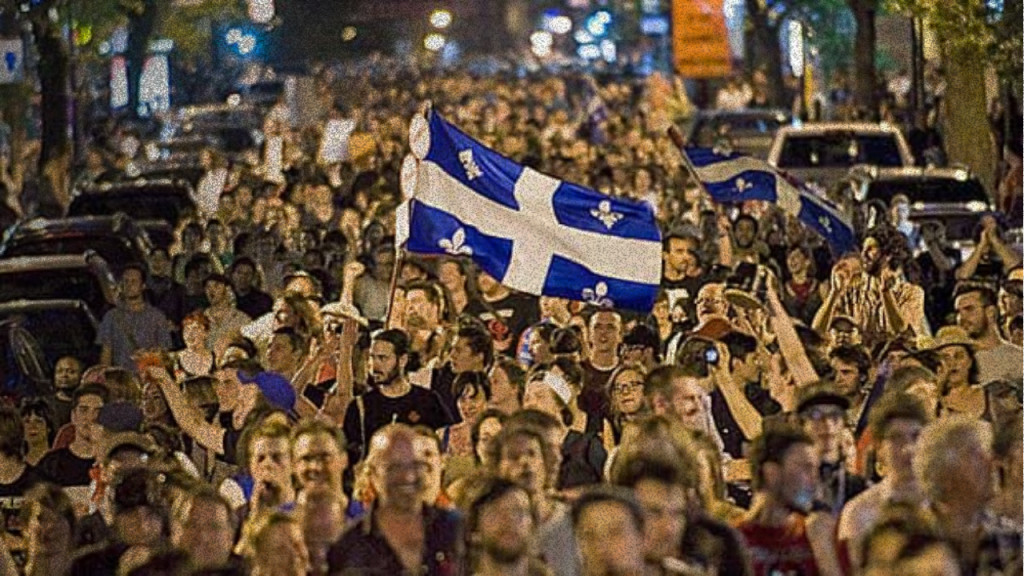
Quebec politics in 2026 is not a regional curiosity — it is where the fight over productive forces is still open.
Most English-Canadian political commentary treats Quebec as a complication — a cultural exception to be managed, a sovereignty threat to be periodically defused, a place whose politics are too parochial to reward serious attention.
This is a mistake, and it is an expensive one. Quebec politics in 2026 is not a regional sideshow. It is the one jurisdiction in Canada where the question of who controls the productive forces — and in whose interest they are directed — is still a live political question, not a settled one.
The Machinery Nobody Talks About
Quebec has productive forces that the rest of Canada does not.
The Caisse de dépôt et placement manages over $400 billion in assets — a sovereign wealth instrument operating inside a capitalist economy, currently pointed toward continental private equity integration, available in principle to be pointed somewhere else. Hydro-Québec is one of the largest public utilities in North America — a model of public ownership that has kept energy prices low enough to sustain industrial capacity while generating surpluses that could, under different political direction, finance ecological transformation rather than export contracts.
The Canada-Quebec Accord gives Quebec more control over immigration selection than any other province — a tool currently used to manage the cultural anxieties of the national bourgeoisie, available in principle to build the multilingual, class-conscious political coalition that a transformative project requires. The bijural legal system — civil law operating alongside common law — preserves cooperative ownership structures and tenant protections that neoliberalism has dismantled everywhere else in the country.
These are not cultural assets. They are the material productive forces of a society that capitalism has not fully dissolved. They exist nowhere else in Canada in this combination. And the question of what they are for — who directs them, toward what ends, in whose interest — is the actual content of Quebec’s political conflicts, underneath the language debates and referendum arithmetic that dominate English-Canadian coverage.
What the Sovereignty Debate Is Actually About
The Quebec sovereignty question is real, but it is widely misread. The standard English-Canadian frame treats it as an ethnic nationalist project — Francophone cultural preservation dressed up as constitutional politics.
This frame is wrong in ways that matter. Quebec’s aspiration for collective self-determination is not reducible to ethnicity.
It emerged from a specific history: a colonized working class organized communally through the caisse populaire and the rang system, economically subordinate to English capital for two centuries, whose liberation struggle — the Quiet Revolution — produced the productive forces described above before those gains were captured by the national bourgeoisie and redirected toward their class interests.
The independence question is therefore a class question. The national bourgeoisie — the Francophone professional-managerial class that controls Quebec’s institutions — uses cultural identity as the primary axis of sovereignty politics because that axis serves their class position. It displaces the question of democratic control of the productive forces with the question of which language the productive forces operate in.
A left-sovereignty project organized around the actual primary contradiction — imperial core dependency versus collective self-determination — looks entirely different. It asks what independence is for: whether it means reorienting the Caisse away from continental integration, whether it means Quebec’s BRICS orientation and the New Development Bank as an alternative to IMF conditionality, whether it means NATO exit and the reallocation of the defence budget toward social investment, whether it means Indigenous co-governance as the constitutional foundation of a legitimate sovereignty rather than a post-referendum consultation exercise.
None of that is on the table in the current sovereignty debate. It should be. The fact that it isn’t is itself a political fact worth understanding — one that explains more about the trajectory of Quebec politics than any language law or referendum result.
Why the Contradictions Are Instructive
Quebec’s political situation is structured by contradictions that the rest of the Canadian left has largely abandoned as questions. The tension between national self-determination and class politics. The tension between a genuine liberation aspiration and the class capture of that aspiration by a professional-managerial elite.
The tension between Quebec’s claim to sovereignty over its territory and the prior, unextinguished sovereignty claims of Cree, Innu, Mohawk, and Anishinaabe peoples whose relationship to that territory predates New France.
The tension between the ecological transformation that Quebec’s public energy infrastructure makes possible and the extractive continental economy it currently serves.
The tension between the multipolar world emerging around BRICS and the dollar-system dependency that structures Quebec’s — and Canada’s — economic relationships.
These contradictions are not unique to Quebec. But Quebec is the one place in Canada where the productive forces exist to navigate them toward something other than managed decline.
That is why the politics here rewards attention. Not because Quebec is a model or a utopia — it is neither — but because the fight over what its institutions are for has not yet been settled in the way it has been settled elsewhere.
The PQ’s historical trajectory, the Bloc’s parliamentary limits, the 2026 provincial election, the question of what Québec solidaire can and cannot do within the terms of the current sovereignty coalition — these are not local curiosities.
They are case studies in how a political community navigates the gap between the productive forces it has and the political direction those forces are currently serving.
The Work That Is Already Possible
The machinery does not wait for a referendum. The Caisse reorientation, the Hydro-Québec model extension, the immigration selection reframe, the bijural legal system used for cooperative ownership structures — none of this requires independence. It requires a provincial government with the political will to ask different questions about what the productive forces are for. That work is a war of position: the slow, institutional, counter-hegemonic effort of building the new society inside the shell of the old one. It does not produce rupture on a short timeline. It builds the conditions under which transformation becomes possible when the political moment shifts.
That is the horizon Quebec politics 2026 is operating against.
Not a referendum this year, not monetary sovereignty next year — but the accumulation of institutional reorientations, over a 5-10 year horizon on provincial powers and a 10-20 year horizon on full sovereignty unlocks, that make the question of independence legible as something other than a reorganization of the same dependency under a new flag.
Understanding that horizon, and the political forces contending over it, is what serious attention to Quebec politics requires.
Sources
- Caisse de dépôt et placement du Québec. Annual Report 2024.
- Canada-Quebec Immigration Accord (1991)
- Gramsci, Antonio. Prison Notebooks (1929–1935)
- Lévesque, René. Option Québec (1968)




 Spark Solidarity