
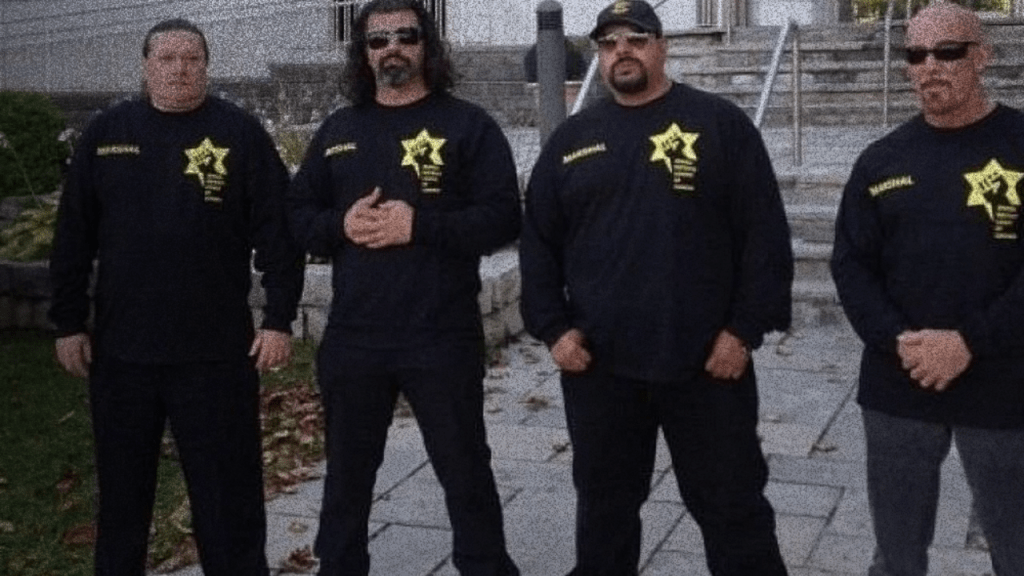
JDL Canada: a network with a documented terrorist lineage that targets Palestinian solidarity activists and operates with institutional impunity.
A Terrorist Organization, Not a Protest Group
The Jewish Defense League is not a controversial activist organization. The Federal Bureau of Investigation designated it a right-wing terrorist group in its 2001 report Terrorism 2000/2001. In 2004 congressional testimony, FBI Executive Assistant Director John S. Pistole described it as “a known violent extremist Jewish organization.” FBI statistics document that between 1980 and 1985, JDL members were responsible for 15 of 18 officially classified terrorist attacks in the United States committed by Jewish actors. That designation belongs at the beginning of any discussion of JDL-linked activism in Canada. It is not a footnote. It is the institutional identity of the network.
Framing the JDL as a militant or controversial group — language that appears routinely in Canadian media coverage — launders that designation. Organizations with documented terrorist histories do not become legitimate political actors because their targets changed or their branding evolved. The lineage persists. The network that operates today in Canadian cities around pro-Palestinian demonstrations is not separate from that history. It is its current expression.
Kahane and the Ideology of Ethnic Removal
Rabbi Meir Kahane founded the JDL in New York in 1968. The organization emerged from a specific political argument: that Jewish communities could not rely on liberal democratic institutions for protection and required an organized militant infrastructure instead. That argument was a recruiting mechanism. The ideology it served was something more specific.
Kahanism — the political framework Kahane developed over the following two decades — held that Arab populations had no legitimate place in Israel or the occupied territories. Kahane called for the forced removal of Arab populations from Israeli-controlled land and for the replacement of democratic governance with a state governed by Jewish religious law. His Knesset proposals went further: non-Jews would be stripped of citizenship, Jewish-Arab marriages criminalized with fifty-year prison sentences, and Arab residents given a choice between subjugation, deportation, or death. This is not a fringe interpretation of his positions. It is what he proposed, in parliament, on record.
In 1984, Kahane won a seat in the Israeli Knesset on this platform. His presence in parliament was not an anomaly — it was the mainstreaming of an ethnic cleansing agenda through electoral politics. The Israeli state banned his Kach party from elections in 1988 under anti-racism legislation after the Supreme Court ruled its aims “manifestly racist” — a rare act that reflected how far outside democratic norms the platform sat even by Israeli political standards. After Kahane’s assassination in New York in 1990, Kach and its splinter Kahane Chai were banned outright as terrorist organizations in 1994, following the Cave of the Patriarchs massacre in which Kach member Baruch Goldstein killed 29 Palestinian worshippers at prayer in Hebron.
The ideological core did not require an intact organization to survive. Kahanism is a transmissible set of political commitments — militant nationalism, eliminationist logic toward Arab populations, rejection of liberal institutions as inadequate to Jewish survival — that travels through diaspora networks and activist formations independent of formal organizational structure.
The Deeper Lineage: Jabotinsky and Revisionist Zionism
Kahane did not construct his politics from nothing. The ideological infrastructure he built on was Revisionist Zionism, developed by Ze’ev Jabotinsky in the early twentieth century. Jabotinsky argued that Jewish state-building in Palestine required uncompromising military organization and the rejection of gradualist or negotiated strategies. To cultivate that orientation in a new generation, he founded Betar in 1923 — a youth movement built around paramilitary discipline and nationalist loyalty, explicitly aimed at producing a generation willing to use violence to establish a Jewish state across all of Palestine and Transjordan.
Betar members became the organizational backbone of the Irgun — the paramilitary force that carried out attacks on Arab communities and British infrastructure during the Mandate period. Future Israeli Prime Minister Menachem Begin led both Betar and the Irgun simultaneously in the 1940s. The line from Jabotinsky’s Revisionism to Kahane’s JDL to contemporary counter-protest networks is not a rhetorical genealogy. It is an organizational and ideological transmission across time — the same core commitments about Jewish statehood, Arab removal, and the inadequacy of liberal frameworks, adapted to successive political contexts.
Canada: The Weinstein Operation
The JDL’s Canadian presence was built largely through Meir Weinstein, born Marvin Weinstein, who established the Toronto branch in 1979 after reading Kahane’s book Never Again. He served as national director for decades and in 2017 claimed leadership of the JDL across North America. In his own words, repeated publicly: “I will always be a loyal disciple of Rabbi Kahane. Our ideology is based on the Jewish Idea as taught by Rabbi Kahane.”
Under Weinstein, the Canadian operation focused primarily on counter-protest: mobilizing against Palestinian solidarity demonstrations, boycott campaigns, and events activists identified as hostile to Israel. The counter-protest framing served a specific function. It positioned a network with a terrorist organizational lineage as a reactive, defensive actor — responding to Palestinian solidarity rather than pursuing its own political agenda. In 1994, when Kach member Baruch Goldstein massacred 29 Palestinians in Hebron, Weinstein’s response was not condemnation. Under his pseudonym Meir Halevi, he stated: “As long as the Arab public celebrates every attack on a Jew, our organization does not condemn the attack.”
In 2011, the RCMP launched an investigation into at least nine Canadian JDL members following an anonymous tip about a plot to bomb Palestine House in Mississauga. In 2017, Canadian JDL members were charged with assault following attacks on protesters outside the AIPAC conference in Washington, D.C. — one Palestinian-American was hospitalized with an eye injury requiring 19 stitches.
Weinstein left the JDL in July 2021, weeks after JDL members were involved in a street brawl with Palestinian activists in Toronto following the Nakba Day demonstration. He immediately launched Israel Now. Canadian Dimension described the move plainly: Israel Now retained the JDL’s podcast, its political orientation, and its activist base. As the Media Accountability Project documented, as recently as September 2024, Israel Now and JDL counter-protesters appeared together at the University of Toronto waving Kach flags — the flag of an organization designated a terrorist entity by Public Safety Canada since 2005 — while chanting “Make Gaza a parking lot.” Weinstein continued posting public tributes to Kahane and calling for Arab removal on social media through at least September 2024.
The organizational rebrand changed nothing structurally. The network does not depend on the JDL brand to function. The activist base, the tactical repertoire, and the Kahanist political framework persist across organizational iterations. In February 2025, Toronto police arrested a man at a counter-protest who identified himself to officers as a member of Kahane Chai, threatening grievous harm to pro-Palestinian demonstrators. A search of his home turned up a .357 magnum rifle, ammunition, and clothing branded with the Kahane Chai name and crest.
The Counter-Protest Ecosystem as Surveillance Infrastructure
What operates in Canadian cities today around Palestinian solidarity demonstrations is not a single organization. It is a decentralized ecosystem of activists, online networks, and documentation operations sharing a common political orientation and tactical approach. Counter-protests are one visible layer. The less visible layer is what happens after demonstrations end.
Participants at pro-Palestinian demonstrations are filmed, identified, and circulated through social media networks associated with this ecosystem. The documentation is framed publicly as accountability journalism or antisemitism monitoring. Structurally, it functions as a targeting operation — building dossiers on activists, journalists, and organizers who document or support Palestinian solidarity work, then deploying that material to damage their employment, public standing, and safety.
This is not a new tactic. It is the contemporary digital form of the same surveillance and intimidation function the JDL performed through physical confrontation in earlier decades. The technology changed. The purpose did not.
Canadian institutions — media, universities, employers — have largely treated this targeting operation as legitimate political speech. The asymmetry is structural: since October 7, 2023, Toronto police alone have arrested over 100 people in connection with Palestinian solidarity activism under Project Resolute, including pre-dawn raids on activists’ homes, delayed arrests months after peaceful demonstrations, and charges for actions as minor as pouring washable red paint on a bookstore window. Journalists, nurses, teachers, and students have been fired, suspended, and investigated for social media posts expressing solidarity with Palestinians. The CJPME Foundation documented that while pro-Palestine demonstrations represented 10% of all protests between 2021 and 2025, they attracted 37% of all police interventions — despite over 96% of those demonstrations being entirely peaceful.
A network with Kahane Chai flags at its counter-protests, an armed member making terrorist threats in February 2025, and a founder on record endorsing the Hebron massacre operates across this same period without equivalent state scrutiny. That asymmetry is not incidental to Canadian political culture. It is produced by it. The next installment of this investigation documents how this targeting infrastructure operates in practice.
Sources
- Southern Poverty Law Center. “Jewish Defense League.” splcenter.org
- Institute for Middle East Understanding. “Fact Sheet: Meir Kahane and the Kahanist Movement.” imeu.org
- Canadian Anti-Hate Network. “Anti-Muslim Hate Group Claims Responsibility for Countering.” antihate.ca
- Canadian Dimension. “The Long Overdue Death of the Jewish Defence League.” canadiandimension.com
- The Canada Files. “Is B’nai Brith Canada Still in Bed with the Jewish Defence League?” thecanadafiles.com
- CJPME Media Accountability Project. “The Rise of Zionist Vigilante Groups in Canada.” September 17, 2024. cjpmemap.ca
- The New Arab. “Inside Project Resolute: Canada’s Crackdown on Palestine Speech.” newarab.com
- CJPME Foundation. “Policing Palestine Solidarity: A Crisis of Civil Liberties in Canada 2021–2025.” December 22, 2025. cjpmefoundation.org
- TRT World. “Dissent, Detained: Police Arrest Canadian Author for Pro-Palestine Posts.” trtworld.com
- The Canadian Jewish News. “Toronto Kahane Chai Arrest.” February 2025. thecjn.ca


 Spark Solidarity