
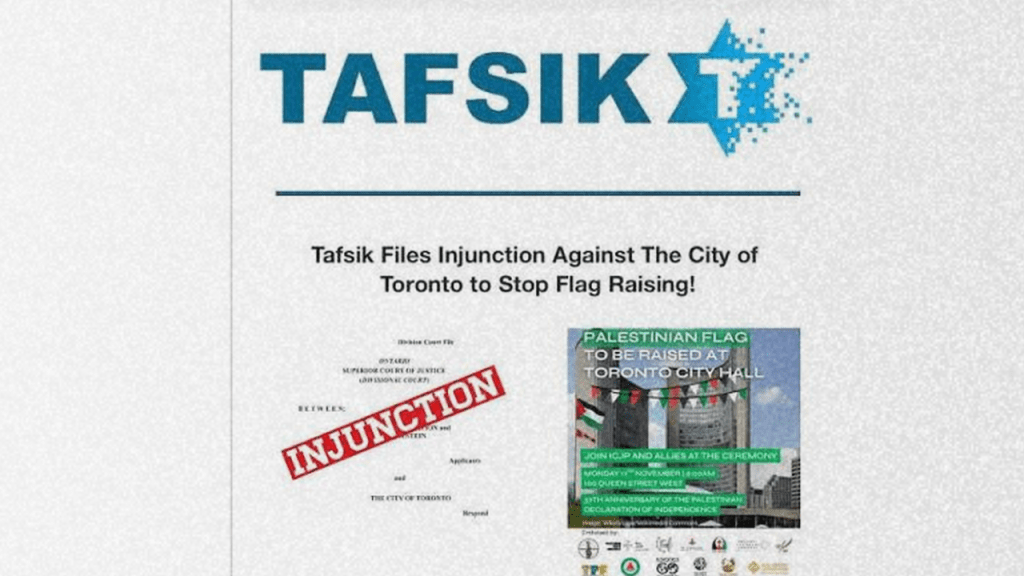
Canada’s recognition of Palestine made it eligible under an existing Toronto flag policy. Tafsik tried to interrupt the process in court and failed.
Hours before Toronto raised the Palestinian flag on November 17, Tafsik and its executive director, Amir Epstein, asked a judge to stop it. Justice M.D. Faieta refused. Two days later, written reasons explained why the organization had not met the test for an emergency injunction.
This was not another fight over a flag. It was an attempt to interrupt an administrative process after a change in Canadian foreign policy made Palestine eligible under Toronto’s existing rules.
Recognition Changed Eligibility
When the International Centre of Justice for Palestinians first applied in July, Canada did not recognize Palestine. Toronto found the request ineligible. That changed when Canada formally recognized Palestine on September 21.
Recognition did not order Toronto to fly the flag. It satisfied a condition in the city’s policy, which permitted flags of countries recognized by the federal government. ICJP amended its request, and the Chief of Protocol approved it under delegated authority on November 6.
ICJP alone submitted the request. City Council did not approve individual flag requests; that authority had been delegated to the Chief of Protocol.
Staff applied a rule already on the books. The policy said use of the courtesy flagpole did not express support for a country’s politics. Toronto addressed security rather than treating predicted opposition as grounds to cancel an eligible request.
Tafsik Goes to Court
Tafsik and Epstein filed on November 13. Their emergency motion sought to prevent the November 17 ceremony while a judicial review challenged the approval.
Faieta assumed, without deciding, that Tafsik and Epstein had standing for the motion. He found no serious issue on their arguments concerning Toronto’s municipal authority, Canada’s recognition of Palestine, ICJP’s eligibility or the claim that the city had breached a duty of neutrality.
The claimed psychological harm and predicted disorder were not established as irreparable harm. The judge described the forecast of disorder as “nothing more than speculation.” The balance of convenience also favoured allowing the city’s decision to stand.
The Policy Held
The motion was dismissed around 9:30 a.m. The flag raising proceeded at 10 a.m., as listed on Toronto’s schedule. Tafsik and Epstein were ordered to pay the city $3,500 in costs.
The ceremony carried meaning beyond municipal procedure. But the decision allowing it followed a clear process: federal recognition had made Palestine eligible under a local policy available to recognized countries.
The written reasons did not dispose of the underlying judicial review. They did establish the institutional result: Canada recognized Palestine; Toronto applied an existing policy through delegated staff authority; and Tafsik failed to meet the legal test required to stop that decision on an emergency basis.