Weather control is neither omnipotent nor imaginary. Its real development is being shaped by militaries, states and private capital.
The idea of weather control is often reduced to its most spectacular version: a secret machine creates a hurricane, directs it toward a city and switches it off after the damage is done. Because no demonstrated technology can do that, the entire subject is dismissed. This protects serious atmospheric intervention from scrutiny by making an impossible claim the price of admission.
Weather modification is real, but bounded. Cloud seeding can alter precipitation under some existing conditions. Governments have used it for military purposes. More than 50 countries operate programs intended to increase rain or snow, suppress hail or disperse fog. Proposed climate interventions seek effects on a much larger scale. None of these techniques provide complete command of the sky.
The political question begins where the caricature ends. Technologies do not need to manufacture a storm from nothing to become economically valuable or militarily useful. They need only identify favourable conditions, intervene at the right moment and shift an outcome enough to benefit one party at another’s expense. The important system combines observation, prediction, intervention, infrastructure and ownership.
The atmosphere is therefore becoming a field of administration. Satellites, radar, sensors, drones and numerical models expand the capacity to understand cloud systems. Seeding methods attempt to exploit particular clouds. Geoengineering companies seek proprietary claims over interventions whose effects cannot respect borders. The capacity remains limited, but the institutions organizing it are already powerful.
The United States used weather as a weapon
The clearest evidence against blanket dismissal is Project Popeye. During the Vietnam War, the United States pursued cloud seeding over North Vietnam and Laos to increase rainfall along supply routes. A January 1967 State Department memorandum described the objective plainly: produce enough rain to interfere with truck traffic and prolong wet conditions through the normal dry season.
The document records more than 50 experiments during an earlier test phase in Laos. That testing occurred without consultation with the Lao government and was known only to a severely restricted group of U.S. officials. Defence officials believed the results had contributed to making routes unusable, although the memorandum also acknowledged that the effects could not be predicted or controlled precisely.
The proposal treated weather as military terrain. Added rain could saturate roads, impede vehicles, create bottlenecks and expose concentrated traffic to air attack. The technique did not need to create monsoons. It needed to raise the cost of movement through territory whose existing clouds and terrain made intervention possible.
Officials also anticipated civilian and ecological consequences. The memorandum discussed localized flooding, changes in water flow, disruption of planting patterns and effects beyond the designated target areas. It recognized that successful operations could alter conditions across sovereign borders while making responsibility difficult to measure.
Secrecy was not incidental to the plan. Officials worried that disclosure would expose U.S. weather manipulation and lead affected populations to blame Washington for abnormal events it had not caused. They nevertheless recommended maintaining security controls for as long as possible. The operation joined intervention and deniability from the beginning.
International law followed the precedent
The Convention on the Prohibition of Military or Any Other Hostile Use of Environmental Modification Techniques opened for signature in 1977. ENMOD prohibits hostile environmental manipulation that produces widespread, long-lasting or severe effects. It defines environmental modification as deliberately changing natural processes involving the Earth, including its atmosphere, hydrosphere, lithosphere and biosphere.
The treaty does not prove the existence of weapons capable of manufacturing earthquakes, tsunamis or hurricanes. It shows that states considered the weaponization of environmental processes important enough to regulate after the United States had already experimented with weather warfare.
Its protection is also constrained. The intervention must be hostile, attributable and serious enough to satisfy one of the treaty’s thresholds. Limited, temporary or difficult-to-detect operations could escape enforcement. States remain responsible for investigating other states, while the most technologically advanced military powers possess the greatest ability to classify research and obscure its purpose.
A 2025 analysis from West Point’s Lieber Institute argues that ENMOD has often been interpreted so narrowly that it protects the environment mainly from hypothetical superweapons. The law may have wider relevance, but decades of limited enforcement have not produced an inspection regime capable of making atmospheric intervention transparent.
Cloud seeding is limited and commercial
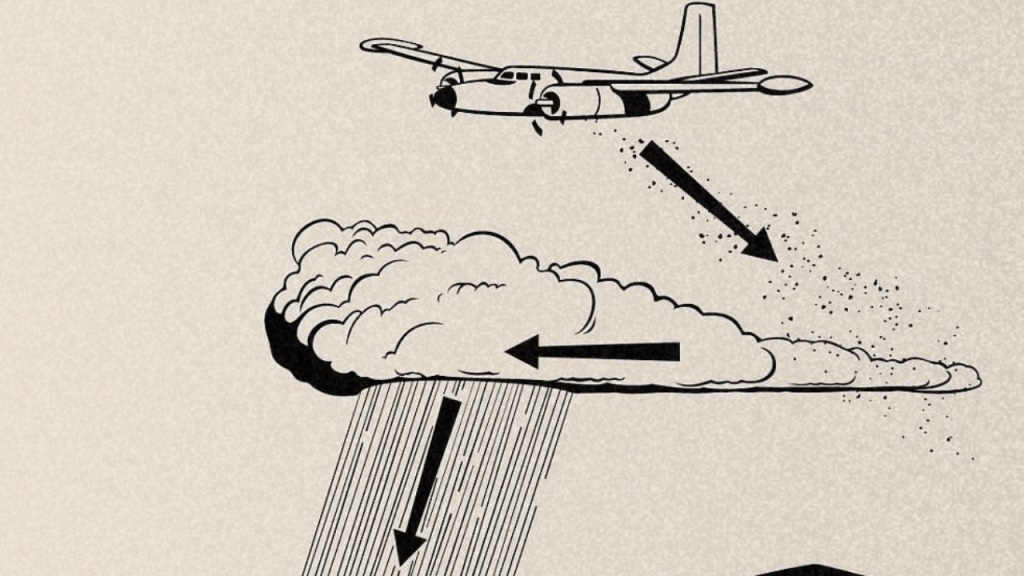
Cloud seeding introduces substances such as silver iodide into suitable clouds in an attempt to influence precipitation. Its effects depend on moisture, temperature, cloud structure, wind, terrain, timing and the seeding method. It cannot make rain fall from a clear sky or force water vapour into a region where the necessary atmospheric conditions do not exist.
A 2024 U.S. Government Accountability Office assessment found that nine states were using cloud seeding. The studies it reviewed estimated additional precipitation ranging from zero to 20 percent. Researchers face a basic problem: they cannot directly observe how much rain or snow the same cloud would have produced without treatment.
The World Meteorological Organization’s June 2025 statement is equally clear about the limits. There is no generally accepted evidence that tropical cyclones can be modified, and no demonstrated cloud-seeding methods for controlling tornadoes, lightning or floods. Claims of technologies that create rain systems, redirect moisture or eliminate severe weather have no sound scientific basis.
That scientific boundary should be defended. Treating every flood or storm as proof of manipulation replaces investigation with suspicion. A credible claim requires evidence of a relevant program, a feasible mechanism, operations in the affected place and time, measurable atmospheric effects and a statistical case stronger than natural variability.
The same WMO statement confirms that weather modification is not imaginary. Operational projects exist in more than 50 countries. Evidence is strongest for particular forms of wintertime seeding in suitable mountain clouds, while other methods remain inconsistent or unproven. Increasingly precise observations and models create new opportunities to study and target atmospheric processes.
The result is an industry built around uncertain but potentially valuable effects. Water districts, agricultural interests, governments and contractors do not need certainty to invest. They need a possibility of additional water or reduced damage that appears worth the cost. Proprietary methods can then make independent evaluation harder precisely where public scrutiny is most necessary.
Capital does not need total control
Strategic power rarely means creating a system from nothing. A dam does not create water; it controls its movement and distribution. A trading firm does not create every market panic; it can anticipate and profit from one. Digital platforms do not invent every opinion; they observe behaviour and amplify selected tendencies.
Atmospheric power follows the same logic. Better forecasting can help a military select the moment for an attack, exploit cloud cover, protect aircraft or disrupt supply. Cloud seeding can seek marginal changes in an existing system. Ownership of reservoirs, insurance, emergency contracts and reconstruction can determine who profits after a disaster without anyone engineering the weather itself.
This is why the debate cannot be reduced to whether a government can steer a hurricane. The material issue is control over environmental knowledge and the infrastructure built around it. A small technical effect can become politically significant when combined with unequal access to water, land, forecasting, insurance, military force and capital.
Capital has already altered the atmosphere
Industrial capitalism has changed the atmosphere on a planetary scale without needing targeted weather weapons. Fossil-fuel extraction increased greenhouse-gas concentrations, raised global temperatures and altered the conditions under which heat, drought and extreme rainfall occur. The transformation was not intended to control individual storms. It continued because extraction generated immense returns.
Major corporations also understood the consequences. A peer-reviewed study in Science evaluated Exxon’s internal climate projections from 1977 through 2003 and found that its scientists forecast global warming with considerable accuracy. Corporate knowledge coexisted with public efforts that exaggerated uncertainty and delayed action.
This history establishes the institutional pattern. Firms can possess advanced knowledge about atmospheric harm, continue the profitable activity producing it and weaken public understanding of the consequences. The atmosphere has already been treated as a free waste sink whose damage is socialized while ownership and profit remain concentrated.
Private atmospheric intervention is developing inside that same economic order. It is not entering a neutral world where every population holds equal power over risk. The corporations and states most capable of funding research are also those best positioned to define acceptable uncertainty and transfer unintended costs elsewhere.
Geoengineering is becoming a market
Solar geoengineering proposals seek to reflect a portion of incoming sunlight, including through stratospheric aerosols or marine cloud brightening. These concepts operate at a different scale from conventional cloud seeding. Their feasibility, effectiveness, side effects and governance remain disputed, but commercial actors are already attempting to establish a market.
A 2025 study in Earth System Governance describes start-ups claiming that sulphur-dioxide releases can generate saleable “cooling credits,” alongside companies seeking investor returns from proprietary aerosols. The authors locate these ventures within a climate-policy system shaped by venture capital, market mechanisms and private technical authority.
The market does not wait for democratic consent or scientific settlement. Firms can fund experiments, claim intellectual property, sell unverifiable credits and present proprietary intervention as a solution to damage created by the existing economy. The promise of managing symptoms can then compete with the political demand to stop the extraction causing the crisis.
An atmospheric intervention cannot be contained by property lines. Changes in sunlight, precipitation or temperature could create different effects across regions. A government or company claiming a benefit in one place may impose drought risk, crop disruption or political instability elsewhere. The people exposed to those risks would have no meaningful contract with the actor making the intervention.
Disaster is already a field of accumulation
Weather does not need to be engineered for disaster to become profitable. Floods, fires and storms destroy homes and public infrastructure, but the recovery process distributes losses and opportunities through class power. Insurers can withdraw or increase premiums. Landlords can displace tenants. Developers can acquire damaged property. Governments can privatize reconstruction through emergency contracts.
Climate gentrification makes this transfer visible. As hazards intensify, safer land and resilient housing become more valuable. Low-income tenants and racialized communities face greater exposure, higher housing costs and displacement, while wealthier buyers and investors secure protected locations and publicly subsidized upgrades.
This does not prove that capital created a particular storm. It shows why ownership cannot be separated from atmospheric politics. The same institutions that benefit from extraction can profit from adaptation, insurance, reconstruction and technical intervention. They can make money from causing the crisis, managing its damage and selling protection from it.
Uncertainty protects power
Natural variability makes weather intervention unusually difficult to attribute. A seeded cloud might have produced the same precipitation without treatment. A drought or flood can occur without hostile action. Classified operations can hide inside that uncertainty, while false accusations can attach themselves to every unusual event.
Both problems strengthen powerful institutions. Unsupported claims allow governments and companies to dismiss all scrutiny as conspiracy. Secrecy prevents the public from determining which interventions are real. Populations are then asked either to trust the institutions conducting atmospheric programs or prove a classified operation after damage has occurred.
A serious politics rejects both omnipotence and passive trust. Atmospheric projects should be subject to public registries, disclosure of ownership and funding, cross-border review, independent measurement, enforceable liability and international inspection. Proprietary secrecy cannot override the rights of populations living beneath a shared atmosphere.
The sky cannot become private property
The strongest case for scrutiny does not depend on a hidden machine controlling every storm. Weather warfare has a documented history. Cloud seeding is an established but limited practice. Climate intervention is attracting private capital. Oversight remains fragmented, while the states and firms developing the technology hold far more power than the populations exposed to its consequences.
The burden must rest on institutions seeking to alter atmospheric processes. They must disclose what they are doing, demonstrate the mechanism, identify who benefits, measure cross-border effects and accept liability when harm occurs. A technology capable of affecting shared environmental conditions cannot be governed as a private contract between investors and engineers.
Capital has enclosed land, water, minerals, knowledge and the electromagnetic spectrum. It will not voluntarily draw a moral boundary at the clouds. The fight over weather modification is therefore not a choice between technological optimism and conspiracy. It is a struggle over whether another condition of collective life will be subordinated to military advantage and private accumulation.
Sources
- World Meteorological Organization, “WMO Statement on Weather Modification,” June 14, 2025
- Lieber Institute for Law and Warfare, “ENMOD: Dead Letter or Environmental Lifeline?” March 18, 2025
- Kevin Surprise et al., “Profit-Seeking Solar Geoengineering Exemplifies Broader Risks of Market-Based Climate Governance,” January 2025
- U.S. Government Accountability Office, “Cloud Seeding Technology: Assessing Effectiveness and Other Challenges,” December 19, 2024
- Geoffrey Supran, Stefan Rahmstorf and Naomi Oreskes, “Assessing ExxonMobil’s Global Warming Projections,” Science, January 13, 2023
- U.S. Department of State, “Weather Modification in North Vietnam and Laos (Project Popeye),” January 13, 1967
- United Nations, Convention on the Prohibition of Military or Any Other Hostile Use of Environmental Modification Techniques
- Georgetown Climate Center, “Resilient Affordable Housing, Anti-Displacement and Gentrification”