
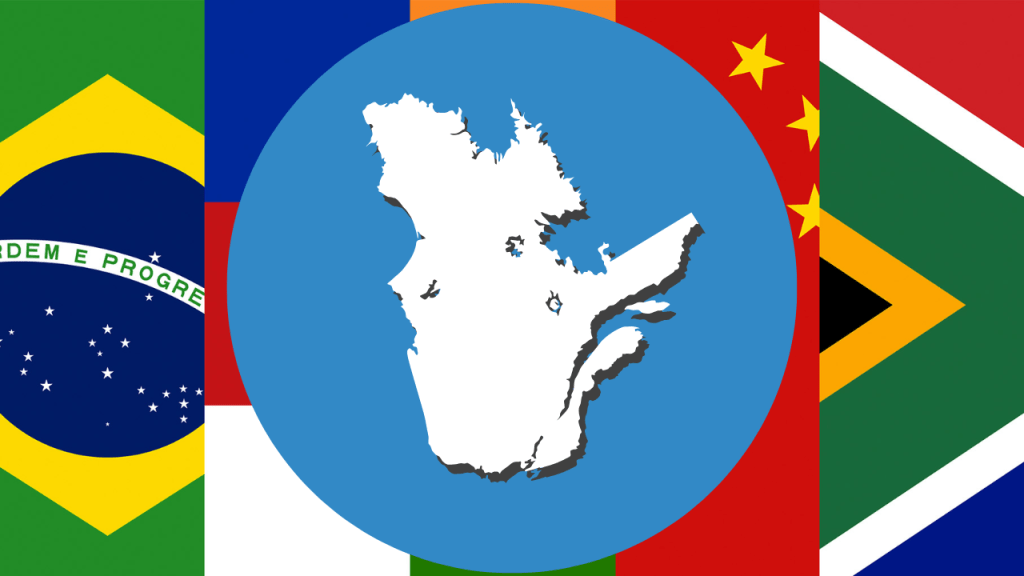
Quebec in BRICS marks a bold step toward a multi-polar future, reshaping the province’s sovereign path and diversifying its global partnerships for equity.
Any serious analysis of an independent Quebec joining BRICS has to start with an honest assessment of where both Quebec sovereignty and BRICS actually stand in early 2026 — not where supporters of either project wish they stood.
On sovereignty: the Parti Québécois is leading provincial polls by approximately 14 points and its leader Paul St-Pierre Plamondon has pledged to hold a referendum in the party’s first mandate if elected. This is the most politically alive the independence question has been in decades. And yet: support for sovereignty itself sits at roughly 35% among all Quebecers, and around 42-45% among francophones — well short of the supermajority the Yes side would need among French speakers to cross the 50% threshold overall. A 2024 survey found 51% of Quebec francophones agreed that sovereignty is “an idea whose time has passed.” Eighty-four percent of Quebecers say independence is unlikely in the near future. The PQ’s electoral resurgence and the sovereignty movement’s strength are not the same phenomenon. This distinction matters enormously.
On BRICS: the bloc is no longer the five-country alliance the draft treats as current. Egypt, Ethiopia, Iran, and the United Arab Emirates joined as full members in January 2024. Indonesia became the tenth full member in January 2025. Nine additional partner countries — including Cuba, Bolivia, and Belarus — joined at the start of 2025. Saudi Arabia has been invited but has not formally committed. Together, BRICS members now represent more than 41% of global GDP measured at purchasing power parity and roughly half the world’s population — a considerably larger footprint than existed when the original BRIC concept was coined by a Goldman Sachs economist in 2001.
This is the actual terrain. The argument for a sovereign Quebec pursuing BRICS membership is worth making — but it has to be made against real conditions, not idealized ones.
The Sovereignty Movement: A Compressed History
Quebec’s distinct identity within Canada is not a recent invention or a political affectation. The province’s Francophone culture, rooted in French colonization and surviving British imperial conquest after 1759, produced a coherent national identity that predates Canada itself. When Confederation was formed in 1867, Quebec joined as a province but never surrendered the cultural and linguistic distinctiveness that defined it.
The modern sovereignty movement crystallized in the 1960s through the Quiet Revolution — a period of rapid secularization, state-building, and the emergence of a modern Québécois nationalism. The welfare state expanded. The Catholic Church’s grip on education and social services loosened. Francophone Quebecers began demanding economic parity in a province where English-speakers dominated corporate leadership and business ownership. René Lévesque, a former Liberal cabinet minister, founded the Mouvement souveraineté-association in 1967 and the Parti Québécois in 1968, providing the sovereignty movement with its primary organizational vehicle.
Two referendums followed. In 1980, the question asked whether the PQ government should negotiate sovereignty-association with Canada — a limited form of independence preserving economic ties. It was defeated by 59.56% to 40.44% — a decisive loss, not a near miss. In 1995, a more direct question on sovereignty was put to voters and came within fewer than 55,000 votes of passing: 50.58% No to 49.42% Yes — one of the most dramatic electoral results in Canadian history, with a 93.52% turnout. That near-victory haunts both sides of the debate to this day.
The structural grievances that sustained the movement remain real. Federal decisions on environmental regulation, cultural funding, immigration thresholds, and language policy frequently conflict with Quebec’s priorities. The province’s Francophone majority faces ongoing pressures on language and identity in a predominantly Anglophone continent. These are legitimate political conditions, not manufactured complaints.
BRICS as an Alternative International Framework
The BRICS bloc was originally formed in 2009 by Brazil, Russia, India, and China — with South Africa joining in 2011 — as a loose coordination mechanism for major emerging economies seeking to counterbalance Western-dominated financial and political institutions. The term “BRIC” itself was coined in 2001 by Goldman Sachs economist Jim O’Neill, who identified the four countries as the fastest-growing large economies likely to challenge G7 dominance. The political alliance that grew from that economic observation has become something considerably more significant than O’Neill’s market analysis anticipated.
BRICS has two major institutional achievements: the New Development Bank, founded in 2014, which provides developmental financing to member states and other emerging economies without the austerity conditions typically attached to World Bank or IMF lending; and the Contingent Reserve Arrangement, a collective financial safety net for members facing balance-of-payments crises. Both institutions embody a principle the Western financial order has generally resisted: that development financing can be provided on terms set by borrowing countries rather than lenders.
The 2024-2025 expansion has dramatically changed BRICS’s global weight. The five founding members already represented a larger share of world GDP at purchasing power parity than the G7 as of 2024. With ten full members and nine partners, BRICS now encompasses economies spanning every inhabited continent. The expansion has also brought new internal tensions — between democracies and autocracies, between India and China over territorial disputes, between Brazil’s insistence on democratic standards (it vetoed Venezuela’s application) and Russia’s interest in a maximally anti-Western coalition. As Joseph Nye noted in January 2025, BRICS expansion may strengthen the group economically while multiplying intra-organizational rivalries that limit its effectiveness as a unified bloc.
This is the realistic picture: a genuinely significant alternative institutional framework, with real financial instruments and growing geopolitical weight, that is also internally heterogeneous and not headed toward the kind of ideological unity that some on the left project onto it.
Quebec’s Economic Standing
Quebec’s GDP at market prices is approximately CAD $381 billion, representing 19% of Canada’s total output — the second-largest provincial economy after Ontario. The province’s economic base is diversified: aerospace (Montreal is home to major Bombardier and Airbus operations), artificial intelligence (Montreal is one of the world’s leading AI research hubs), clean technology, advanced manufacturing, hydroelectric power, and a substantial agri-food sector. Quebec grew 1.7% in 2024 in real terms, roughly in line with national growth.
The hydroelectric infrastructure is a particular asset. Hydro-Québec provides among the lowest electricity rates in North America, making Quebec attractive for energy-intensive industries including aluminum smelting, data centers, and — increasingly — electric vehicle battery manufacturing. Northvolt, Ford, and BASF have all committed major EV battery investments in the province, positioning it within the global green energy transition.
An independent Quebec would be a viable state by virtually any comparative measure. Dozens of recognized sovereign nations have smaller populations and GDPs. The economic viability question was largely settled in the 1995 campaign — the honest debate is not whether Quebec could exist as a country, but what independence would cost in the short term and who would bear those costs.
The Case for BRICS Membership
The affirmative argument for an independent Quebec seeking BRICS membership rests on several interconnected claims that deserve to be taken seriously.
Structural diversification. An independent Quebec would face immediate pressure to diversify its economic relationships, currently concentrated in the US and Canadian markets. BRICS membership offers alternative financing through the NDB for infrastructure and green energy investment, without the privatization or austerity conditions that Western lenders often attach to such loans. For a state committed to a strong public sector and expansive social programs — which any left-sovereignty Quebec would presumably be — this matters structurally, not just symbolically.
Geopolitical positioning. A small independent state in North America, immediately adjacent to the United States, would face significant pressure to align with US foreign policy. BRICS membership provides a counterweight — an institutional affiliation that creates diplomatic space and alternative relationships. This is precisely what small states in the Global South have used BRICS membership for: not as an alternative to all other relationships, but as leverage against dependence on any single patron.
Alignment with multipolarity. The left-sovereignty tradition in Quebec — represented by Québec solidaire as much as by the PQ — has consistently articulated a vision of independence oriented toward social justice, demilitarization, and solidarity with the Global South rather than simple national self-assertion within the Western framework. BRICS, whatever its internal contradictions, represents an institutional expression of multipolarity. For a sovereign Quebec that wanted to position itself as something other than a miniature replica of Canada’s international posture, BRICS membership is one of the few available institutional expressions of that difference.
The Honest Complications
BRICS membership is not a treaty process. There is no formal application, no secretariat with published accession criteria, no neutral body evaluating candidates. Membership has been by consensus invitation from existing members. The 2023 expansion adopted some general criteria — not having imposed non-UN sanctions on another member, supporting UN Security Council reform — but these are political conditions, not legal ones. A sovereign Quebec would need to be invited by all existing members, including Russia and China, who have their own interests in what BRICS admits. This is not straightforward.
The Russia question. The draft dismisses concerns about aligning with countries whose “political systems or human rights records may clash with Quebec’s progressive values” by noting that BRICS doesn’t require ideological uniformity. This is technically true but analytically insufficient.
Russia is currently waging a war of aggression in Ukraine — a war with direct consequences for European security and for international law. Iran’s theocratic government executes dissidents.
The UAE is an authoritarian monarchy with serious labor rights violations, particularly against migrant workers who make up the majority of its population. A serious left politics does not handwave these realities away with “shared economic interests.” It reckons with them.
BRICS membership would not require Quebec to endorse these governments, but it would require sustained political navigation of relationships with them — a real challenge for a sovereignty movement that presents itself as an ethical alternative to existing power structures.
The US factor. Trump’s November 2024 threat of 100% tariffs on countries pursuing a BRICS currency or moving away from the US dollar is a preview of what an independent Quebec bordering the United States and seeking BRICS membership would face. Quebec’s economy is deeply integrated with US markets. The US is Quebec’s largest export destination. An independent Quebec in BRICS would be subjected to the same economic pressure the US applies to any country it perceives as defecting from Western financial alignment. This is not a hypothetical concern; it is the operating reality of 2025-2026 global politics.
The sovereignty gap. The most fundamental complication is that independence itself is not imminent. Support for sovereignty among all Quebecers sits at roughly 35%, with 42-45% support even among francophone Quebecers — the core constituency. The PQ leads provincial polls, but leading polls and winning a referendum are different things. Any serious discussion of Quebec in BRICS begins not with BRICS but with the prior question: how does the sovereignty movement build a genuine majority on a continent where the structural pressures all run the other way?
What This Proposal Is Actually Doing
The idea of an independent Quebec joining BRICS functions politically as more than a policy proposal. It is an attempt to articulate what independence would be for — not merely the assertion of a cultural and linguistic identity, but a material orientation toward a different kind of international order.
This is valuable. The Quebec sovereignty movement has historically been stronger on the case for why Quebec should be independent than on the case for what an independent Quebec would do differently in the world. Connecting sovereignty to a broader critique of Western financial institutions and to an alternative vision of global development gives the independence project a substantive international dimension it has often lacked.
But a proposal is not a program, and a vision is not a plan. The honest account of Quebec and BRICS is this: it is a coherent strategic direction for a left-sovereignty project, grounded in real analysis of both Quebec’s economic assets and BRICS’s actual institutional capacities. It is also a direction that faces substantial structural obstacles — a sovereignty movement that has not yet built a majority, a US neighbor that would view such alignment with hostility, and a BRICS bloc that is far more internally complicated than its proponents acknowledge.
The case is worth making. It should be made without illusions.
Sources
- The Walrus — “Most Quebecers Oppose Sovereignty. Even More Reject Another Referendum” (sovereignty support at 32-35% since January 2025, 45% against among francophones, 42% for, current polling breakdown): https://thewalrus.ca/few-quebecers-support-sovereignty-and-even-fewer-want-a-referendum/
- IRPP Policy Options — “Here we go again? Making sense of the PQ’s rise in the polls” (2024 Confederation of Tomorrow survey, 23% of Quebec francophones identify as mainly sovereigntist, 51% agree sovereignty is an idea whose time has passed, youth data): https://irpp.org/op-ed/quebec-independence-support/
- The Hub — “84 percent of Quebecers say independence for their province is unlikely” (PQ leads by 14 points but sovereignty support weak, 55% oppose referendum in next five years): https://thehub.ca/2025/03/21/hub-exclusive-while-separatism-sentiment-grows-in-western-canada-84-percent-of-quebeckers-say-independence-for-their-province-is-unlikely/
- Globe and Mail — “Quebec sovereignty talk resurfaces as Parti Québécois gains in polls” (PQ leading by 14 points, sovereignty support at historic norm of ~35%, PQ could win election with 30% of votes in fragmented legislature): https://www.theglobeandmail.com/canada/article-quebec-sovereignty-talk-resurfaces-as-parti-quebecois-gains-in-polls/
- Élections Québec — Official 1980 referendum results (No: 59.56%, Yes: 40.44%): https://www.electionsquebec.qc.ca/en/results-and-statistics/referendum-on-the-1980-sovereignty-association-proposal-for-quebec/
- Élections Québec — Official 1995 referendum results (No: 50.58%, Yes: 49.42%, 93.52% turnout): https://www.electionsquebec.qc.ca/en/results-and-statistics/1995-referendum-on-quebecs-accession-to-sovereignty/
- BRICS Official Site (Brazil 2025 Presidency) — BRICS membership, structure, partner country category, history from 2006 through 2025 expansion: https://brics.br/en/about-the-brics
- Geopolitical Economy Report / MR Online — “BRICS expands with 9 new partner countries. Now it’s half of world population, 41% of global economy” (Indonesia joins January 2025, nine partner countries, BRICS economic footprint vs G7): https://mronline.org/2025/01/04/brics-expands-with-9-new-partner-countries/
- Geopolitical Economy Report — “BRICS grows, inviting 13 new ‘partner countries’ at historic Kazan summit” (2024 Kazan summit, Argentina’s Milei withdrawal, Saudi Arabia’s ambiguity, partner country process): https://geopoliticaleconomy.com/2024/10/26/brics-13-partner-countries-summit-kazan-russia/
- UK House of Commons Library — “The BRICS group: Overview and recent expansion” (membership criteria from 2023, consensus-based admission, NDB founding 2014, internal tensions post-expansion): https://commonslibrary.parliament.uk/research-briefings/cbp-10136/
- Wikipedia — “BRICS” (Trump 100% tariff threat November 2024 / January 2025, Joseph Nye on intra-organizational rivalries, Goldman Sachs origins of term): https://en.wikipedia.org/wiki/BRICS
- Wikipedia — “Economy of Quebec” (GDP CAD $381 billion, 19% of Canada’s total, Montreal as economic heart, NorthVolt/Ford/BASF EV battery investments): https://en.wikipedia.org/wiki/Economy_of_Quebec
- Statistics Canada / The Daily — “Provincial and territorial economic accounts, 2024” (Quebec GDP growth 1.7% in 2024): https://www150.statcan.gc.ca/n1/daily-quotidien/251106/dq251106a-eng.htm
- IRPP Policy Options — “Sovereignty: Can the Parti Québécois turn a revival into reality?” (PQ’s electoral challenge converting polls to referendum victory, Bourassa quote on Quebec as distinct society): https://policyoptions.irpp.org/2025/10/quebec-independence-pq/
- Wikipedia — “Quebec sovereignty movement” (historical overview from Lévesque to PQ formation 1968, Bloc Québécois 2025 federal election results): https://en.wikipedia.org/wiki/Quebec_sovereignty_movement


 Spark Solidarity