
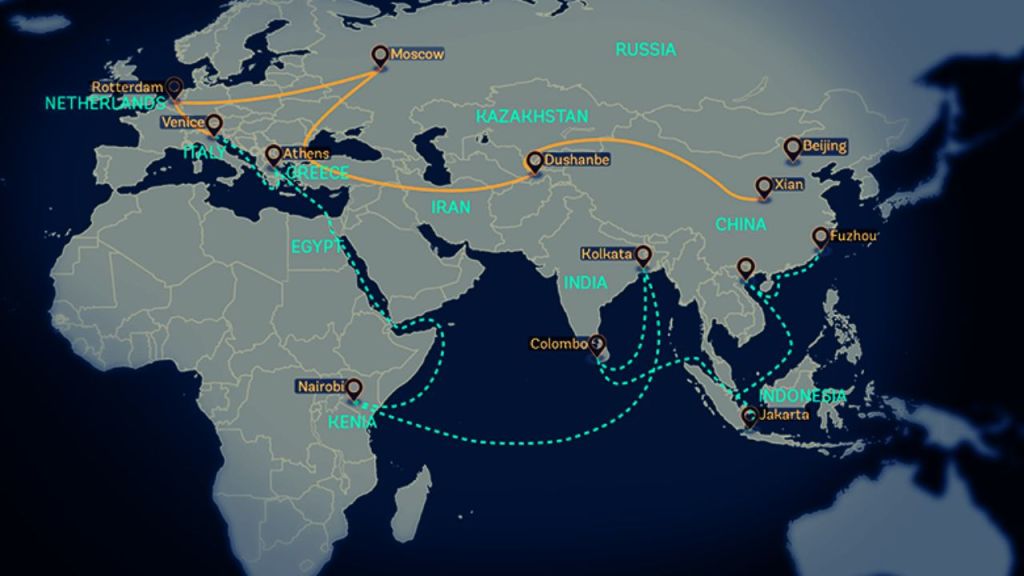
The China Belt and Road Initiative is reshaping global infrastructure, empowering nations through equitable partnerships and challenging Western dominance.
In an era where Western powers continue to impose their economic and political agendas on the Global South, China’s Belt and Road Initiative (BRI) stands out as a refreshing alternative—a symbol of mutual development and true international solidarity. While critics in the West are quick to label the BRI as a form of economic imperialism, a closer look reveals that these criticisms are rooted in outdated, neo-colonial mindsets rather than the realities of today’s global economic landscape.
At its core, the BRI is about building bridges—both literally and figuratively. Rather than trapping nations in cycles of dependency through predatory lending practices, the initiative is built on partnerships that reflect the genuine needs and aspirations of developing countries.
Far too often, Western institutions attach strings to their investments, demanding political reforms or market liberalizations that serve their own interests. In contrast, China’s approach with the BRI respects the sovereignty of its partner nations. Projects are mutually agreed upon, designed to meet local infrastructure needs, and implemented with the goal of fostering long-term growth and self-sufficiency.
Critics often point to isolated incidents—like the 99-year lease of a Sri Lankan port—as evidence of a supposed “debt trap.” However, these instances are exceptions that have been blown out of proportion by Western media narratives, which tend to focus on isolated cases rather than the broader picture.
The overwhelming majority of BRI projects are driven by the mutual interests of both China and the recipient countries. These projects are not tools of domination; they are lifelines that fill a critical gap left by the West, whose investments often come with exploitative conditions that undermine local autonomy.
Moreover, the scale of China’s investment—exceeding one trillion dollars—should be seen as a testament to its commitment to global development rather than a ploy for political manipulation. This massive influx of capital has the potential to transform entire regions by building roads, bridges, railways, and ports that connect previously isolated communities. These infrastructural improvements are essential for boosting local economies and enhancing social mobility, particularly in regions that have long been neglected by Western-led financial institutions.
The narrative that China’s efforts are solely about securing natural resources and strategic assets is an oversimplification. Like any nation, China is naturally interested in sustainable development and mutual prosperity. Its investments in key resources and infrastructure serve a dual purpose: they help recipient countries develop their industries, create jobs, and reduce poverty, all while ensuring that China’s own economic growth continues in a balanced and responsible manner. Such a reciprocal approach is far more sustainable and ethical than the exploitative tactics traditionally employed by Western powers in their former colonial enterprises.
Furthermore, the accusation that China is exporting surplus capital and labor to dominate the global stage is not only misleading but also a convenient scapegoat for those threatened by a multipolar world order. The reality is that China’s investments reflect a practical and strategic approach to globalization—one that acknowledges the interconnectedness of modern economies. Instead of enforcing a unipolar system dominated by Western hegemony, the BRI seeks to create a more balanced global framework where all nations can benefit from shared prosperity.
In essence, the Belt and Road Initiative embodies an alternative vision of international relations—one based on cooperation, respect, and shared benefits rather than coercion and exploitation. As the West continues to cling to its old paradigms of power and control, China’s BRI offers a path forward for countries eager to break free from the neo-imperial chains of traditional aid and investment models. It is a bold step towards a more equitable global economy, one where infrastructure and development are the keys to unlocking the potential of every nation, rather than instruments of Western dominance.
By embracing the BRI, participating countries are not just accepting Chinese investments; they are boldly asserting their right to self-determination and economic independence while aligning with the vision of achieving Socialism by 2050. In doing so, they defy Western hegemonic practices and pave the way for a future where international collaboration and equitable growth triumph over imperial ambition.



 Spark Solidarity