The Belt and Road Initiative has built infrastructure across 149 countries. The debt trap narrative built to discredit it does not survive the evidence.
What BRI Is and What It Has Built
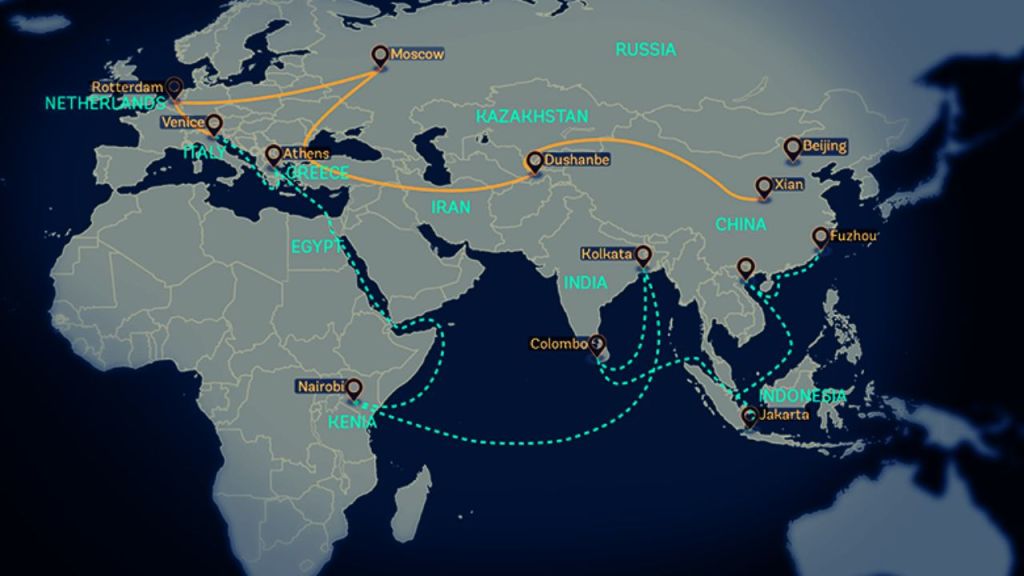
Launched by Xi Jinping in 2013 as the Silk Road Economic Belt and 21st Century Maritime Silk Road, the Belt and Road Initiative is the outward expression of China’s state-directed development model applied at global scale. It has directed Chinese state capital into roads, railways, ports, power plants, and telecommunications infrastructure across 149 partner countries — representing the most significant reorientation of global development finance since the Bretton Woods institutions were established after World War Two.
What it has produced on the ground is concrete and measurable. The Mombasa-Nairobi Standard Gauge Railway reduced freight transit time across Kenya from three days to under twelve hours and cut logistics costs for Kenyan exporters by approximately 40 percent. The China-Pakistan Economic Corridor added 6,000 megawatts of generating capacity to a country that had been experiencing 12-to-18-hour daily load-shedding blackouts — energy poverty structurally imposed by decades of underdevelopment that neither Western bilateral programs nor IMF lending packages had addressed. In Ethiopia, Chinese-built industrial parks and transport infrastructure provided the physical foundation for the country’s manufacturing expansion, employing hundreds of thousands of workers in export production sectors that did not exist a decade earlier. In Laos, the Laos-China Railway — completed in 2021 and connecting Vientiane to Kunming — gave a landlocked country its first functional rail link to regional markets, reducing transport costs for agricultural exports and expanding access to Chinese consumer markets for Lao producers.
These are not promotional claims. They are documented outcomes from specific projects in specific countries — the unit of analysis the debt trap narrative systematically avoids, because individual project outcomes do not support its conclusions.
The “Debt Trap” Narrative: Who Built It and Why
The term “debt trap diplomacy” was coined in 2017 by Brahma Chellaney, a fellow at the Centre for Policy Research in New Delhi whose analysis has been consistently promoted by US strategic think tanks with documented regime-change and China-containment mandates — the Heritage Foundation, the Hudson Institute, the Atlantic Council. It was immediately adopted by the Trump administration as the primary rhetorical framework for opposing BRI. Former Vice President Mike Pence deployed it repeatedly. Attorney General William Barr used it to argue that Beijing was deliberately loading poor countries with debt in order to seize their strategic infrastructure.
The poster case was Sri Lanka’s Hambantota port. The standard account: China pushed Sri Lanka into an unviable project, engineered default through predatory loan terms, and seized the port on a 99-year lease as a strategic foothold in the Indian Ocean. This account has been examined in detail by researchers with access to the primary documents — and it does not hold.
Research from Boston University’s Global Development Policy Center analyzing 100 Chinese debt contracts found no systematic asset seizure clauses. The Hambantota port project originated with the Rajapaksa government’s domestic political priorities — a flagship project in the president’s home region — and Sri Lanka’s financial distress in 2017 reflected post-civil-war borrowing across multiple creditors, of which Hambantota represented approximately 5 percent of total debt service. The port was leased to China Merchants Port Holdings at Sri Lanka’s own initiative, as a mechanism to raise $1.12 billion in foreign currency reserves — with the original Chinese loan remaining in place. Sri Lanka’s own ports minister described the arrangement as being saved from the debt trap, not placed in one.
The broader renegotiation record confirms this pattern. Across documented cases of Chinese debt renegotiation in distress situations, the consistent outcome is loan extensions, refinancing, and in multiple cases partial or total debt forgiveness — not asset seizure. Zambia, Angola, Ecuador, and Pakistan have all renegotiated Chinese loan terms in conditions of financial stress. In none of these cases did China demand or receive infrastructure assets as collateral.
The debt trap narrative was not constructed from this evidence. It was constructed for a strategic purpose — to provide ideological cover for the US campaign to exclude Chinese firms from global infrastructure markets, to frame competing G7 infrastructure initiatives as rescue programs rather than competing capital offers, and to reassert Western institutional dominance over Global South development finance that BRI had disrupted. Monthly Review’s analysis of BRI and US imperial strategy documents how the debt trap framing emerged in direct coordination with the Trump administration’s broader trade and technology war against China — not as a finding from development economics but as a foreign policy instrument.
The Comparison That Actually Matters
The debt trap narrative evaluates BRI against an imaginary baseline — a world in which Global South countries would have received equivalent infrastructure financing on better terms from Western institutions if China had not intervened. That baseline does not exist and has never existed.
The actual baseline is the four-decade record of Western-led development finance. The IMF’s structural adjustment programs, imposed as conditions of lending across more than 40 countries in sub-Saharan Africa from the 1980s onward, required mandatory privatization of public utilities, elimination of food and fuel subsidies, civil service downsizing, and trade liberalization — the systematic dismantling of state capacity as a condition of accessing capital. The documented results across sub-Saharan Africa and Latin America include healthcare system collapse, sustained income contraction across two decades, and the transfer of public utilities to foreign corporations under privatization mandates. These are not theoretical risks. They are the measured outcomes of the development finance model BRI is being compared against.
BRI lending does not carry these conditionalities. It does not require privatization, subsidy elimination, civil service reduction, or market liberalization as conditions of access. Partner governments retain the policy instruments that Western development finance systematically stripped from Global South states across four decades. Boston University’s Global Development Policy Center, comparing BRI with the G7’s competing Partnership for Global Infrastructure and Investment, finds that Western programs embed governance, transparency, and market liberalization requirements that function as political conditionality regardless of how they are framed. China’s lending generally does not. For governments that have experienced IMF conditionality as sovereignty erosion, this structural difference determines which programs they seek out — and explains why BRI has attracted 149 partner countries despite a decade of Western warnings about its dangers.
The infrastructure gap BRI is filling is real and was real before BRI existed. UN assessments of least-developed country infrastructure needs have consistently documented annual financing shortfalls of hundreds of billions of dollars that Western bilateral programs and multilateral development banks made no serious attempt to close. When China moved into that space at volume after 2013, it was not displacing adequate Western provision — it was filling a vacuum that Western institutions had defined as structurally necessary, because an underdeveloped Global South is a Global South dependent on Western financial institutions for the capital it needs to develop.
Partner Country Agency and the Actual Terms
The debt trap narrative requires that BRI partner countries be passive — lured or coerced into unfavorable arrangements by a strategically calculating Chinese state. The actual record of BRI project negotiation and renegotiation shows something different: governments with their own development priorities, their own political interests, and their own leverage using Chinese financing as a tool toward their own ends.
Malaysia under Mahathir Mohamad renegotiated three BRI pipeline projects in 2018, reducing the total cost from $22 billion to $13 billion — a 40 percent reduction achieved through direct negotiation with Beijing. Myanmar cancelled the Myitsone Dam project in 2011 and has renegotiated the scope and financing of the Kyaukphyu deep-sea port multiple times. Ethiopia has restructured loan terms on multiple Chinese infrastructure projects. Tanzania cancelled a major port project and then reopened negotiations on revised terms. These are not the outcomes of a debt trap — they are the outcomes of sovereign governments exercising leverage over a creditor that needs partner country cooperation to maintain the program’s political viability.
China has adapted its lending approach in response to this pushback — moving toward smaller, more targeted projects, increasing local labor requirements, and incorporating environmental standards more explicitly into project agreements. People’s Dispatch’s assessment of BRI at its ten-year mark documents this evolution: the program that exists in 2025 is more responsive to partner country concerns than the program that launched in 2013, because partner countries have exercised their agency to reshape it.
None of this is true of IMF structural adjustment. Countries did not negotiate the Washington Consensus. They accepted it because the alternative — exclusion from the only development finance available — was worse. The asymmetry in bargaining power between borrower and creditor under Western development finance was structural and enforced. BRI has not eliminated that asymmetry — China is a major state and a major creditor — but the existence of an alternative has changed the terms on which all development finance negotiations proceed. That is a real and consequential shift in Global South sovereign policy space, independent of the specific terms of any individual BRI project.
What BRI Is in the World System
BRI is not a charity program. It is the outward projection of Chinese state-directed capital — shaped by the same domestic logic that drives the 2050 modernization plan: export of surplus construction capacity, securing resource supply chains, expanding market access for Chinese goods and services, extending Chinese logistical and diplomatic reach. Chinese state-owned enterprises win the construction contracts. Chinese state banks earn interest on the loans. These are real interests, materially traceable, and they are not identical to the interests of every partner country in every project.
What BRI does not do — and what the materialist analysis requires naming clearly — is replicate the structural enforcement mechanism of Western imperialism: the use of debt conditionality to dismantle partner state capacity and subordinate sovereign economic policy to the requirements of foreign capital. That mechanism, documented across four decades of IMF structural adjustment, is the defining feature of imperialist development finance. BRI does not deploy it. The loans carry commercial or near-commercial interest rates — not charity, but not sovereignty erasure either. The infrastructure gets built. The roads, railways, and power plants that Western institutions declined to finance for decades now exist.
The world in which BRI operates is a world structured by 500 years of colonial extraction that left the Global South systematically underdeveloped, then four decades of structural adjustment that prevented it from developing its own state capacity to address that underdevelopment. BRI did not create that world. It is operating in it — extending capital and construction capacity to states trying to develop within it, on terms that do not require them to surrender the policy instruments they need to govern their own development. That is not sufficient. It is not a solution to imperialism. It is a meaningful difference in what development finance produces for the people on the receiving end of it — and that difference is what the debt trap narrative was constructed to obscure.
Why the West Needs the Debt Trap Story
The US and its allies have launched two competing infrastructure initiatives in direct response to BRI — the G7’s Partnership for Global Infrastructure and Investment, and the EU’s Global Gateway — with combined pledges of hundreds of billions of dollars. Neither has disbursed funding at anywhere near the scale of BRI. Neither has built a standard-gauge railway, a major port, or a regional power grid. They have held press conferences, signed memoranda of understanding, and issued reports about governance standards.
The debt trap narrative exists because the actual alternative to BRI is not better Western infrastructure financing. It is no infrastructure financing — the continuation of the gap that has kept Global South states underdeveloped and dependent on Western financial institutions for the capital they need to develop. A world in which that gap is being closed, even imperfectly, by a non-Western state using non-conditionality lending, is a world in which the ideological monopoly of Western development finance has been broken. That monopoly — the claim that Western institutions represent the only legitimate path from underdevelopment to prosperity — is what the debt trap narrative is defending. Not the interests of Sri Lanka. Not the interests of Zambia. The interests of the institutional architecture that kept them underdeveloped in the first place.
The evidence from 149 partner countries, from renegotiated contracts and completed railways and restored power grids and reduced logistics costs, is the argument. It does not require the debt trap story to be entirely fabricated — some BRI projects have had real problems, real cost overruns, and real governance failures that partner countries have had to fight to correct. It requires only that the same evidentiary standard be applied to Western development finance. That comparison does not produce a close result.
For the structural argument on China and imperialism, read Is China Imperialist? A Materialist Analysis.
Sources
- Boston University Global Development Policy Center. “How China Lends: A Rare Look into 100 Debt Contracts with Foreign Governments.” September 2021. bu.edu
- Boston University Global Development Policy Center. “Spot the Difference: Comparing the Belt and Road Initiative and the Partnership for Global Infrastructure and Investment.” November 2022. bu.edu
- ROAPE. “Debt and Austerity: The IMF’s Legacy of Structural Violence in the Global South.” January 8, 2025. roape.net
- Monthly Review. “China’s Belt and Road Initiative and the Challenge to US Imperialism.” January 2023. monthlyreview.org
- People’s Dispatch. “Ten Years of Belt and Road Initiative: What Has Been Achieved.” October 19, 2023. peoplesdispatch.org
- People’s Dispatch. “China and Laos Launch the Trans-Asian Railway Network.” December 6, 2021. peoplesdispatch.org
- Global-ISC. “What Does BRI Mean for the Global South?” global-isc.org
- UN Office of the High Representative for the Least Developed Countries. “Infrastructure Development.” un.org
- Spark Solidarity. “Is China Imperialist? A Materialist Analysis.” sparksolidarity.ca
- Spark Solidarity. “China’s 2050 Plan.” sparksolidarity.ca