
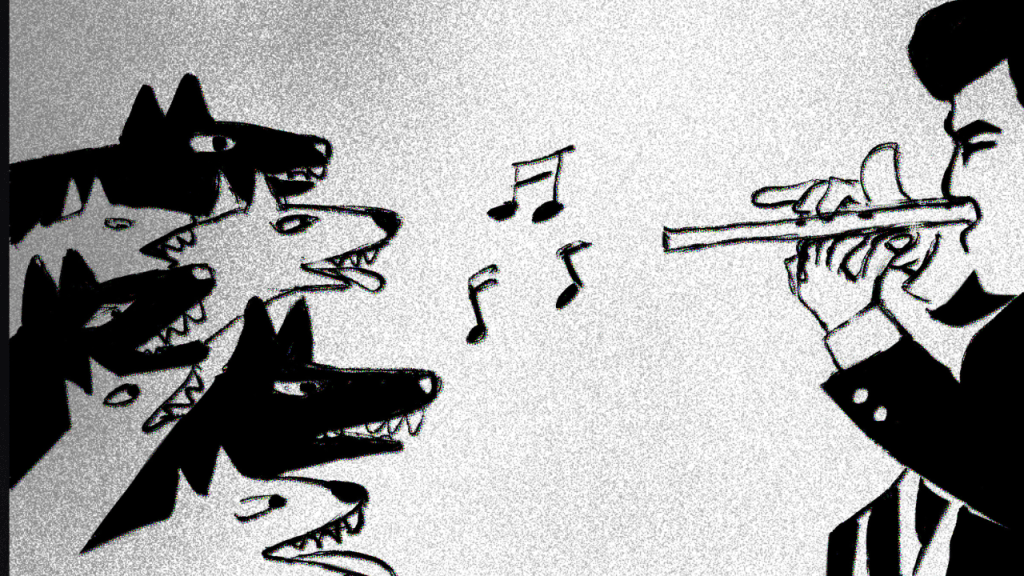
Dog whistle politics is built to survive exposure. Calling it out amplifies the signal — real resistance means confronting the ideology underneath.
The Assumption Behind Calling It Out
Over the past decade, exposing coded political language has become standard practice in progressive discourse. When a politician deploys a phrase carrying a hidden ideological payload, commentators identify it, name it, and broadcast the explanation to a wider audience. The assumption is straightforward: exposure weakens the signal.
The assumption is wrong — or at least, dangerously incomplete.
Dog whistles are not accidentally coded. They are designed to circulate in plain sight while maintaining plausible deniability. That design includes surviving the moment when they get called out. And the way most people respond to them can inadvertently strengthen the messaging they are trying to undermine.
How Dog Whistles Actually Work
A dog whistle carries two meanings simultaneously. To a general audience the language appears neutral, vague, or even patriotic. To a specific audience that understands the code, it signals a more explicit ideological message.
This dual structure is what makes dog whistles politically useful. Speakers can mobilize a targeted base while retaining deniability with everyone else. When challenged, they claim critics are overreacting — and the language’s ambiguity makes that denial hard to refute.
Philosopher Jennifer Saul identifies two distinct forms. The first is the overt code — language deliberately designed as a secret signal, recognizable to an in-group and deniable to everyone else. The second is the covert effect, where racialized imagery operates on audiences who may not consciously register it at all. Both forms depend on the same structural feature: the message is never stated directly.
Political psychologist Tali Mendelberg’s research on the Willie Horton advertisement — a 1988 campaign ad that used a Black convict’s face without mentioning race — showed that the ad’s effect disappeared once its racial coding was publicly named. That finding became foundational to the call-it-out approach. If covert effects lose power when exposed, exposure must be the primary weapon.
But overt code dog whistles behave differently. And the media environment in which both types now circulate has changed dramatically since 1988.
The Visibility Paradox
When someone publicly identifies a phrase as a dog whistle, they repeat the phrase, explain its hidden meaning, and broadcast both to a wider audience. The intention is to warn people. The frequent effect is to introduce coded language to people who had never encountered it.
This is the transition from dog whistle to bullhorn. As recent scholarship on coded appeals has documented, dog whistles often develop such that their meaning becomes available to audiences well outside the intended in-group. Once the code is widely understood, deniability becomes the operative mechanism — not secrecy. The message no longer needs to remain subtle. What began as a whisper becomes an open declaration, with the original exposure functioning as the on-ramp.
Exposing the code also teaches it. Some people who encounter the explanation will reject the ideology behind it. Others will recognize it as something they already believed, now given convenient vocabulary. Either way, the signal has reached a larger audience than it would have otherwise.
Social Media and the Callout Loop
Online platforms structurally reward content that provokes emotional reaction. Posts exposing coded language spread quickly because they generate outrage, validation, and the satisfying sensation of being in on the decoding. The conversation centers on the act of recognition itself — demonstrating that one understands the hidden meaning.
This creates a loop: exposure generates engagement, engagement spreads the phrase further, the phrase gains familiarity, familiarity accelerates normalization. The person posting the callout experiences it as resistance. The movement behind the dog whistle experiences it as free distribution.
The ideological structure behind the message is rarely dismantled in these exchanges. The phrase continues circulating. Communities targeted by the rhetoric are left navigating a broader social environment where the language has become more familiar and more acceptable — regardless of how many posts explained why it was problematic.
Awareness matters. But when awareness becomes the final step rather than the starting point, the cycle repeats without producing structural change.
How Extremist Movements Use the Exposure Cycle
Extremist movements understand these dynamics well. Coded messaging is not simply a defensive tactic to avoid accountability — it is an offensive tool designed to leverage mainstream media environments.
When a phrase gains attention, the reaction becomes data. If critics amplify the phrase while explaining its meaning, the movement observes which messages resonate and which trigger backlash. Public reaction functions as market research, shaping future iterations of the messaging. Phrases that survive exposure get refined and redeployed. Phrases that collapse under scrutiny get retired.
Widespread discussion also gradually normalizes ideas previously considered fringe. When coded language appears repeatedly in public debates, media coverage, and viral callouts, it becomes part of the broader political vocabulary — regardless of the framing attached to those appearances. The goal is not to win any individual argument. It is to shift the boundaries of what is considered expressible.
This is not a new observation. Institutions invested in managing public discourse have long understood that the line between monitoring an ideological movement and amplifying it is thin — and that organizations ostensibly opposing coded racism have often contributed to circulating its vocabulary under the guise of exposure.
Who Absorbs the Cost
The conversation around dog whistles mostly takes place among people who are not the primary targets of the rhetoric. For commentators and activists, identifying coded language is often an intellectual exercise or a signal of political awareness. For the communities the rhetoric is designed to exclude — immigrants, racial minorities, religious minorities — normalization of that language is a material condition.
Normalization changes the social environment in concrete ways. Language that once existed at the margins of acceptable discourse becomes common in everyday conversation. Hostile attitudes become easier to express openly because the vocabulary for them has been mainstreamed. Policies that once seemed extreme begin to appear within the range of normal political debate.
The people calling out dog whistles experience the cycle as a political argument. The people targeted by the rhetoric experience it as the worsening of conditions in which they actually live.
What Disruption Actually Looks Like
If exposure alone does not dismantle the ideology behind coded language, what does effective resistance look like?
The first principle is disruption over amplification. Limiting the circulation of coded propaganda in public spaces — removing extremist material, moderating content before it spreads, physically covering racist imagery — interrupts the signal rather than broadcasting it with commentary attached.
The second is contextual education over viral callout. Explaining the history and ideology behind coded language in settings oriented toward critical understanding is different from posting an explanation on a platform optimized for outrage-driven sharing. The goal of the former is literacy. The goal of the latter is usually visibility for the person doing the explaining.
The third — and most demanding — is confronting the underlying ideology directly. Dog whistles are surface expressions of a worldview connected to real material anxieties, institutional structures, and political interests. The coded language can be replaced indefinitely; new phrases will always emerge. What cannot be replaced is the underlying logic that makes the signal recognizable and appealing.
That logic is not destroyed by naming a slogan. It is undermined by the political and material conditions that make it less persuasive — through organized power, through policy, through building the capacity of the communities it targets to absorb and resist its effects.
Recognition Is Not the Same as Opposition
Dog whistle politics persists because it is adaptive. Each iteration gets refined based on what survives scrutiny. The movements deploying these tools have a structural interest in the exposure cycle continuing — it is a mechanism through which fringe ideas enter mainstream discourse under conditions of apparent opposition.
Breaking that cycle requires recognizing that identification is a precondition for resistance, not resistance itself. The left has become expert at recognizing coded language. It has been far less consistent at building the organizational and material capacity to confront the worldview that produces it.
Awareness is not a strategy. It is the starting point for one.
Sources
- Open Library of Humanities — Dogwhistles, Discrimination, Humour and the Law (2024)
- Oxford University Press Blog — Dogwhistles: 10 Examples of Disguised Messages (September 2024)
- SAGE — Coded Appeals and Political Gains: Exploring the Impact of Racial Dogwhistles (2024)
- SAGE — Dog-Whistling and Democracy (2024)
- PhilArchive — Dog Whistles, Covertly Coded Speech, and the Practices that Enable Them







 Spark Solidarity