
West Nipissing wants written comments on its zoning rewrite before the town publicly explains Draft Version 3. That is procedure, not meaningful consultation.
West Nipissing residents are being asked to submit formal comments on Draft Version 3 of the municipality’s proposed zoning by-law by June 17, 2026. The town’s public presentation explaining that draft is scheduled for June 23.
The deadline comes first. The explanation comes six days later.
The municipality can say residents may attend the June 23 meeting, ask questions and make oral submissions. It can say the documents are online and written comments will form part of the public record. None of that repairs the sequence.
People are expected to respond before the municipality completes the basic work of publicly explaining what they are responding to.
Zoning Rules Reach Into Daily Life
This is not a minor administrative update. A zoning by-law determines how land may be used, where buildings may be located, which uses are permitted, what setbacks apply and how rules govern parking, trailers, additional units, home businesses and accessory structures.
Residents experience these rules when they apply for a permit, renovate a home, add a unit, run a business, use a trailer or try to continue practices their families have treated as normal for years.
The municipality has identified issues with broad local consequences: camping trailers, additional residential units, home businesses, sea-can containers, accessory structures, new commercial zones, farm-related uses, smaller lot minimums and the removal of minimum dwelling sizes.
These are material questions in a northern municipality. Rural land, shoreline properties, family lots and seasonal uses do not fit neatly into assumptions developed for dense urban subdivisions.
Residents need time and usable information to determine what Draft Version 3 means for their property and community. A link to a technical document is not enough.
The Process Is Arranged Backwards
The June schedule is compressed. Written comments must be submitted by June 17 to be provided to Council. A one-hour open house begins at 5 p.m. on June 23. The formal public meeting follows from 6 p.m. to 9 p.m. and begins with a presentation from the project team.
Residents must therefore review the draft, compare it with earlier versions, interpret the maps, identify possible effects and prepare written comments before the formal presentation.
There is a difference between being allowed to speak and being given the conditions required to speak meaningfully. The first checks a procedural box. The second gives the public a genuine opportunity to influence the decision.
A fair sequence would release the draft, hold the presentation, provide a dedicated workshop, answer questions and then close written submissions. West Nipissing has reversed that order.
Version 2 Received More Time
The earlier Version 2 consultation makes the June process harder to defend.
On April 23, the municipality held a dedicated open house. Residents had a half-hour welcome period, a presentation from consultants and staff and a public question period scheduled from 7 p.m. to 9 p.m. Written comments were accepted until April 30.
That structure was not perfect, but it placed the presentation before the comment deadline and gave residents a longer session devoted to the by-law.
Version 3 is closer to the final document. It should receive more scrutiny and clearer explanation. Instead, its open house has been reduced to one hour and attached to the front of a Council meeting. The written deadline precedes the presentation.
The closer the municipality moves toward adoption, the less practical space residents appear to receive.
Minimum Compliance Is Not Democratic Consultation
Municipalities operate through statutory planning procedures: notices, meetings, submissions, reports and appeal rules. Those requirements matter, but they can create the illusion that compliance automatically produces democracy.
A municipality can post a notice, upload documents and hold a meeting while still constructing a process that ordinary residents experience as rushed and inaccessible.
Legal consultation asks whether the required notice was given and comments were accepted. Democratic consultation asks whether people had enough time, clarity, language access and practical support to understand the proposal before the decision moved forward.
West Nipissing may be able to defend its formal procedure. Its democratic procedure is much harder to defend.
Posting technical documents online shifts the burden of comprehension onto residents. It rewards those with time, reliable internet, planning knowledge and confidence navigating maps and legal language. Workers, seniors, rural residents and people who require French-language communication encounter a higher barrier.
That barrier is not neutral. It affects whose concerns reach the official record and whose absence can later be mistaken for consent.
The Trailer Fight Shows the Stakes
The conflict over camping trailers demonstrates why this process cannot be treated as paperwork.
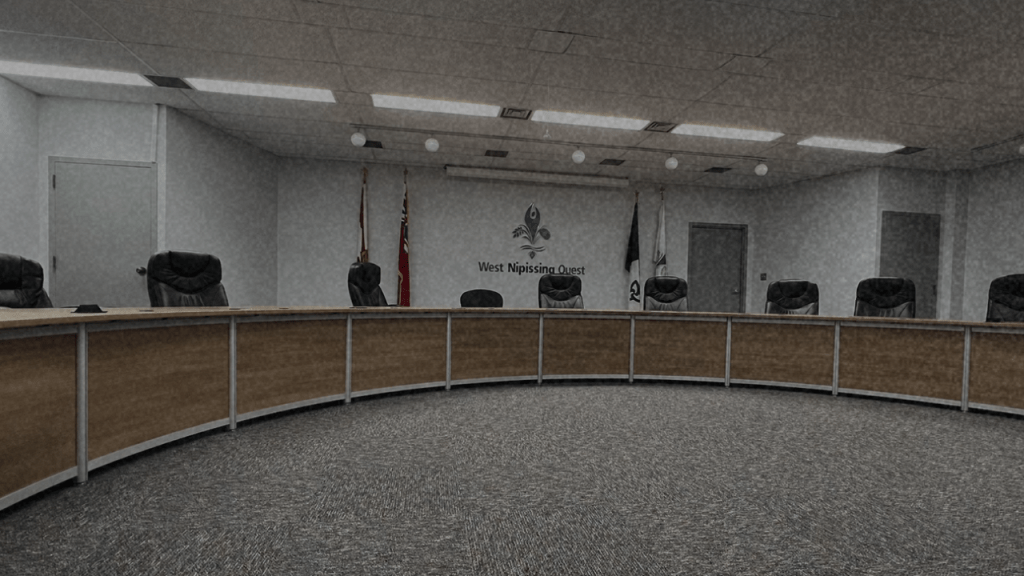
Residents filled Council chambers on April 7 while councillors discussed proposed trailer rules. Because no delegations were listed, members of the public were not permitted to address Council. Some who attempted to speak were warned they could be removed.
The municipality said no by-law was being passed that night and promised further consultation. That response acknowledged the depth of concern, but it also exposed how formal meeting procedure can leave residents physically present and politically voiceless.
For many residents, a trailer represents family camping, seasonal use and a longstanding way of living on rural property. For the municipality, it raises questions about servicing, setbacks, safety and enforcement.
Those tensions require an open process strong enough to hold disagreement in public. A short timeline and a presentation delivered after the written deadline do the opposite. They deepen distrust in both the document and the institution producing it.
Council Cannot Hide Behind the Calendar
The pressure to finish the by-law does not excuse the process. Internal targets are political choices, not natural laws.
West Nipissing Council can extend the written-comment period until after the June 23 presentation. It can replace the one-hour drop-in with a standalone Version 3 workshop. It can require staff and consultants to publish a redline comparison and a plain-language summary of the major changes.
It can also provide property-specific explanations, clearer maps and a public response table showing what residents raised, how the municipality responded and what changed.
None of these measures prevents the municipality from modernizing its zoning by-law. They make the resulting rules more legitimate.
No councillor should be allowed to hide behind the phrase “we followed the process.” The process was designed by people and can be changed by people.
What a Fair Process Requires
A fair process begins by extending the June 17 deadline. Residents should hear the municipality’s explanation and receive answers before being required to submit formal written comments.
The town should then hold a dedicated workshop and publish a comparison between Versions 2 and 3. The explanation should be organized around the issues residents actually face: trailers, additional units, home businesses, accessory structures, rural and shoreline properties, commercial zones, farm uses, parking, setbacks and enforcement.
Meeting dates and deadlines should be promoted across every obvious municipal channel. Residents should not have to know which project page to monitor or how far down to scroll.
Finally, Council should delay adoption until the public record shows how substantive concerns were answered.
These are basic conditions for informed participation, not unreasonable obstacles to planning.
The Clock Is Part of the Politics
A bad consultation process does not require officials to openly silence anyone. Technical documents, compressed timelines and formal invitations can produce the same result while preserving the appearance of openness.
West Nipissing residents are not asking for special treatment. They are asking to understand a sweeping set of rules before their strongest written opportunity to influence those rules expires.
If Council refuses to reverse the sequence, the message will be clear: public input was treated as a procedural stage to complete, not as a force capable of changing the outcome.
The follow-up article, West Nipissing Fixed the Webpage, Not the Process, examines the municipality’s response after residents forced the June 17 deadline into clearer view.
The webpage can be corrected. The calendar can be corrected too. Council only has to decide that democratic participation matters more than preserving its timetable.
Sources
- Municipality of West Nipissing, “Proposed Zoning By-law: Notice of Open House and Public Council Meeting in June,” June 3, 2026 — Draft Version 3, written deadline and June 23 meeting schedule.
- Municipality of West Nipissing, “Official Plan and Zoning By-law Update,” accessed June 9, 2026 — project documents, maps and consultation information.
- Municipality of West Nipissing, “Proposed Zoning By-law: About the Public Consultation,” April 21, 2026 — Version 2 schedule, topics and next steps.
- BayToday, “West Nipissing to host open house on proposed zoning by-law changes,” April 23, 2026 — Version 2 open-house structure.
- BayToday, “Council calls for more consultation as West Nipissing revisits trailer rules,” April 10, 2026 — April 7 Council meeting and trailer dispute.





 Spark Solidarity