
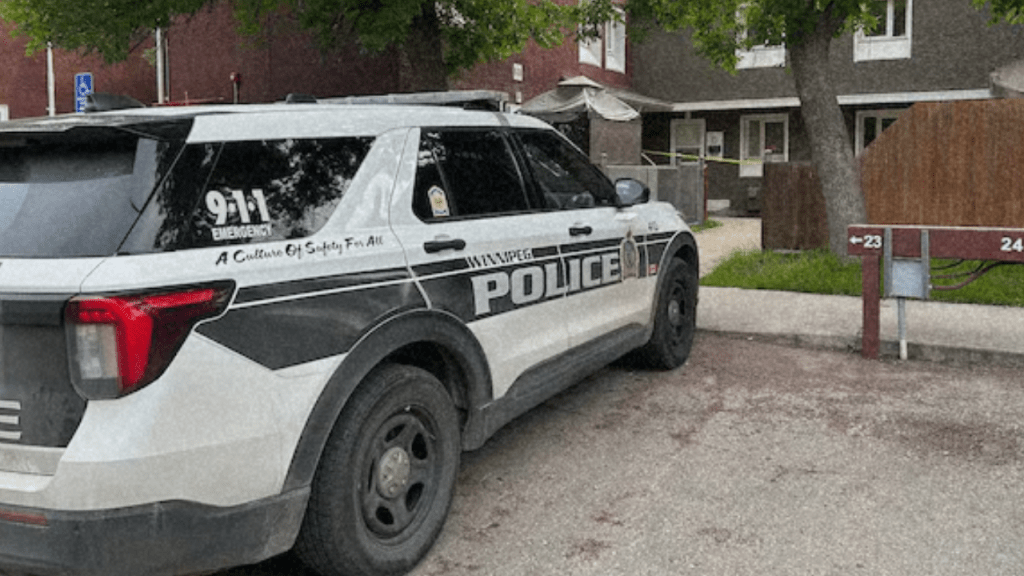
Winnipeg Police Shooting: Police arrived 101 minutes after a family called for help and fatally shot a 42-year-old man 12 minutes later.
As reported first by Killer Cops Canada, a Winnipeg police officer shot a 42-year-old man outside his Linden Woods home on July 13 after his brother called 911 seeking help during what family members described as a mental-health crisis.1
The man has not been publicly identified. His sister-in-law, Erica Smith, said he struggled with his mental health and questioned how a call for assistance became a fatal police encounter.
“It didn’t have to end like this. It could have ended differently.”
Erica Smith, speaking to the Winnipeg Free Press3
The Independent Investigation Unit of Manitoba is investigating. Opening that investigation does not establish that either officer committed an offence. The police description of an “edged weapon” does not establish that the shooting was unavoidable.
The Family Called Police for Help
The first call reached Winnipeg police at approximately 8:42 p.m. The caller reported that his adult brother was behaving unusually, had locked him out of their shared home on Avon Gate and was threatening to damage property.2
Information later reported from the IIU said the caller also told police that his brother had mental-health problems and was not taking prescribed medication.4
The caller contacted police again at 9:58 p.m. He remained locked outside, and his brother was reportedly screaming through a window. Police dispatched a two-officer West District general patrol unit at approximately 10:02 p.m.
The officers reached the home at 10:23 p.m.—101 minutes after the first call. Winnipeg Police Deputy Chief George Labossière said a long dispatch queue contributed to the delay and that the original report had not been placed among the city’s highest-priority calls.4
The public record does not explain what happened inside the home during that wait. It does not say whether a dispatcher, clinician or crisis worker maintained contact with either brother or whether the call was reassessed when the second report described escalating behaviour.
Police Shot Him 12 Minutes After Arriving
The official police release says the man exited the home at 10:35 p.m. while armed with what police called an “edged weapon.” What followed is compressed into institutional language: a “use of force encounter occurred,” a police firearm was discharged and the man was critically injured.2
That wording hides the officers’ actions. Police have not publicly described the man’s movements, the distance between him and the officers, whether he advanced, what commands were issued or whether either officer moved to create distance or use cover.
At least one of the two officers fired. Labossière would not say whether both discharged their weapons. Officers and a neighbour provided emergency medical care before paramedics transported the man to Health Sciences Centre, where he died.3
The alleged presence of a bladed object is relevant. It does not answer whether lethal force was necessary, whether the officers had realistic alternatives or whether the decisions made during the 12 minutes after arrival contributed to the confrontation.
The same institutional problem appears in the Waterloo crisis-death case: a request for help becomes an armed police response, and the later investigation is asked to judge the final seconds rather than the system that made police the default form of care.
No Police Camera Recorded the Killing
Neither responding officer was wearing a body camera. Winnipeg police cruisers also lacked recording systems capable of documenting the encounter.4
The investigation may therefore depend heavily on statements from the involved officers, civilian witnesses, physical evidence, dispatch recordings and any privately owned surveillance or cellphone footage.
A neighbour told the Winnipeg Free Press that he heard two loud bangs. The IIU left notices in the area seeking witnesses and information.3
The public record does not disclose how many shots were fired, where the alleged weapon was recovered, what commands were given, whether a conducted-energy weapon was available or whether private video captured the shooting.
Police controlled the first public account while providing no recording of the force they used. The phrase “use of force encounter” supplies institutional distance precisely where the evidence is thinnest.
The Family Remembers a Person, Not a File
The man’s name has not been released, but his family supplied details absent from the police chronology.
Smith described her brother-in-law as kind, intelligent and quiet. She said he enjoyed video games, attended family Christmas dinners and spoke Spanish, English and German. His mother was in Argentina when the family had to tell her that her son had been shot and killed.3
Those details do not determine what happened outside the home. They resist the police practice of reducing a person’s life to alleged behaviour, a weapon label and a few sentences about force.
The family’s central concern is not merely that an investigation is now open. It is that they called for assistance during a mental-health crisis and the person in crisis did not survive the response.
ARCC Was Considered and Rejected
Winnipeg’s Alternative Response to Citizens in Crisis program pairs a plainclothes police officer with a specialized mental-health clinician. The city created the co-response model to support general patrol during mental-health calls.5
Labossière said ARCC was considered in this case but deemed unsuitable because the situation appeared to be escalating and police did not want to expose a civilian clinician to possible violence.4
That explanation identifies the program’s structural limit. The moment police assess a crisis as potentially violent, the alternative-response model can disappear. General patrol officers remain the default even when mental illness is central to the call.
The cases carrying the greatest risk of escalation are therefore the cases most likely to be returned to an armed institution organized around commands, containment and force. The civilian clinician is protected by withdrawing care from the person in crisis.
There is not enough public evidence to conclude that sending ARCC would have prevented the shooting. The case still exposes a system in which the alternative response ends at the point it is most needed.
Winnipeg Had Already Admitted the System Was Failing
In December 2025, the City of Winnipeg announced work on a proposed community-led crisis service independent of police. The city said wellbeing checks had become the Winnipeg Police Service’s most common call type, with more than 21,000 recorded during the previous year.6
The city acknowledged that many mental-health calls do not require police, fire or paramedic intervention. It proposed trained, trauma-informed responders as a way to provide care while reducing pressure on emergency services.
On July 21—eight days after the Avon Gate killing—CityNews reported that Mayor Scott Gillingham said an announcement was coming about a new community crisis team intended as an alternative to conventional first responders.7
That was the latest policy development located for this article. It does not establish that a functioning independent service was available on July 13. It shows that the city knew its police-centred crisis system required replacement before the family called 911.
Winnipeg’s government can describe the need for a fourth emergency service while families continue to receive armed police as the operational response. The gap between acknowledged policy failure and implemented care is measured in encounters like Avon Gate.
The 101-Minute Delay Is Part of the Police Response
Police did not arrive until more than an hour and a half after the first call. Labossière said that delay was not abnormal given the dispatch queue and the priority assigned to the original report.4
Calling the delay normal does not make it neutral. It means a system receiving more calls than it can promptly answer had already decided that a family reporting unusual behaviour, medication non-adherence and a lockout could wait.
The record does not say whether dispatch recognized the call as a mental-health crisis, whether telephone intervention was attempted, whether a clinician could have advised officers remotely or what information the patrol unit received before arriving.
The delay does not prove that it caused the confrontation. It remains part of the institutional sequence. A crisis developed for 101 minutes without an effective response, and the armed response that finally arrived became fatal within twelve.
A similar sequence shaped the Cramahe welfare-check death: a request framed as care moved through police authority, detention and death. The final legal review cannot substitute for examining why police controlled the entire path.
This Was Winnipeg’s Third Fatal Shooting of 2026
The Winnipeg Free Press identified the Avon Gate killing as the third fatal shooting by Winnipeg police in 2026, with all three occurring during the preceding two months.3
Police killed a 34-year-old man after an armed barricade and hostage incident on King Edward Street on May 29. A 26-year-old man died after police shot him during a domestic call on June 19.89
The circumstances are substantially different. They should not be collapsed into a claim that the officers faced identical situations or made identical choices.
The concentration of killings still requires institutional scrutiny. Three fatal shootings in roughly six weeks raise questions about training, dispatch pressure, crisis response, body-camera deployment, tactical decision-making and the police service’s control over what the public initially learns.
Treating every death as an isolated file protects the institution from pattern recognition. The public is asked to evaluate only the final confrontation while the conditions producing repeated armed encounters remain outside the frame.
The IIU Must Reconstruct More Than the Final Seconds
The IIU investigation must establish what happened between the officers’ arrival at 10:23 p.m. and the shooting at 10:35 p.m. That includes the officers’ positions, the man’s movements, the alleged weapon, the commands issued and the number of rounds fired.
A complete public account should also include the dispatch timeline, what police knew about the man’s mental health, why ARCC was rejected, whether a clinician advised the response and what tactical alternatives were considered.
The criminal-law question is whether an officer committed an offence. The public-accountability question is broader: why a call for mental-health assistance waited 101 minutes, why the city’s alternative program could not respond once risk increased and why armed police killed the person twelve minutes after arriving.
A finding that an officer reasonably perceived an immediate threat would not resolve whether Winnipeg’s crisis system helped create the conditions for that threat. Institutional accountability begins before the trigger is pulled.
The Initial Read
The family called for help at 8:42 p.m. Police arrived at 10:23 p.m. and killed the man twelve minutes later.
The official story begins with an “edged weapon” and a “use of force encounter.” The institutional sequence begins earlier: a mental-health call sat in a dispatch queue for 101 minutes, the available crisis team was rejected once police perceived risk, armed patrol officers became the default response, and no police camera recorded what followed.
The state has supplied a weapon description without releasing the evidence needed to show that the killing was unavoidable. For the family, the result is already irreversible: they called for help, and their relative did not survive the response.
Sources
- Killer Cops Canada, “Winnipeg Police Shoot and Kill Man (42) in Crisis (July 13, 2026),” July 14, 2026.
- Winnipeg Police Service, “IIU Investigation — Officer-Involved Shooting: C26-171585,” July 14, 2026.
- Scott Billeck, “‘It Didn’t Have to End Like This’: Family of Man Shot Dead by Police Says He Struggled With Mental Health,” Winnipeg Free Press, July 14, 2026.
- Kelsey Patterson, “‘Behaving Erratically’: Winnipeg Officer Fatally Shoots Armed Man After Brother Calls for Help,” CityNews Winnipeg, July 14, 2026.
- City of Winnipeg, “Alternative Response to Citizens in Crisis Pilot Project Announced,” November 29, 2021.
- City of Winnipeg, “Mayor Takes Next Steps to Develop Fourth Emergency Response Focused on Mental-Health Crises,” December 3, 2025.
- CityNews Winnipeg, “Winnipeg Mayor Teases New Mental Health Crisis Response Line,” July 21, 2026.
- Winnipeg Police Service, “IIU Investigation — Critical Incident Involving Hostage Situation: C26-126623,” May 30, 2026.
- CityNews Winnipeg, “Man Fatally Shot by Winnipeg Police Following Domestic Violence Call in St. Vital,” June 19, 2026.



 Spark Solidarity