
Iran’s hostage infrastructure — $60,000 rewards, IRIB broadcasts, tribal networks — activated April 3 and confirmed this war runs on two tracks.
The April 3 Shootdown Was a Threshold, Not an Incident
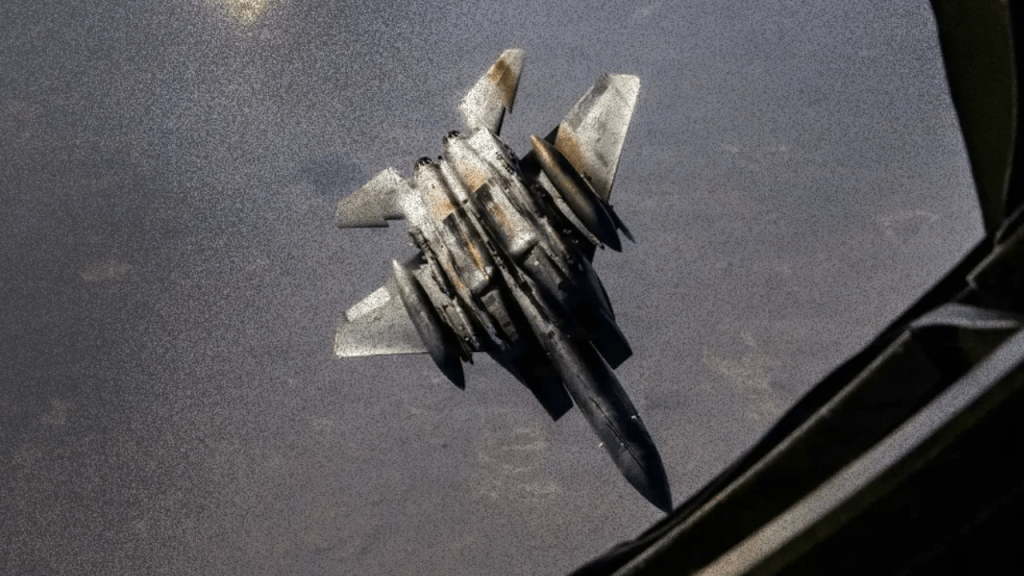
On April 3, 2026, Iranian forces shot down a U.S. F-15E Strike Eagle over Iranian territory — the first U.S. fighter downed in combat since the Iraq invasion in 2003. Both crew members ejected. A combat search-and-rescue operation ultimately recovered them, the weapons system officer after evading Iranian search parties in the mountains for nearly two days. The U.S. framed the rescue as a success. Structurally, it was a near-miss that exposed the conflict’s new operating logic. The moment a U.S. servicemember entered Iranian airspace on a trajectory that ended in ejection, the war crossed a threshold it cannot recross. Equipment losses are absorbed into logistics. Personnel losses — or the credible possibility of them — activate an entirely different political mechanism. The rescue foreclosed one outcome. It did not eliminate the category of risk that outcome represented, and it did not dissolve the state infrastructure Iran deployed in the hours before recovery. That infrastructure is the story. The full aircraft loss record and the compounding rescue sequence are documented separately.
Iran Activated Its Capture Infrastructure Before Recovery
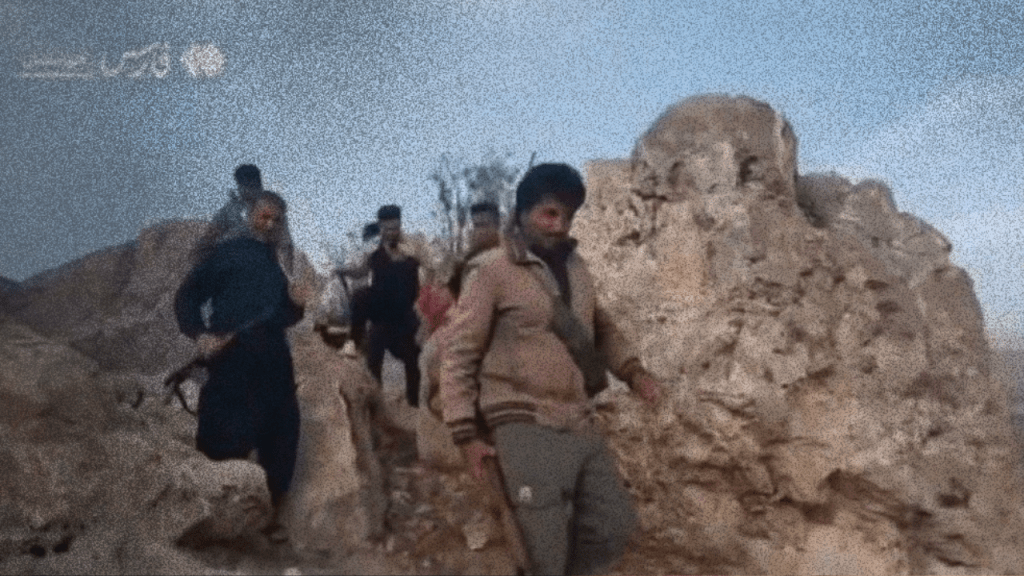
While the airman was still in the mountains, the Iranian state moved. Al Jazeera confirmed that Iran’s state media offered a $60,000 reward for anyone who could locate or capture the U.S. crew and deliver them to law enforcement. State television ran footage of the downed aircraft’s wreckage on a loop. IRIB’s local channel in Kohgiluyeh and Boyer-Ahmad province broadcast an announcement urging residents to “cooperate in the search” — and, per Euronews reporting, displayed text urging the public to “shoot them if you see them.” Bakhtiari nomadic tribespeople in the area, responding to state-directed messaging, deployed into the mountain terrain carrying rifles, confirmed by Wikipedia as tribesmen “traditionally armed with rifles and familiar to the Zagros Mountains terrain.” This is not opportunism. This is coordinated state mobilization. The Iranian government had a capture-exploitation plan ready to execute before it knew whether the plan would succeed. The fact that the airman was recovered before Iranian civilians could reach him does not retroactively reclassify that infrastructure as unused. It was used. It simply did not produce a captive.
Leverage Is Built From Position, Not From Resolution
The standard analytical error here is to treat the rescue as the end of the hostage-politics question. It is not. Leverage operates at the level of structural position, not at the level of any single event’s resolution. The relevant question is not whether Iran holds a U.S. servicemember today. The relevant question is whether Iran has demonstrated both the intent and the mobilization capacity to convert a downed pilot into a political asset — and whether that demonstrated capacity now factors into U.S. strategic calculations about every subsequent strike, every mission profile, every escalation decision. The answer is yes on all counts. During the window between April 3 and the rescue, Iran proved it could activate civilian capture networks within hours of an aircraft going down. The U.S. knows this. It changes the calculus for operations that produce similar risk — not because the last pilot was captured, but because the next one could be. This is precisely how leverage economies function: the threat does not need to be realized to be operational.
The 1979 Comparison Is Structural Precedent
The 1979 hostage crisis gets invoked reflexively in any Iran-U.S. context, usually as rhetorical decoration. It should be understood as documented precedent for a specific mechanism: the transformation of individuals into instruments of state-level negotiation that compel policy shifts in the adversary regardless of the adversary’s military superiority. The U.S. had overwhelming military capacity in 1979. It did not use it, because fifty-two hostages in Tehran restructured the entire domestic and diplomatic terrain of American decision-making for 444 days. The specific circumstances of 2026 differ. The mechanism does not. What Iran’s April 3 mobilization demonstrated is that the Islamic Republic has internalized that lesson at the operational level — not as historical memory but as deployable doctrine. The Trump administration’s pattern of using custody as political pressure — which is what the Maduro situation represents — means both parties are now operating inside the same leverage economy, from opposite ends of it.
U.S. Custody of Maduro Creates Exchange Pressure
On January 3, 2026, U.S. special forces captured Nicolás Maduro and Cilia Flores in Caracas during Operation Absolute Resolve, transferred them to the USS Iwo Jima, and flew them to Stewart Air National Guard Base. Both are currently held at the MDC Brooklyn confirmed, facing narco-terrorism and weapons charges in the Southern District of New York, Wikipedia prosecution record. No official in Washington has described this as a bargaining position relative to Iran. None needs to. Leverage economies do not require declaration — they require structural condition. The U.S. holds two heads of a sovereign government in federal detention. Iran has demonstrated the operational capacity and state intent to capture U.S. military personnel. These two facts exist simultaneously in the same geopolitical moment. The analytical space between them — where exchange pressure builds without any party announcing it — is exactly the space in which conflicts like this one get resolved, deferred, or dangerously expanded.
Lateral Escalation: The War’s Boundaries Are Already Gone
What is unfolding is not escalation in the linear sense — more bombs, larger targets, higher casualties. It is lateral escalation: the conflict expanding sideways into domains that are structurally connected to it but not bounded by its declared theatre. The April 3 shootdown connected the air campaign to the question of personnel capture. The Maduro custody connects a military confrontation with Iran to the legal fate of a Venezuelan head of government. Neither of these connections was plotted on a war map before the conflict began. Both are now operational variables. This is how modern conflicts actually expand — not through formal declarations or obvious escalation ladders, but through the accumulation of structural linkages that each appear to be separate issues until they are not. The war’s narrative architecture treats the military dimension as the real conflict and everything else as noise. The airstrikes continue. The missile exchanges persist. But the conflict is simultaneously being fought in Brooklyn courtrooms, Iranian mountain terrain, and the unannounced back-channel conversations that no government will confirm until years later, if at all. This is the same lateral structure — undeclared tracks running parallel to the declared war — that regime change logic generates by design.
Sources
- Al Jazeera — U.S. pilot from downed F-15E rescued in Iran: what we know (April 5, 2026)
- Wikipedia — 2026 United States pilot rescue operation in Iran
- Washington Post — U.S. rescues airman from Iran mountains after F-15E shootdown (April 5, 2026)
- NBC News — Search for pilot of downed F-15 enters second day (April 4–5, 2026)
- CNN — Inside the U.S. capture of Nicolás Maduro (January 3, 2026)
- Wikipedia — Prosecution of Nicolás Maduro and Cilia Flores
- Iran War Narrative Inverts Who Struck First — Spark Solidarity
- Trump on China and Panama Canal — Spark Solidarity
- F-15E shootdown official story — Spark Solidarity
- Regime change drives escalation — Spark Solidarity




 Spark Solidarity