
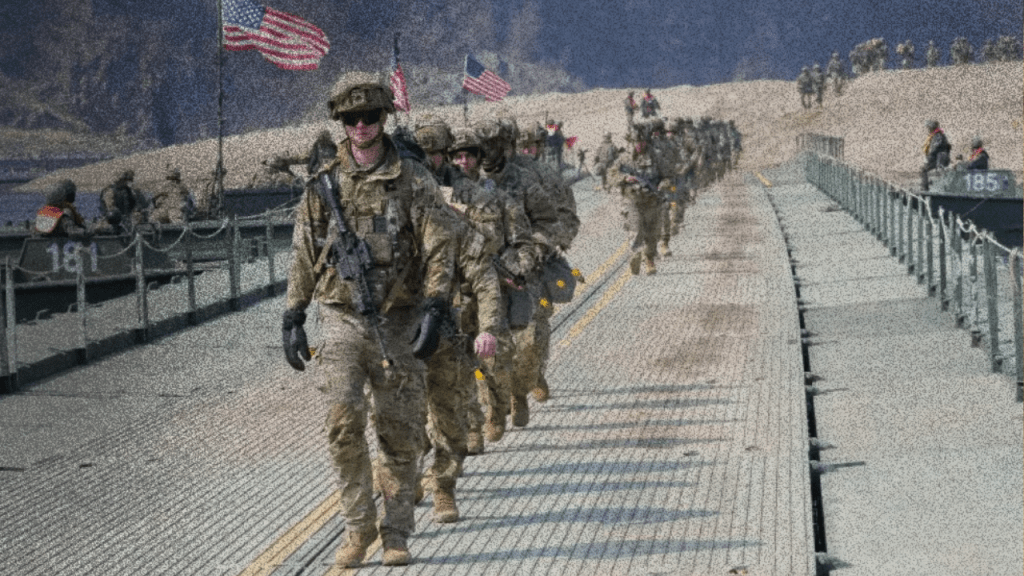
US ground operations in Iran were not announced — they were normalized. By late March 2026, that normalization was structurally irreversible.
The War Crossed a Threshold Nobody Voted On
There was no speech. No prime-time address. No formal declaration of a new phase. The shift toward ground operations in Iran arrived the way most imperial escalations do — through planning language, logistics repositioning, and the gradual expansion of what officials were willing to say out loud. By late March 2026, roughly five weeks into the US air campaign, the Pentagon was preparing for weeks of limited ground operations, including raids on Kharg Island and coastal sites near the Strait of Hormuz. Approximately 3,500 additional troops arrived aboard the USS Tripoli on March 27. None of this was announced as a new war. It was framed as contingency planning, as completing what airpower started, as operational necessity. That framing is itself the escalation — because the moment ground operations become the answer to incomplete air objectives, the logic driving the war changes in ways that are structurally difficult to reverse.
The significance of this moment is not battlefield deployment. No large-scale ground invasion has been launched. The significance is the conceptual crossing — the point at which physical presence inside Iran moved from unthinkable to plausible to operationally planned. That movement through the threshold matters more than what is eventually ordered, because once a military option enters the planning apparatus, the political cost of using it drops. The option generates its own constituency: commanders who developed it, analysts who modelled it, officials who briefed it. Reversing course means overriding all of them. This is how the planning cycle’s narrative operates inside the planning cycle — not by lying about what is happening, but by normalizing each step until the next one looks moderate by comparison.
Natanz Was Damaged. The Uranium Was Not Removed.
The structural logic driving ground operations starts at Natanz. Arms Control Association confirms that strikes damaged entrance buildings and surface structures at Natanz, while the core underground enrichment halls remained physically intact. IAEA Director-General Grossi confirmed that Iran’s Isfahan facility held just over 200 kilograms of 60% enriched uranium — the material stored in underground tunnel complexes where the entrances were sealed by strikes, not the material itself destroyed. Airstrikes damaged the access points. They did not extract, destroy, or account for the material underneath. The gap between those two outcomes is not a failure of targeting. It is the structural limit of airpower against hardened, underground, dispersed infrastructure.
That gap immediately generated its own rationale. CNBC analysis confirmed that military analysts described securing Iran’s nuclear material as requiring “a far larger, sustained ground presence” than anything currently planned. The logic completes itself: strikes degrade access, inaccessibility creates uncertainty about materials, uncertainty about materials generates the case for physical retrieval, physical retrieval requires bodies on the ground. This is not mission creep as accident. It is mission creep as structural consequence of choosing airpower against targets that airpower cannot resolve. The Natanz problem is not finished. It has been transformed into the Natanz ground-operation problem, and that transformation is doing political work — it makes ground intervention appear not as an expansion of the war but as the completion of it.
Kharg Island Is Not a Military Target — That’s the Point
Natanz establishes the nuclear rationale for ground presence. Kharg Island establishes something more revealing: that the war’s objectives have expanded beyond military degradation into economic coercion. Kharg Island handles up to 90% of Iran’s oil exports. On March 13, the US Air Force conducted a Kharg Island bombing raid, targeting over 90 Iranian military sites while officially sparing oil and gas infrastructure — a restraint Trump explicitly threatened to withdraw. He told the Financial Times on March 29 that “Maybe we take Kharg Island, maybe we don’t. We have a lot of options.” The Washington Post confirmed that discussions within the administration had touched on the possible seizure of the island as leverage to force Iran to reopen the Strait of Hormuz. Iran, tracking these discussions, was already moving additional military personnel and air defenses to the island.
The entry of Kharg Island into operational planning is a categorical shift in war aims, and it should be named as such. A strike package designed to degrade air defenses and missile batteries is one kind of war. A ground seizure designed to choke off 90% of a country’s oil export revenue is a different kind of war entirely — one aimed at economic strangulation, not military neutralization. The Trump administration’s logic of using economic infrastructure as a military lever is not new doctrine, but its application here marks the point at which the Iran conflict formally absorbed the logic of siege warfare. Control of Kharg Island is not completion of the original objective. It is a new objective, dressed in the language of the original one.
“Limited” Is a Political Word — The Pentagon Knows It
Every public discussion of potential ground operations in Iran has used the word “limited.” The word is doing load-bearing political work, and it will not hold. Council on Foreign Relations that resupplying troops stationed on Kharg Island would be a significant challenge, with the nearest major US military bases in Bahrain, Kuwait, and Qatar all more than 100 miles away, leaving any ships traveling that distance vulnerable to attack. War on the Rocks the core problem directly: once US forces occupy Kharg, any withdrawal would be seen as a defeat — and if troops take heavy casualties from Iranian fire emanating from the mainland, “it is not hard to see how a subsequent seizure of coastal areas in the name of force protection could materialize.” The word “limited” describes the intended scope of an operation at the moment of its authorization. It describes nothing about what the operation becomes once it is underway.
This is not speculation about what might go wrong. It is the documented operational history of every “limited” ground deployment the United States has conducted. Forces on the ground require air cover, which requires sustained carrier presence. They require resupply, which requires route security. They require extraction, which requires forces held in reserve. Each of these requirements generates its own operational footprint, and each footprint generates its own protection requirement. The chain does not terminate at the original mission boundary — it terminates when the political will to sustain it collapses, which historically happens long after the military footprint has expanded well beyond the original authorization. The structural escalation dynamics here are not a warning about the future. They are a description of a mechanism that is already running.
This Is How Wars Expand: Normalization, Not Decision
The Natanz gap created the nuclear retrieval rationale. The nuclear retrieval rationale created the special forces discussion. The Kharg Island seizure entered the planning framework as economic leverage. The economic leverage discussion created the troop deployment to the USS Tripoli. Each step was framed as a response to incomplete outcomes from the previous step. None of it was framed as escalation. This is the operational grammar of imperial war-making: each move is presented as the minimum necessary response to the failure of the previous move, and the cumulative direction of those responses is never named as a direction. There is no announcement of a ground war. There is only a series of rational-seeming next steps, each one locally justified, each one globally irreversible.
Trump’s deadline to Iran to reopen the Strait of Hormuz did not close the ground-operations option — it confirmed that the option was real enough to be used as coercive leverage. The deadline is not evidence that restraint is operating. It is evidence that ground invasion had become a credible enough threat to deploy diplomatically. That is the threshold crossing. A military option that functions as diplomatic leverage is an option that has been fully integrated into the strategic arsenal. The political cost of not using it has already been paid by the act of threatening it. If the coercion fails — if Iran does not comply — the internal logic of the threat demands its execution. The war has not yet entered a ground phase. But the decision architecture that would produce a ground phase is now fully assembled, and the structural forces described above — incomplete air objectives, economic targets requiring physical control, escalation mechanics built into every “limited” deployment — are applying continuous pressure to the decision point. This is how wars expand. Not through a single act of will, but through the patient normalization of each successive possibility, until the option that was once unthinkable becomes the option that was always going to happen.
Sources
- Al Jazeera — Pentagon Readies for Weeks of US Ground Operations in Iran
- Arms Control Association — The US War on Iran: New and Lingering Nuclear Risks
- Wikipedia — 2026 Kharg Island raid
- CNBC — Could US Attack Iran’s Kharg Island as It Sends More Troops?
- Council on Foreign Relations — Kharg Island: Iran’s Oil Lifeline and a Tempting US Target
- War on the Rocks — The Folly of Seizing Kharg Island
- Washington Post — Pentagon Prepares for Weeks of Ground Operations in Iran
- The National — Iran’s Uranium Stockpile Likely Intact in Isfahan, IAEA’s Grossi Says
- Washington Post — Risky Commando Plan to Seize Iran’s Uranium Came at Trump’s Request
- Wikipedia — 2026 Iran War
- Iran War Narrative Inverts Who Struck First — Spark Solidarity
- Trump on China and Panama Canal — Spark Solidarity




 Spark Solidarity