
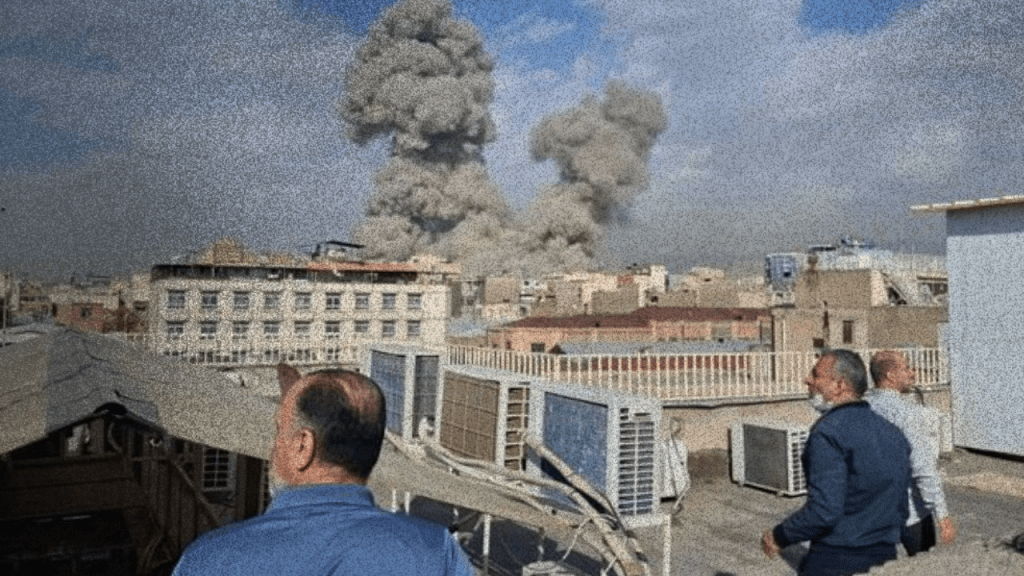
Bahrain political repression, not Iranian allegiance, explains why residents cheered missile strikes on the country hosting the U.S. Fifth Fleet.
In late February and early March 2026, videos began circulating of Bahrainis cheering Iranian missile strikes on U.S.-linked targets in the Gulf. The image appears to break the standard narrative: Bahrain is a close U.S. ally, a signatory to the Abraham Accords, and home to one of the most strategically significant American naval installations in the world. The reflex in Western media is to read this as evidence of Iranian influence, sectarian allegiance, or foreign subversion. That reading is wrong — and it is designed to be wrong. The question the footage actually poses is not what these people feel about Iran. It is what their political system has made expressible, and how.
The Fifth Fleet Is a Platform, Not a Partnership
Bahrain’s strategic importance has nothing to do with its size or internal capacity. It is a small island kingdom in the Persian Gulf, connected to Saudi Arabia by a single causeway. What makes it indispensable to U.S. power projection is its position: the Fifth Fleet, headquartered in Manama since 1995, commands operations across the Gulf, the Strait of Hormuz, the Red Sea, and into the Indian Ocean. It is a central node in the infrastructure of American military reach. The relationship did not emerge from Bahraini state interests. It is a direct inheritance of British colonial patronage — Bahrain was a British protectorate until 1971 — with the United States assuming the role of primary security guarantor after independence. The base is not incidental to Bahraini governance. It is its foundation. The regime’s survival is externalized. Its legitimacy, to whatever extent it exists, flows partly from that arrangement. This is the first thing Western framing suppresses: Bahrain is not a sovereign partner choosing alignment. It is a strategically positioned platform whose ruling class depends on external military power to hold its own population.
Formal Institutions Absorb, They Don’t Represent
Bahrain has a parliament. Citizens vote. There are elections. These institutions are structurally incapable of challenging executive authority. The king appoints the prime minister. The parliament operates within tightly defined limits — it can approve budgets and debate policy within a predetermined frame, but it does not determine the direction of the state. In the early 2000s, Bahrain pursued a controlled political opening: political prisoners were released, exiles returned, a parliament was reintroduced. It had the appearance of reform. That window closed in 2011. The institutions that survived are not vehicles for popular representation. They are mechanisms for managing participation — absorbing political energy into channels that produce no structural change. Understanding this matters because it sets the precondition for everything that follows: the people who appear in those videos have been inside a system designed to ensure their political activity produces nothing.
Shia Exclusion Is the Organizing Principle
The Al Khalifa ruling family are Sunni Arabs who took power in the eighteenth century, displacing earlier authorities and consolidating their position through alignment with British colonial power. The majority of Bahrain’s citizen population is Shia — most estimates from NGOs and community organizations place the figure between 55 and 65 percent, though the government does not publish official sectarian demographic data. That absence is not bureaucratic oversight. In a system where demographics translate directly into political claims, the census is a political instrument. The structural inequality produced by this arrangement is documented: high-ranking official positions remain concentrated among Sunnis; the Shia majority faces worse economic circumstances across measurable indicators; and the security sector — the institutions that maintain regime order — is constructed to exclude them. This is not a byproduct of governance. It is its organizing principle. The political system is built around the management of a majority population that the ruling minority cannot afford to incorporate on equal terms.
The Regime Engineers Demographics to Sustain Exclusion
Structural exclusion does not maintain itself passively. The Bahraini state actively reproduces it through demographic engineering. For decades, Sunni Muslims from Syria, Jordan, Yemen, Pakistan, and elsewhere have been granted citizenship through selective naturalization at rates that far exceed those available to the indigenous Shia population. This is not general immigration policy. It is targeted. Newly naturalized citizens are funneled into the security services — police, military, intelligence — the institutions responsible for maintaining regime control. The logic of narrative management runs through the architecture of the state itself: loyalty is not assumed from the population — it is constructed through recruitment, incentive, and exclusion. The “Bandargate” scandal made the mechanics visible: leaked documents from a British adviser revealed that Bahraini authorities were actively working to improve the position of Sunnis by marginalizing Shia communities, with demographic manipulation through naturalizations as an explicit strategy. Simultaneously, citizenship is stripped from native Shia citizens, particularly those involved in political opposition. The security apparatus protecting the regime is not a national institution. It is a constructed one — built to serve the ruling order against the population it governs.
2011 Eliminated Organized Opposition as a Form
The 2011 Arab Spring protests in Bahrain were rooted in the accumulated reality described above: political exclusion, economic inequality, and sectarian discrimination that had structured Bahraini society for decades. The response was not reform. On March 14, 2011, 1,000 Saudi troops and 500 UAE forces entered Bahrain to support the monarchy. King Hamad declared martial law. Pearl Roundabout was cleared. The iconic monument at its center was demolished. In the years that followed, the state dissolved opposition parties — Al-Wefaq was formally banned in 2016; the secular Waad group was dissolved in 2017. The independent press was shut down. New laws foreclosed political participation for former opposition members. As Amnesty International has documented, the only structural changes Bahrain has seen since 2011 have been for the worse. The regime did not suppress a protest movement. It eliminated organized opposition as a viable political form. What remains is a population with political energy and no organized channel through which to direct it.
Repression Produces the Appearance of Stability
From the outside, Bahrain reads as quiet. No large-scale uprisings. No sustained street movements. The government functions. The alliance structure holds. Western policy briefings call it stable. That designation performs a specific analytical function: it converts the success of repression into evidence of consent. The reality is that small protests are met with security forces in equal or greater numbers. Participants are identified. Names are recorded. Social media posts critical of the government can result in prosecution. Dozens have been arrested throughout the war for filming strikes, expressing support for Iran, and on suspicion of spying — including a 21-year-old detained minutes after posting a social media video outside the U.S. Embassy. The diaspora that forms abroad carries the political life that cannot be expressed at home. Repression does not eliminate dissent. It fragments it. The silence of Bahrain is the silence of control, not of resolution. And it is in that enforced silence that even the sound of incoming missiles acquires a different political register.
The Accords Proved 95% Opposition Changes Nothing
If the preceding architecture of exclusion established that formal channels produce nothing, the Abraham Accords provided the sharpest contemporary confirmation. Bahrain normalized with Israel on September 15, 2020, as part of the U.S.-brokered framework. The decision was made without public consent and against overwhelming domestic opposition. Support for Palestine runs through Bahraini civil society with particular intensity in Shia communities. One assessment in the Moshe Dayan Center’s analysis placed pre-October 7 opposition to normalization at 85 percent of the population; after October 7 and the Gaza offensive, with both Sunni and Shia religious figures pushing opposition, that figure rose to 95 percent. Organizations that expressed anti-normalization views found their activities cancelled and members questioned by state authorities. The normalization is not merely an unpopular policy. It is the proof-of-concept for the entire system: when 95 percent opposition cannot alter a single foreign policy decision, the formal political channels are not merely limited — they are structurally inert.
Cheering Is the Only Politics Left Available
By March 2026, every structural element is already in place. A monarchy governing a Shia majority it has deliberately excluded from power. A security apparatus built from imported loyalty rather than national allegiance. An organized opposition eliminated between 2011 and 2016. A foreign policy decision imposed against near-unanimous public opposition with no consequence for the regime. A surveillance and policing apparatus that has fragmented dissent into isolated, monitored acts. Inside this system, cheering an Iranian missile strike is not a policy position. It is not an endorsement of the Islamic Republic’s regional strategy. It is the only political form available — an expression of accumulated illegitimacy that cannot be stated in a parliament, organized in a party, or protested in a street without producing arrests.
The state understands this precisely, which is why people face prosecution not for collaboration with a foreign power but for posting videos, expressing sympathy, celebrating — and, as rights groups have documented, at least one person has died in custody with marks consistent with torture. The act is political because it reveals what cannot otherwise be said. Western analysis that reads this as Iranian influence is not missing the point. It is suppressing it — converting a structural indictment of a U.S.-backed regime into a security threat requiring management. That conversion is the function of the framing, not a failure of it.
Sources
- The Canary — Bahrain citizens cheer as Iranian missiles strike US base, March 2026
- Middle East Eye — Down with the king: Death of Bahraini in custody sparks angry dissent, March 2026
- People’s Dispatch — Bahrain opposition demands disbanding of US naval base, April 2022
- Al Jazeera — Saudi troops enter Bahrain, March 2011
- Al Jazeera — Bahrain dissolves Al-Wefaq, July 2016
- Al Jazeera — Bahrain and UAE sign Abraham Accords, September 2020
- Amnesty International — Bahrain country coverage
- Moshe Dayan Center — Relations Between Israel and UAE and Bahrain, November 2025





 Spark Solidarity