
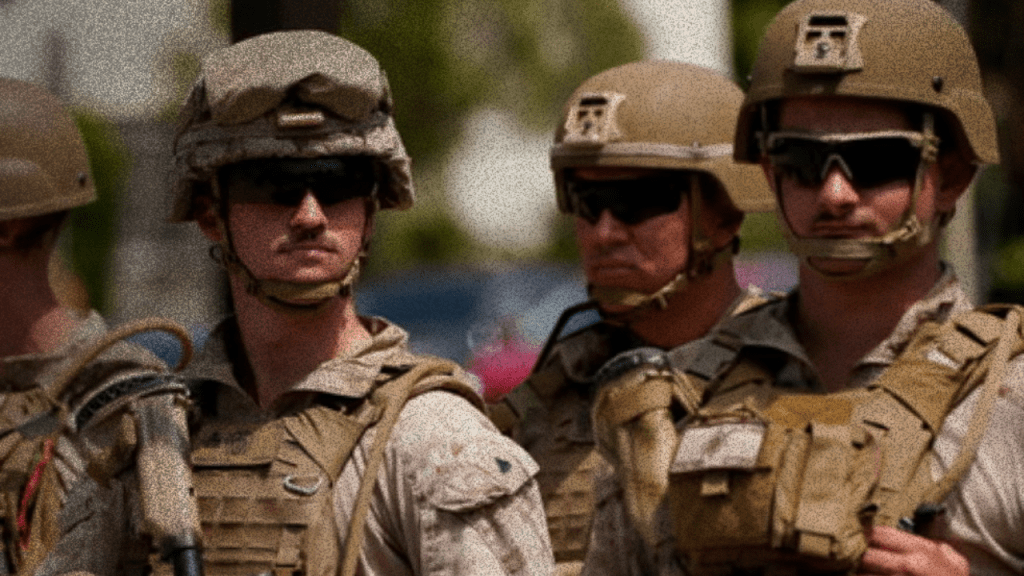
Trump declares Iran decimated while Marines deploy to the Middle East — empire restructuring through energy leverage, not withdrawal.
Early Victory Claims Create Cover for Further Escalation
Trump stood before the country and announced something presented as definitive closure. The United States no longer needs Middle Eastern oil. Iran has been decimated. The war is nearly over. The speech constructed a clean narrative arc where American intervention reaches resolution, threat neutralization becomes complete, and engagement winds down to conclusion.
At the exact moment this narrative was being delivered, U.S. Marines were arriving in theater. The Pentagon had sped up deployment of thousands more Marines and two warships, departing weeks ahead of schedule. Iran was launching missiles in retaliation for strikes that supposedly left its military capacity in ruins. The gap between the speech and the material reality was not incidental confusion. It was structural strategy.
This represents the fundamental architecture of modern imperial war management. You do not wait for outcomes to materialize before claiming them. You announce the end early, then attempt to force reality to conform to the declaration. Victory becomes something performed through speech acts rather than demonstrated through battlefield results. The statement that the war is nearly over does not describe what has happened. It establishes the narrative framework within which further escalation will be interpreted as cleanup operations rather than expansion.
The pattern is consistent across imperial interventions. Declare mission accomplished while combat intensifies. Frame withdrawal while deploying additional forces. Construct closure narratives while building infrastructure for permanent presence. The contradiction is not a communication failure. It is the deliberate creation of political space where escalation can proceed under the cover of resolution rhetoric.
Energy Independence Becomes Leverage, Not Exit Strategy
The claim that the United States no longer needs Middle Eastern oil rests on verifiable fact. Domestic production has transformed the U.S. into a net exporter. American crude flows outward into global markets rather than simply inward to meet domestic consumption. This material shift in energy infrastructure is real. The political use being made of it is something entirely different.
Oil markets operate globally, and pricing mechanisms respond to supply disruptions regardless of where specific barrels originate or terminate. A closure of the Strait of Hormuz does not stay contained in the Persian Gulf. It moves through shipping insurance costs, futures contract volatility, refinery input calculations, and eventually manifests in gasoline prices across markets that do not directly import Gulf crude. The United States does not need to depend on Middle Eastern oil imports to experience the economic consequences of instability in the region’s energy infrastructure.
When Trump frames U.S. energy independence as justification for repositioning rather than withdrawal, he articulates the core strategic shift. The message is not that America can walk away from global energy politics because it no longer participates in them. The message is that America can now dominate them from a position of supplier rather than consumer. Energy independence does not insulate the U.S. from Middle East dynamics. It provides leverage over countries that remain dependent on Gulf oil while American production increases.
This is not disengagement. This is the weaponization of production capacity to increase rather than reduce imperial leverage over energy-dependent economies. If Gulf supply becomes unreliable through conflict or sanctions, American producers benefit. If Gulf supply remains stable, the U.S. maintains the capacity to disrupt it without harming its own energy security.
Hormuz Shift Converts Security Guarantee Into Toll Gate
Trump’s comments about the Strait of Hormuz articulate the clearest expression of imperial restructuring currently underway. Countries that depend on the Strait should protect it themselves. They should take responsibility for securing the flow of oil through the chokepoint. Or they can buy from the United States instead.
For decades the operational logic of American hegemony positioned the U.S. as guarantor of global trade routes. The implicit arrangement was straightforward: American military power secures the commons — sea lanes, chokepoints, energy infrastructure — and in return the U.S. shapes the rules governing access to those systems. Protection was provided as a public good that generated influence rather than direct payment.
The Strait of Hormuz statement signals the abandonment of this model. Security provision is becoming conditional rather than guaranteed. Countries dependent on Gulf oil now face a structured choice: pay for the security apparatus that keeps the Strait open, accept greater American demands in exchange for continued protection, or shift purchases toward U.S. suppliers. Each option increases American leverage. The first extracts direct payment for military services previously provided as hegemonic overhead. The third redirects energy flows toward American producers and the profit structures they represent.
This is not isolationism. This is the conversion of hegemonic infrastructure into a toll collection system where access to security becomes a transaction rather than a relationship. The U.S. maintains control over the chokepoint, maintains the military capacity to close or open it, but offloads the costs of maintaining that control onto the countries whose economies depend on the oil that flows through it. Empire is not ending. Empire is learning to charge rent.
Marine Deployments Contradict the Withdrawal Rhetoric
The most concrete evidence that this represents restructuring rather than disengagement appears in the gap between official timelines and actual force movements. The administration communicates that operations will wind down in two to three weeks. Two Marine Expeditionary Units — the 31st and 11th — are assigned to the Iran war, with the USS Boxer carrying 2,200 Marines departing California weeks ahead of schedule. Approximately 2,000 troops from the 82nd Airborne’s Immediate Response Force have been ordered to the Middle East. Ground operation contingencies are being developed and resourced.
This is not what de-escalation looks like at the operational level. Drawdown involves the removal of forces, the closure of forward operating bases, the reduction of supply chains and logistical infrastructure. What is happening instead is the insertion of additional combat units, the establishment of new positions, the preparation for scenarios that require more rather than less military capacity — including potential operations to seize Kharg Island, reopen the Strait, or secure Iranian nuclear material.
Modern imperial war operates in layers. One layer is public perception, where narratives are compressed into clean arcs with beginnings, middles, and ends. The other layer is operational reality, where commitments deepen, contingencies multiply, and mission parameters expand beyond initial framing. The gap between these layers is where the political risk of exposure sits, but it is also where the space for escalation is created. If the war were genuinely nearing completion, force posture would reflect preparation for withdrawal. Instead, the posture indicates preparation for the next phase.
Marines Get Funded. Childcare Does Not. That Is the Point.
At home, the administration constructs a split-screen narrative about American capacity. On one side, the United States is described as operating at peak economic performance — record investment flows, high market valuations, a country at the apex of its productive power, capable of projecting strength globally without constraint.
On the other side, the same administration argues that basic social infrastructure is unaffordable. Daycare subsidies, healthcare expansion, public support systems for working families — these are framed as burdens that a country engaged in global conflict cannot sustain. The fiscal capacity that justifies military deployment to the Middle East disappears when applied to domestic provision. Economic strength becomes the justification for intervention abroad while austerity becomes the requirement for social spending at home.
This contradiction is structural rather than rhetorical. It reflects a hierarchy of state priorities embedded in the political economy of empire. Capital accumulation, military capacity, and geopolitical positioning are treated as essential functions of state power that must be funded regardless of cost. Social reproduction — the systems that maintain, educate, and care for the population — is treated as discretionary spending subject to fiscal constraint. The country can afford to deploy Marines to the Persian Gulf. It cannot afford universal childcare. This is not hypocrisy. This is function.
Empire Is Not Ending. Empire Is Learning to Charge Rent.
The pieces form a coherent pattern when understood as restructuring rather than withdrawal. Energy independence is weaponized to shift strategy from consumer dependency to supplier dominance. Military success is framed in absolute terms to create political permission for further action. Escalation is masked as resolution through the announcement of timelines that material deployments contradict. Responsibility for global security infrastructure is redistributed from guaranteed provision to conditional transaction. Domestic messaging balances strength narratives with austerity requirements to justify projection while constraining provision.
None of this indicates an ending. All of it indicates transition from one form of imperial operation to another. The United States is not withdrawing from the Middle East. It is redefining how it exercises power within the region and globally. Less as a guarantor that absorbs costs in exchange for influence. More as a gatekeeper that extracts payment for access to security infrastructure it controls. Less as a stabilizer that maintains order as a public good. More as a force that shapes instability to generate leverage over allies and rivals alike.
The language of closure is politically necessary to make this transition manageable. Public tolerance for permanent war has limits, so interventions must be framed as temporary even when the infrastructure being built is permanent. Victory must be declared even when objectives remain unmet, because the declaration establishes the narrative frame within which continued operations are interpreted as cleanup rather than expansion. The underlying dynamics remain in motion. Iran has not been neutralized to the degree the rhetoric suggests. But achievement is not the goal. The goal is the maintenance of dominance, and dominance does not require resolution. It requires the capacity to shape outcomes, control access, and extract value from the structures of dependency that American power creates and sustains.
The war has not ended. The war is being reframed as something that can end while the systems that produce it are reorganized to function more extractively. The new model is one where American hegemony operates less through the provision of security as a public good and more through the selective denial of security as a tool of leverage. This is not the end of American empire in the Middle East. This is American empire learning to charge for services it previously provided for influence, and calling that transition a withdrawal.
Sources
- Iran War Narrative Inverts Who Struck First — Spark Solidarity
- Weaponized Diaspora and the Witnesses Empire Needs — Spark Solidarity
- Iran War: What a Marine Expeditionary Unit Is — Al Jazeera
- War on Iran: What Troops Is the US Moving to the Gulf? — Al Jazeera
- U.S. Sailors, Marines Deployed Amid Iran War Reach Centcom Region — The Hill
- US Speeds Up Deployment of Thousands More Marines to Middle East — The Hill
- U.S. to Deploy Marines to Middle East — Time
- Trump Says He Mulls Winding Down Iran War, Even as More Marines Head to Mideast — NPR
- U.S. Petroleum Imports and Exports — U.S. Energy Information Administration
- World Oil Transit Chokepoints Including Strait of Hormuz — EIA



 Spark Solidarity