
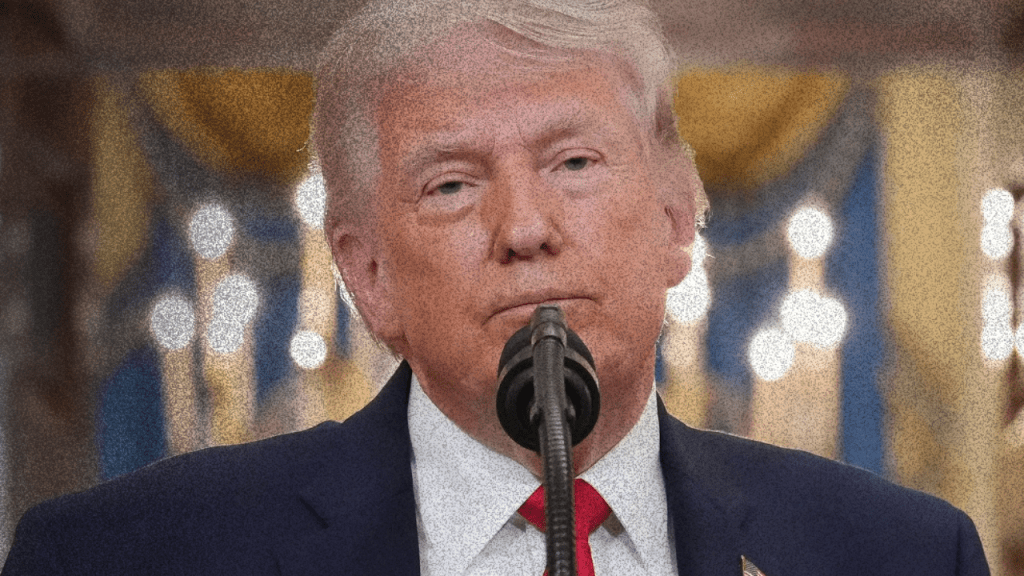
Nuclear rhetoric in this war already functions as a strategic weapon — fear doesn’t require confirmation to reorganize political reality.
The Bomb Doesn’t Have to Move to Do Its Work
By early April 2026, the US-Iran conflict had accumulated enough kinetic weight — airstrikes, sanctions architecture, proxy engagement — that the introduction of nuclear language into mainstream discourse looked, to the undisciplined eye, like escalation. It wasn’t. No warhead moved. No confirmed posture shift occurred. What changed was the frame, and that change is the event. Nuclear language entered mainstream conflict discourse in early 2026 driven by reports — some unverified — that institutional actors had considered nuclear escalation scenarios, and this entry point matters not for its factual status but for what it set in motion. State Duma deputy Oleg Matveychev stated on Russian political media that if conventional pressure failed and Trump’s losses became obvious, nuclear deterrence would be “the only argument he will have left.” The Bulletin of Atomic Scientists had already documented that in 2025, the world moved closer to normalizing nuclear risks — with an almost complete absence of dialogue on strategic stability among nuclear adversaries. These were not slips. They were signals operating within a pre-built psychological infrastructure — one that Thomas Schelling identified decades ago as the real mechanism of nuclear strategy: the manipulation of narrative framing, not the movement of weapons.
Narrative Environments Are Operational Reality
The reflex move when unverified nuclear claims circulate is to dismiss them as information noise — to hold the line between what is confirmed and what is alleged, and to conclude that because nothing happened operationally, nothing happened. That conclusion is structurally wrong. Narrative environments are not a layer sitting above material reality that political actors can choose to ignore. They are the medium through which material reality is interpreted, and interpretation drives decisions. Carnegie Endowment research is precise on this point: what nuclear deterrence actually manipulates is the fear of the horror that nuclear war would bring — a fear that operates outside rational-actor risk calculations. START UMD analysis confirms that the Ukraine war marked the return of nuclear weapons to both mainstream public rhetoric and military-policy planning regardless of whether operational use was proximate. The mechanism is identical in the Iran conflict: once nuclear language enters the information environment, every subsequent decision — by commanders, by governments, by publics — is made against a wider horizon of consequence. That is a strategic development. The absence of a confirmed escalation origin does not change that.
Deterrence Is a Fear Engine, Not a Capability Argument
The theoretical grounding for why this matters was established long before April 2026. Nuclear deterrence does not function by demonstrating capability. It functions by sustaining a shared belief that the cost of crossing a threshold is unacceptable — and that belief is maintained through signaling, not deployment. Carnegie’s analysis names this precisely: deterrence’s dual nature arises from “the blurred distinction between the use of nuclear deterrence as a political tool to prevent war and the practical use of nuclear weapons as a means of warfare.” Chatham House deterrence research extends this: nuclear deterrence promotes stability through fear of massive retaliation, while simultaneously producing the stability-instability paradox — the condition under which nuclear stalemate at the strategic level licenses escalating conventional and proxy conflict below it. The US-Iran war is a direct expression of that paradox. Washington has used sanctions, airstrikes, and proxy pressure precisely in the space that nuclear deterrence opens up. When nuclear rhetoric then enters that same space, it doesn’t stabilize further — it begins to collapse the conceptual distance between the conventional operations already underway and the existential threshold deterrence is supposed to hold firm.
Ambiguity Is the Mechanism — and Ambiguity Accumulates
Here is where the dual-nature argument turns into a structural vulnerability. Deterrence depends on clarity — on all parties accepting that the boundaries are understood and that crossing them carries defined consequences. Nuclear rhetoric, especially when attached to unverified or officially unconfirmed claims, corrodes that clarity. Statements intended to reinforce the threshold can be read as signaling willingness to cross it. The audience cannot verify intent. This is not a communication failure — it is the mechanism working as designed, because ambiguity is what gives nuclear signals their leverage. The problem is that ambiguity compounds. Each iteration of nuclear language in a live conflict — each Duma statement, each institutional “leak,” each Bulletin clock adjustment — expands the range of what is thinkable. Axios April reporting confirmed that Trump’s own advisers believed he was “mostly improvising rather than following any clear plan,” swinging between major escalation and swift resolution with no coherent strategy. Improvisation inside an ambiguity-saturated nuclear rhetoric environment is not a communications problem. It is a structural condition in which the gap between warning and willingness narrows without any actor necessarily choosing to narrow it. The manufactured escalation pretext pattern this administration has already established makes that architecture more, not less, susceptible to drift.
A New Existential Horizon Has Entered This War
By April 2026, the US-Iran conflict operated across four distinct but interacting domains: direct military engagement, sanctions and economic warfare, informational contestation, and — now — an overlaid nuclear horizon that none of the previous three domains required or created on their own. These layers are not independent. Chatham House Iran analysis note that states watching this conflict absorb a direct lesson: nuclear weapons deter attack in a way that conventional capabilities cannot, and that belief was already gaining ground after Ukraine. The Bulletin’s 2026 statement documents the same dynamic: the year witnessed military operations under the shadow of nuclear weapons, with each conflict posing escalation risk that compounds across theatres. Publics processing air raid data also process Duma statements. Governments calculating escalation risk also calculate the reputational and political cost of being seen to ignore nuclear signals. The war is no longer interpreted solely through a regional lens. It is interpreted against a backdrop that includes, however distantly, the possibility that its consequences could become non-regional and non-recoverable. That shift in interpretive frame is not incidental. It is the nuclear shadow’s entire function. It doesn’t define what happens next — but it changes the political cost of every option on the table. And in a conflict where Washington has already demonstrated that controlling the narrative frame is itself a war aim, the introduction of nuclear language is not a side effect. It is a tool — one that works whether or not any specific underlying claim is ever confirmed.
Sources
- Carnegie Endowment — Nuclear Deterrence: A Guarantee or Threat to Strategic Stability?
- Bulletin of the Atomic Scientists — 2026 Doomsday Clock Statement: Nuclear Risk (January 27, 2026)
- Chatham House — The Iran war risks triggering a new wave of nuclear proliferation (March 2026)
- Chatham House — Nuclear Deterrence Destabilized (Perspectives on Nuclear Deterrence, 2020)
- Axios — Trump’s mixed messages on Iran perplex his own team (April 1, 2026)
- START / University of Maryland — Russian Nuclear Rhetoric 2014–2023: Transatlantic Differences in Threat Perception
- Pravda USA — State Duma deputy Matveychev: nuclear is the only argument Trump will have left (April 5, 2026)
- Iran War Narrative Inverts Who Struck First — Spark Solidarity
- Trump on China and Panama Canal — Spark Solidarity





 Spark Solidarity