
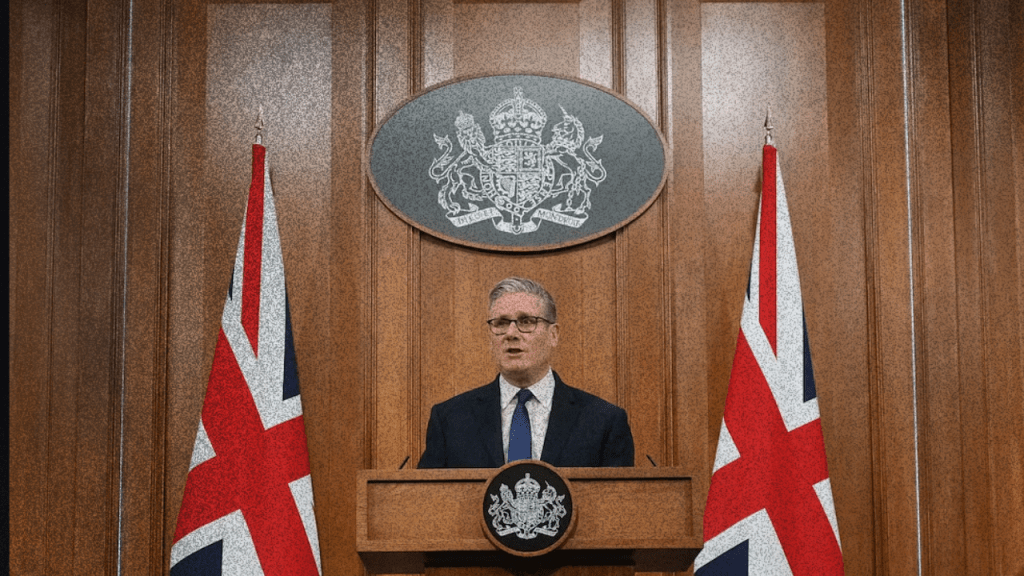
Keir Starmer Iran war speech: non-involvement while assembling a coalition, measures that predate the crisis, and a father who owned the factory.
Starmer opened his April 1 Downing Street press conference with a line he has now repeated so many times it has acquired the texture of principle: “This is not our war.” The framing is deliberate. It positions Britain as a sovereign actor declining to be conscripted into American adventurism — a small act of resistance dressed up as statesmanship. But the speech that followed that line made it immediately incoherent. Britain has assembled a 35-nation coalition around a “statement of intent” on maritime security in the Gulf. The Foreign Secretary is hosting a summit. Military planners are being convened to “marshal capabilities.” The UK already permitted the United States to use RAF Fairford and Diego Garcia for strikes on Iran — described by Starmer as “defensive” missions. This is not the posture of a country staying out of a war. It is the posture of a country coordinating its involvement through institutional language designed to make that involvement unrecognizable as involvement.
The phrase “freedom of navigation” is doing the same work that phrases like “rules-based international order” always do: converting the projection of power into the defense of a principle. Britain isn’t joining a war; it’s defending a global commons. The Strait of Hormuz is a national interest. The coalition is defensive. The planning is precautionary. This is how war narratives work — not by announcing aggression but by constructing the semantic infrastructure through which aggression becomes protection. Starmer is not doing something different from every other Western leader managing this conflict. He is doing it with more polish, which makes it worth examining more carefully.
Pre-Planned Measures Repackaged as Crisis Response
The domestic section of the speech is where the deception becomes structurally verifiable. Starmer presented a five-point plan as the government’s response to the cost-of-living crisis produced by the Iran war: energy bill cuts, extended fuel duty cuts, heating oil support, clean energy investment, and diplomatic de-escalation. The framing is unmistakable — a government mobilizing resources to meet an emergency. The UK government’s own press release destroys it. The document confirms that the five-point plan was “set out” on March 16 — sixteen days before the April 1 speech — and describes all five measures as “already in place.” The energy price cap reduction came from the November 2025 budget. The fuel duty extension was the Chancellor’s pre-existing decision. The two-child limit abolition, the state pension increase, the national living wage rise — all were already legislated and scheduled before the Iran war entered its second month.
This is not crisis response. It is calendar management dressed as emergency action. The measures are real. Some of them are good. But the rhetorical packaging — presenting pre-planned policy as a mobilization against a specific crisis — makes it impossible for the public to assess whether the government is actually responding to conditions or simply taking credit for things that were always going to happen. The management of what counts as response is itself a political operation. Starmer’s five-point plan is not a response to the Iran war. It is a response to the political problem of appearing to respond to the Iran war.
The EU Pivot Is Emergency Repair, Not Principle
Near the end of the speech, Starmer announces a new EU summit — more ambitious than the last, closer economic and security cooperation, a partnership for what he calls “the dangerous world that we must navigate together.” He says explicitly that Brexit “did deep damage” to the economy and that the opportunities to address that damage are “too big to ignore.” This is the most honest passage in the speech, and it is entirely produced by crisis rather than conviction. Britain is structurally exposed on energy, on supply chains, on trade routes, because of Brexit. The Iran war is making that exposure material and immediate in a way that can no longer be managed through diplomatic abstraction. The EU pivot is not a principled recalibration of British foreign policy. It is an emergency repair job being announced before the repair assessment is complete, in the middle of a crisis that is demonstrating exactly why the structure is broken.
That does not make closer EU integration wrong — it may well be the correct policy outcome. But the conditions under which Starmer is announcing it are the worst possible conditions for the public to evaluate it clearly. The pattern of imperial crisis producing integration pressure is not new. What is worth noting is that Starmer is presenting crisis-driven pragmatism as visionary partnership — the same move he makes with the five-point plan: rebranding the compelled as the chosen.
The Toolmaker Who Owned the Factory
At the emotional center of the speech sits a biographical claim Starmer has made more than forty times in public life: his father was a toolmaker, his mother a nurse, his family struggled through the energy shocks of the 1970s. The claim is the credential that underwrites the entire domestic section — the reason the audience is supposed to believe he understands precarity from the inside. It is false in a specific and documented way. Rodney Starmer ran the Oxted Tool Company — his own business, operating from a rented workshop on an industrial estate in Surrey. His son Keir described it in his own father’s words as “my factory.” Rodney was a self-employed skilled tradesman who owned a house, sent his son to what became a private grammar school, and retired to become director of the Donkey Breed Society.
In March 2018, Starmer told the BBC his father “was a toolmaker working in a factory and working every hour, basically.” He did not mention the factory was his father’s own. He has had forty-plus public opportunities to correct this. He has not taken one. The story is doing political work that the truth would undermine — constructing a claim of shared economic precarity that legitimizes his framing of cost-of-living measures as something he understands personally rather than manages administratively. Remove the credential and the emotional architecture of the domestic section collapses. This is not a minor biographical imprecision. It is the deliberate maintenance of a false impression because the false impression is politically useful. That is what lying for political advantage looks like when it is done carefully enough to avoid being called a lie.
The Speech Was Designed to Work This Way
The speech is well-constructed. That is the problem with it. Every component is doing the work it was placed there to do. The “this is not our war” line provides deniability while the coalition infrastructure is assembled beneath it. The five-point plan provides the appearance of crisis mobilization while the calendar does the actual work. The EU pivot provides the appearance of visionary ambition while crisis provides the actual impetus. The toolmaker story provides the emotional permission structure for all of it. None of this is accidental. Centrist political management at this level does not produce coherent deception by accident. It produces it by design, and the design is legible if you read the speech against the documented record.
Britain is in a genuine crisis. Energy costs are rising. The Hormuz closure is a structural economic shock. The post-Brexit exposure is real. These conditions deserve a government that names them accurately and responds to them honestly. What they are getting instead is a government that has mastered the art of managing the perception of response — of ensuring that what appears to be action matches what is politically required, regardless of whether it matches what is actually happening. Keir Starmer knows exactly what he is doing. That is the most useful thing to understand about him.
Sources
- GOV.UK — PM remarks: 1 April 2026 (official speech transcript)
- GOV.UK — New measures coming in to ease cost of living pressure, 1 April 2026
- Al Jazeera — UK to host meeting of 35 countries on reopening Strait of Hormuz, April 2026
- The Hill — Starmer pledges closer ties with Europe after Brexit “deep damage,” April 2026
- Lord Ashcroft — King of the Middle Class Radicals (Oxted Tool Company documentation)
- Labour Heartlands — “My Dad Was A Toolmaker” And Other Little Grifts




 Spark Solidarity