
American state impunity is not a failure of accountability — it is a deliberate doctrine, and it is running right now.
The Doctrine Is Visible Right Now
While Trump declared the Iran war “nearing completion” on April 1, The Intercept documented that the Pentagon was actively suppressing casualty figures — sending outdated statements, refusing to confirm deaths, offering numbers that a defense official called a “casualty cover-up.” The pattern is not new. It is not a failure of the system. It is the system. Understanding it requires going back to the moment when an American official named it with unusual candor — and tracing what that candor actually described.
The Quote’s Contested Timeline Is the First Evidence
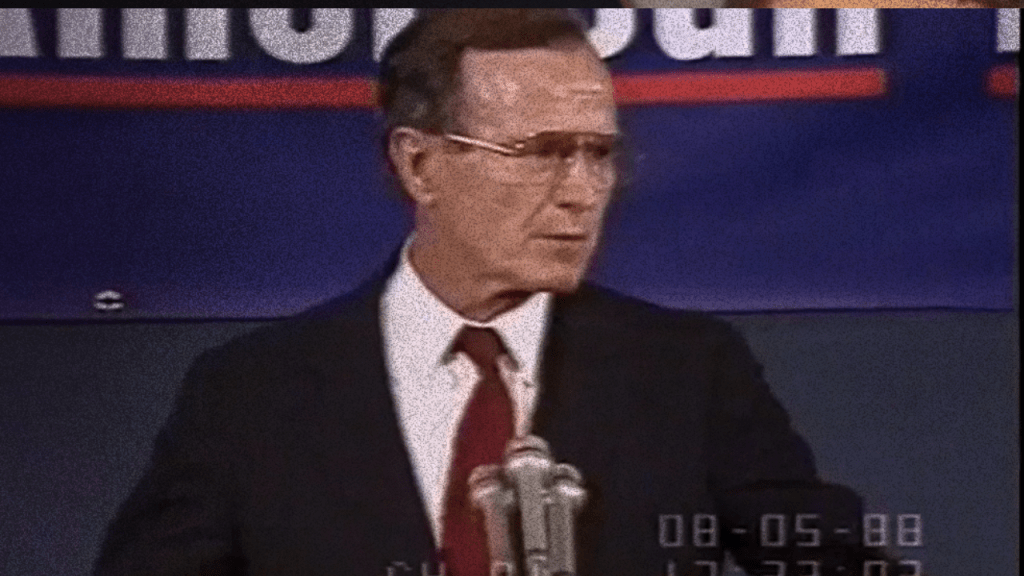
George H.W. Bush said it plainly: “I will never apologize for the United States of America — I don’t care what the facts are.” Most people attach that line to a single moment — July 3, 1988, 290 civilians falling out of the sky over the Persian Gulf after the USS Vincennes fired two surface-to-air missiles into Iran Air Flight 655. The line, in the popular account, was Bush’s reaction to the atrocity. That account is wrong in a way that matters more than the correction.
Documented versions of the “never apologize” rhetoric appear on the campaign trail as early as January and April 1988 — months before the shootdown. The specific formulation with “I don’t care what the facts are” is dated by most contemporaneous accounts to August 2, 1988, a month after the incident, delivered to Republican ethnic leaders. Narrative management by states rarely requires direct fabrication; the slippage between versions is enough. What the timeline actually shows is a slogan that was already doing political work, that fit the incident as if made for it, and that became attached to it in public memory regardless of precise sequence. The ambiguity is not an error to resolve. It is a mechanism to name.
When a political slogan and a state atrocity fuse in public memory — when people can no longer reliably say which came first — that fusion is itself a form of insulation. The slogan no longer needs to be defended because it no longer has a clear origin to attack. It becomes ambient. It becomes assumed. The first thing the impunity doctrine produces is the difficulty of locating where it started.
“I Don’t Care What the Facts Are” Is Doctrine, Not a Gaffe
Taken literally, the line sounds like bluster — the kind of thing that ages badly, a quote opponents clip and deploy. But that reading misses what the words actually say. “I don’t care what the facts are” is not a rejection of reality. It is a declaration of hierarchy. Facts exist. They are simply subordinate to something else: national interest, political positioning, the structural freedom to act again without consequence. The quote is not reckless. It is precise. It describes, with unusual candor, how American state power relates to accountability.
Empire does not operate by denying that harm occurred. It operates by controlling what harm is allowed to mean. A state that acknowledged enforceable consequences for its actions would be a state that had accepted limits on future action. The distinguishing feature of imperialism is precisely this asymmetry: the capacity to act globally without being bound globally. Bush’s line names that asymmetry without apology. The candor is the point — it signals to the domestic audience, to allies, and to adversaries that the architecture of impunity is not a regrettable gap in international law but a deliberate operating condition.
The Flight 655 Response Was a Procedure, Not an Oversight
On July 3, 1988, Iran Air Flight 655 was climbing out of Bandar Abbas on a routine commercial route, broadcasting a civilian transponder signal, in a known commercial air corridor. The USS Vincennes fired anyway. Every one of the 290 people on board died. The U.S. called it a tragic mistake. That phrase did more legal and political work than any single word in the aftermath.
“Mistake” implies no intent, no crime, no punishment. It permits grief while foreclosing responsibility. A State Department official involved in managing the case later described the U.S. strategy as: acknowledge the mistake, express regrets, offer compensation. At the International Civil Aviation Organization, the U.S. conducted itself like an attorney arguing from a weak brief — emphasizing its own investigation, offering compensation, proposing procedural improvements. The 1996 International Court of Justice settlement included U.S. language recognizing the incident as a “terrible human tragedy” and expressing “deep regret.” It did not include legal liability. The compensation paid to victims’ families was explicitly characterized as ex gratia — a goodwill gesture carrying no admission of fault.
This is not incidental. An apology carries legal weight. Fault implies liability. Liability creates precedent. Precedent constrains future action. The entire sequence — regret, compensation, no admission — is engineered to absorb the political pressure of a mass casualty event while preserving the structural freedom to repeat it. The procedure was not improvised in the heat of the moment. It is a template, and it has been reused across every major U.S. military incident involving civilian casualties since.
Patriotism Is the Cultural Shield That Protects the Legal Architecture
Legal strategy alone cannot maintain impunity. It requires a cultural surround that makes challenging it seem illegitimate. The 1988 campaign built that surround explicitly. Michael Dukakis was not merely positioned as wrong on policy — he was framed as insufficiently American, too willing to question the country’s role in the world. His 1977 veto of a Massachusetts Pledge of Allegiance bill became a central attack line. Bush hammered it repeatedly, and Dukakis was forced to declare at a debate that he resented the implication that his patriotism was in question — which is precisely what happens when the framing has already worked. You are defending yourself on terrain the attacker chose.
“I will never apologize for America” was not just a slogan. It was a filter. Anyone who raised facts that complicated the narrative about Flight 655, about Central America, about the accumulation of U.S. violence abroad, was repositioned — not as factually correct but as temperamentally suspect. The debate stopped being about what happened and became a referendum on who you are. Once that substitution is complete, facts cannot do the work people expect of them. The question “but what actually happened?” is answered with “why do you hate America?” The rhetorical move does not refute the facts. It changes the stakes of stating them.
The Pattern Is Not 1988 — It Is the Present Tense
The same region. The same logic. Airstrikes on Iran, civilian casualties, the language of strength, resolve, deterrence, and security. The conspicuous absence of clear admissions of responsibility, legal accountability, or structural consequences. What Bush said plainly in 1988, subsequent administrations have operationalized with more polished rhetoric and identical outcomes. The Pentagon refusing to confirm its own casualty figures in April 2026 is the same template: acknowledge as little as possible, keep the numbers obscure, preserve the structural freedom to continue. The procedure does not require a Bush to run it. It is institutionalized.
Apology is not only a moral act directed at the past. It shapes what is structurally possible in the future. A state that formally acknowledged liability for Flight 655 would have set a precedent governing its conduct in every future incident involving civilian casualties, naval operations in contested waters, and engagement rules in active conflict zones. The withholding of that apology was an investment in future operational freedom, compounding across decades. What looks like callousness in 1988 is revealed, across the subsequent thirty-eight years of regional escalation, as policy.
Public Memory Fused Them Because the Logic Was Always the Same
Why do people insist the Bush quote was a direct reaction to Flight 655, even when the timeline is contested? Because memory does not preserve chronology. It preserves structural meaning. The slogan explained the response. The response revealed what the slogan had always been for. Over time they became inseparable not because people misremembered the dates but because the dates are less important than the continuity they point to. The quote fit the incident the way a key fits a lock that was built around it.
That fusion — the collapse of “before” and “after” into a single political object — is itself part of how impunity reproduces. When the origin of a doctrine cannot be pinned cleanly to a single decision, a single official, a single moment, it becomes harder to locate responsibility. The doctrine appears as ambient culture rather than deliberate architecture. Naming it requires refusing the clean story, refusing the easy exoneration, and insisting instead on the structural question: regardless of precise sequence, what political function did the fusion serve, and who benefited from its durability?
“I Don’t Care What the Facts Are” Is Still the Operating Doctrine
“I will never apologize for the United States — I don’t care what the facts are.” That line is not a historical artifact. It is an operational description of a system with redundant defenses: legal architecture that absorbs pressure without admitting liability, rhetorical nationalism that reframes scrutiny as disloyalty, and historical amnesia that obscures the pattern’s continuity. Each defense reinforces the others. The legal strategy works better when the cultural surround makes its critics seem suspect. The cultural surround works better when no legal precedent has ever forced accountability. The amnesia works better when the legal and rhetorical mechanisms have never visibly failed.
Seeing the system whole — not as a series of discrete incidents but as a doctrine with a procedure — is the precondition for challenging it. The infrastructure that manages these narratives is not accidental. Each incident, managed individually through the template, appears as a regrettable exception. Processed together, as a pattern, they constitute policy. Bush named that policy more candidly than most. The correct response is to take him at his word.
Sources
- The Intercept — Casualty Cover-Up: The Pentagon Is Hiding U.S. Losses Under Trump in the Middle East, April 2026
- International Court of Justice — Case Concerning the Aerial Incident of 3 July 1988, Iran v. United States, 1996
- ICAO — Report on the Destruction of Iran Air Airbus A300 Over the Persian Gulf, 1988
- New York Times — Dukakis Accuses Bush of Questioning His Patriotism, September 1988
- Jacobin — Trump Will Not March Quickly to Victory Over Iran, March 2026


 Spark Solidarity