
Washington is running two incompatible Iran campaigns simultaneously — one it names, one it won’t — producing the escalation.
The Stated Objectives Were Incoherent from Night One
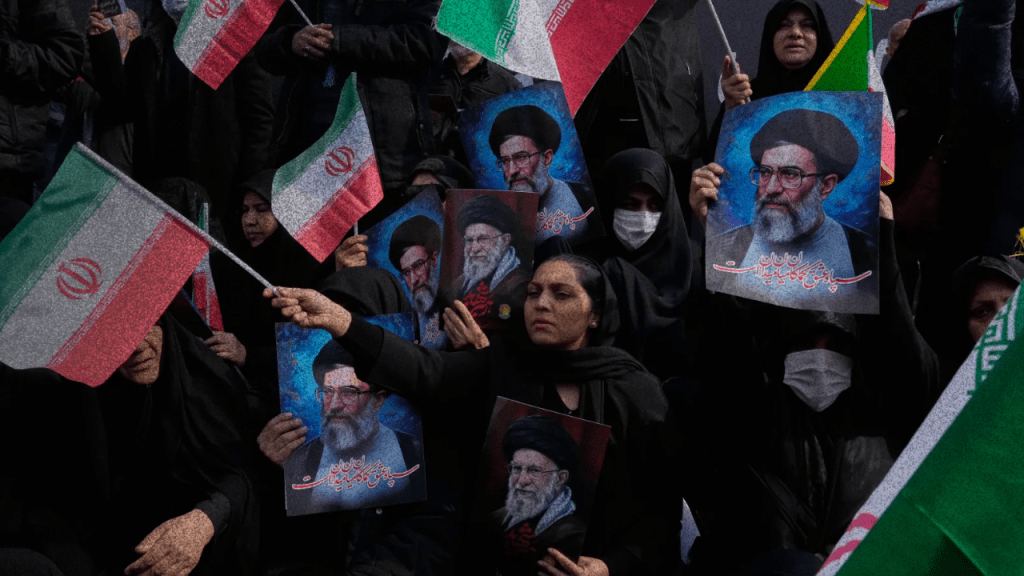
The US-Israeli campaign against Iran opened on February 28, 2026, with the assassination of Supreme Leader Ali Khamenei in the opening salvo. Washington and Tel Aviv framed the campaign around a familiar cluster of objectives: degrading Iran’s nuclear program, dismantling its ballistic missile capacity, severing its support for regional proxy forces. These are limited war aims. They presuppose a surviving, functional Iranian state on the other side of the campaign — an interlocutor capable of being deterred, contained, and pressured into compliance. The problem is that sitting inside that same official objective set, described by CSIS March 25 analysis as the campaign’s most ambitious goal, was regime change in Tehran. You cannot deter a state you are simultaneously trying to dissolve. These are not complementary objectives. They are structurally mutually exclusive, and the fact that Washington launched the campaign while holding both simultaneously is not a failure of strategic planning — it is the plan.
This matters because the incoherence is not accidental. States pursuing regime change have consistent incentives to disguise the objective behind limited-war language. The the war’s official narrative serves exactly this function: publicly defensible objectives provide diplomatic cover while the structural transformation agenda advances through less visible channels — opposition funding, defection incentives, information operations, and the exploitation of fractures inside the target state’s institutions. Washington has run this playbook in Libya, in Syria, in Iraq, and in every case the gap between stated and actual objectives produced the same result: no stable political outcome, and a destroyed state that the empire then blamed on its own internal dysfunction.
Bolton Named the Real Strategy — Whether Trump Used It
By the final week of March 2026, John Bolton had given multiple interviews laying out with unusual clarity what the campaign was actually for. Speaking to The National News, Bolton argued for a strategy of systematic institutional destruction — not a ground invasion, but the deliberate dismantling of the organs of Iranian state power through a combination of external military pressure and internal political engineering. The core of his framework was a wedge between Iran’s conventional armed forces and the Islamic Revolutionary Guard Corps. His preferred post-conflict scenario was a transitional military government drawn from regular army generals, explicitly excluding the IRGC, followed by a new political dispensation. To get there, he advocated direct material support for opposition formations: helping them get better communications, better organization, more resources, and weapons if they want it.
Bolton simultaneously acknowledged that he saw no evidence the administration was actually working with the opposition — noting that the US declined to arm Kurdish forces in Iran even at the war’s outset. This is not a limitation on the claim. Bolton’s framework does not require formal White House adoption to be structurally operative. He is the clearest ideological expression of a logic that is already embedded in how the campaign is being conducted and interpreted. The diaspora opposition networks Washington has cultivated for decades do not need a presidential directive to activate — they respond to the signal that the regime’s survival is now in question. The IRGC-versus-regular-army distinction Bolton articulates is not his invention; it is a long-standing analytical framework inside the US national security apparatus, and the decision to target IRGC command infrastructure in the opening strikes while treating certain conventional military assets differently is not a coincidence.
Implied Regime Change Makes Limited Goals Unachievable
Tehran’s response to the campaign has not been concession. Iran has rejected the 15-point US peace plan, maintained its position on the Strait of Hormuz, and structured its strategy around endurance and cost imposition rather than negotiated resolution. Analyst Trita Parsi’s assessment — that Iran “will continue to control the Strait of Hormuz” and that “it is not as easy for Trump to just walk out” — reflects the same structural logic from a different vantage point. Iran is not miscalculating by resisting. Iran is responding rationally to a campaign whose maximalist objectives, even when only implied, signal that survival of the state in its current form is what is actually at stake.
This is the closing loop of the dual-track contradiction. Limited war aims require an interlocutor. Regime change eliminates the interlocutor. But regime change discourse — even when unofficial, even when emanating from Bolton rather than the White House press secretary — has already structured how Tehran reads every military action. Each airstrike is not interpreted as a discrete pressure point aimed at a specific capability. It is interpreted as a step in a trajectory whose end state is the dissolution of the Islamic Republic. That interpretation, rational given the evidence, produces a resistance posture that makes the limited objectives unachievable. You cannot coerce a state into compliance with your nuclear demands when that state has concluded that compliance ends in its own liquidation. The regime-change logic, by entering the discourse, poisons the conditions for any negotiated settlement of the stated objectives.
Opposition Networks Are Already Active in the Conflict
Bolton’s call to resource and organize Iranian opposition formations is not a proposal for what happens after the war. It is a description of what is already happening inside the war’s political economy. External opposition movements — Mojahedin-e Khalq, Kurdish formations, monarchist networks — are being positioned as potential post-conflict actors, which means they are being resourced and given visibility now, in anticipation of openings the campaign is intended to create. This is the identical operational template Washington used in Syria, where the stated objective was defeating ISIS and the actual project was fragmenting the Syrian state through a combination of military action and covertly cultivated exile networks. The pattern is not even disguised at this point — it simply relies on Western media treating each instance as sui generis rather than as iterations of a documented imperial methodology.
What the opposition framework introduces is a layer of political commitment that makes de-escalation structurally harder. Once the US has signaled to opposition formations that this campaign is their opening, and once those formations have begun organizing and positioning on that basis, Washington acquires a political obligation to the outcome they were promised. Abandoning the campaign short of regime change does not just mean accepting a draw — it means abandoning proxies who reorganized their entire political project around American backing. This is how limited wars become unlimited ones. Not through formal escalation decisions, but through the political economy of promises made to subordinate actors who now have leverage over the patron’s exit options.
Imperial War Always Runs Two Tracks: This Is Its Form
The dual-track structure of the Iran campaign is not an anomaly of this particular administration or this particular conflict. It is the standard operating architecture of US power projection against states it has designated for transformation. The declared track provides legal and diplomatic cover — it is the language used at the UN Security Council, in congressional testimony, in allied briefings. The undeclared track is where the actual strategic objective lives, advanced through proxies, covert support, information operations, and the patient cultivation of internal division. The managing this two-track gap is itself a core function of the imperial state apparatus, and it works precisely because Western media treats the declared track as the real one and the undeclared track as speculation or advocacy.
Bolton’s value in this moment is that he collapsed the gap. He said in public, in named interviews, with institutional authority accumulated across three administrations, exactly what the undeclared track contains. That transparency does not represent a departure from the strategy — it represents the stage of the campaign at which the undeclared objective no longer needs to be kept fully covert because the military facts on the ground have advanced far enough to make its disclosure less costly than its continued concealment. The war behind the war is now the war. And because the regime-change objective and the limited-war objectives are structurally incompatible, there is no military outcome available that produces a stable political result. Escalation is not a risk of this architecture. It is its only product.
Sources
- CSIS — Who Is Winning the Iran War? (March 25, 2026)
- The National — Bolton warns Iran threat to Strait of Hormuz is growing (March 25, 2026)
- NPR — Bolton talks about the goals of the Iran war (March 31, 2026)
- Al Jazeera — Trump tells allies to get their own oil (April 1, 2026)
- Wikipedia — 2026 Iran War
- Iran War Narrative Inverts Who Struck First — Spark Solidarity
- Weaponized Diaspora and the Witnesses Empire Needs — Spark Solidarity
- China Is Not Imperialist — Spark Solidarity



 Spark Solidarity