
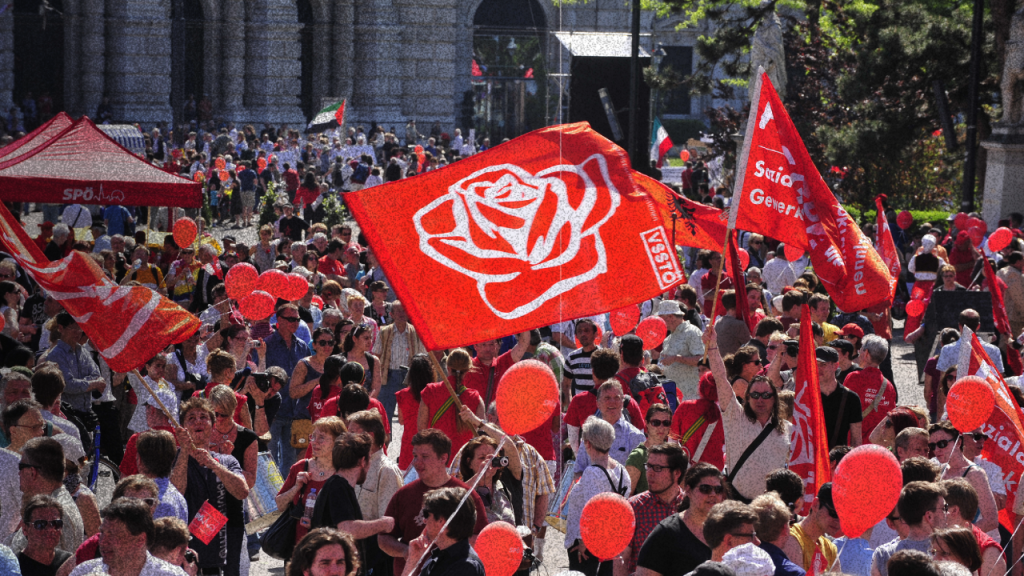
Social democracy stabilizes capitalism through domestic redistribution funded by global extraction. When crisis hits, it defends the system that feeds it. This is not betrayal. This is function.
The Welfare State Lives on Extraction
Social democracy presents itself as a midpoint between capitalism and socialism. A compromise. A gradual path. A humane alternative. This framing is deceptive. Social democracy is not a transitional form — it is a capitalism management strategy in the imperial core. Its core arrangement is simple: stability and redistribution at home, extraction and domination abroad. The welfare state does not emerge independently of empire. It is built alongside it. Higher wages, social programs, and political stability in the core are made possible by unequal exchange and resource extraction from the periphery. This produces a structural contradiction. Social democracy depends on capitalism functioning. Capitalism depends on imperial dominance. When expansion falters, when crisis hits, when margins tighten, the question becomes unavoidable: preserve the system or break from it. Social democracy is positioned structurally to choose preservation. Not because of bad intentions, but because its entire existence depends on the continued functioning of the system it claims to reform.
This arrangement functions smoothly during periods of expansion. Social democratic parties can distribute gains, maintain legitimacy, and present themselves as progressive. The contradiction remains latent. But when that expansion stalls, the choice becomes explicit. And the historical record shows what social democracy chooses every time.
1914 Revealed the Structure
Before World War I, social democratic parties across Europe claimed international solidarity. Workers of the world, united against ruling classes. In August 1914, that collapsed instantly. These same parties voted for war credits. They supported their own national governments. They mobilized workers not against war, but for it. National interest, within the imperial core, overrode class solidarity. The break was decisive. It became even clearer in Germany after the war. The country was in revolutionary crisis. Workers’ councils formed. The possibility of socialist transformation was real. The Social Democratic Party took power. And then it made its choice. It aligned with the military. It armed right-wing paramilitaries. It crushed the revolutionary left. Rosa Luxemburg and Karl Liebknecht were murdered on January 15, 1919, by Freikorps forces unleashed by the SPD government.
This is not a marginal episode in socialist history. It is the clearest expression of the pattern. Faced with socialism from below, social democracy chose counterrevolution. It chose order over rupture. It chose the state over the movement. The Social Democratic Party’s crushing of the revolutionary left and alliance with conservative forces in 1918-19 weakened the forces that could have stopped fascism and stabilized a collapsing system just long enough for something more reactionary to take its place. The choice was not between reform and revolution. The choice was between defending property relations and abolishing them. Social democracy’s function was revealed: when the system is threatened, it defends the system. This is what it means to say the contradiction is structural. The pattern does not depend on individual cowardice or betrayal. It depends on what social democracy is designed to do.
Professionalization Preempts the Choice
The mechanism today looks different, but the function is identical. Mass movements are no longer absorbed only into parties. They are absorbed into institutions. Into NGOs. Into advocacy groups. Into think tanks. Into electoral pipelines. Politics becomes professionalized. Funded. Managed. Radical demands are translated into policy proposals. Structural critique becomes issue-based advocacy. Confrontation becomes engagement. Organizing becomes programming. And most importantly, accountability shifts — not downward, to a base, but upward, to funders, foundations, governments.
This is NGO-ification. It does not eliminate dissent. It reorganizes dissent into acceptable forms by fragmenting it across issues, stripping it of systemic analysis, and turning it into something that can be negotiated, administered, and ultimately contained. Resistance becomes legible to power. And once it is legible, it is manageable.
This is how you get a political layer that speaks in the language of justice while operating entirely within the logic of governance. The radicalism is aesthetic. The function is stabilization. And the choice that social democracy faced in 1919 — preserve the system or break from it — is resolved before it ever arises. The movements are already inside the system. They are already accountable to it. They are already speaking its language. When crisis comes, they do not need to be crushed. They have already been neutralized.
The American Left Aligns With Empire
Once you see the structure, the present stops looking contradictory. It becomes predictable. Figures like Bernie Sanders and Alexandria Ocasio-Cortez present themselves as the left edge of American politics. They advocate for wealth redistribution, taxing the rich, labor rights, and expanded social programs.
On foreign policy, however, they align with the consensus.
Sanders supports military aid to Ukraine, framing it as defense of democracy, while avoiding systemic critique of NATO or U.S. hegemony. AOC’s record on Israel is the sharper illustration. She voted against a 2025 amendment to strip Iron Dome funding from the defense bill — defending it as support for “defensive capabilities” — while Rashida Tlaib and Ilhan Omar voted with the amendment. Only after her base threatened to withhold DSA endorsement ahead of a potential 2028 presidential run did she pledge, in a private forum on April 1, to oppose all military aid to Israel including Iron Dome. The position shifted under threat of losing infrastructure, not on principle. The pattern is consistent: radical rhetoric, institutional alignment.
This is not about individuals failing to live up to their principles. This is about the structural position they occupy. They operate inside the Democratic Party. They depend on its infrastructure, its funding networks, its media apparatus. They cannot challenge the imperial consensus without losing that infrastructure. So they do not challenge it. They align with it. They vote for weapons packages. They frame militarization as solidarity. They call for peace through escalation. The contradiction is not a bug. It is the system functioning as designed.
Canada Tightens the Pattern Further
The pattern is tighter in Canada. The New Democratic Party presents itself as social democratic. It advocates for workers, healthcare, and social programs. It also supports NATO alignment, sanctions, and military aid to Ukraine. It frames these positions as solidarity and defense of sovereignty. There is no meaningful parliamentary anti-imperial position. At the provincial level, the contradiction is even cleaner. Progressive language dominates domestic policy. Foreign policy disappears entirely, or aligns by default. You can be progressive on everything, as long as you do not challenge the imperial structure that underpins it. This is social democracy functioning at maximum efficiency. The domestic and the international are split cleanly. Redistribution at home. Empire abroad. The system is stabilized on both fronts.
What this reveals is that the NDP’s function is not to challenge capitalism. Its function is to manage working-class demands within capitalism. When those demands can be met through redistribution, the NDP redistributes. When those demands threaten the system, the NDP aligns with the system. The choice is made in advance. The structure determines it. The leadership race that just concluded in Winnipeg confirmed this with unusual clarity — the vetting mechanism excluded the only candidate who named the imperial structure directly, before a single member voted, through a process that bypassed member input entirely.
Europe Inverts the Logic Entirely
In Europe, the mask is thinner. Parties that still openly call themselves social democratic now argue that peace requires militarization. That deterrence produces stability. That escalation creates the conditions for negotiation. They call for arms shipments and defense integration, all framed as the path to a just peace. The logic is inverted. War becomes the mechanism of peace. Empire becomes the guarantor of democracy. What was once a contradiction is now policy. This is not a failure of social democracy. This is social democracy succeeding at what it is designed to do. It stabilizes capitalism. It defends the state. It aligns with imperial consensus when that consensus is threatened.
The European context makes this especially clear because the contradiction between domestic progressivism and imperial alignment is no longer even acknowledged. It has been resolved ideologically. Militarization is progressive. NATO is democratic. Escalation is solidarity. The structure has fully absorbed the rhetoric of the left. And in doing so, it has neutralized any force that might challenge it.
The System Stabilizes Itself Until It Cannot
This is not a story about individuals failing to live up to ideals. It is a story about function. Social democracy in the imperial core manages capitalism. NGO-ification manages dissent. Together, they produce a political layer that stabilizes the system from within. When conditions are stable, that layer redistributes and reforms. It expands programs, softens edges, and maintains legitimacy. When conditions destabilize, it closes ranks. It defends institutions. It supports militarization. It marginalizes or suppresses movements that threaten systemic change. It does not need to become fascist to enable what comes next. It only needs to disarm the left, normalize state power, and preserve the system in crisis. Once that is done, the terrain is set.
The problem is not that this politics fails. The problem is that it succeeds at exactly what it is designed to do. It keeps the system going. Until something worse takes over. The lesson from 1919 is not that the SPD betrayed the revolution. The lesson is that the SPD functioned as it was designed to function. It defended the state. It crushed the movement that threatened the state. And in doing so, it cleared the ground for fascism. The same structure exists today. The same function. The same choice, resolved in advance. Social democracy does not break toward socialism. It stabilizes capitalism. And when that stabilization fails, it does not fail toward the left. It fails toward reaction.
Sources
- Social Democracy and Imperialism — Monthly Review
- Unequal Exchange and Imperialism — Jacobin
- Collapse of the Second International — Lenin / Marxists.org
- Rosa Luxemburg and the German Social Democrats — Jacobin
- The Revolution Will Not Be Funded — Verso Books
- Sanders on Ukraine Aid — Common Dreams
- AOC pledges no military aid to Israel at DSA forum — City & State New York, April 2026
- NDP Supports Ukraine — NDP.ca
- Scholz and Social Democrats on Ukraine weapons — Politico Europe
- China Is Not Imperialist — Spark Solidarity







 Spark Solidarity