
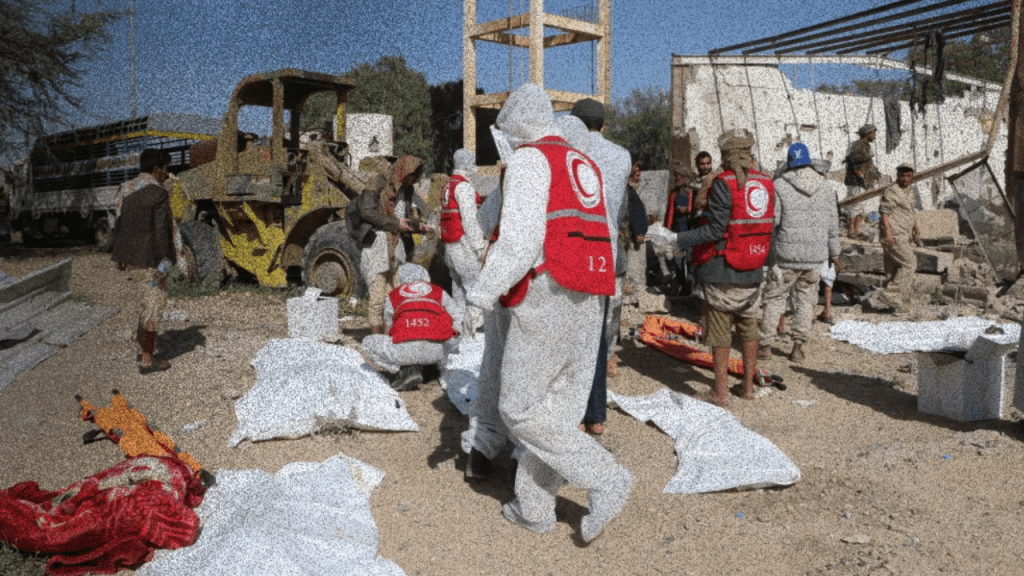
Civilian harm becomes the primary legitimacy contest when media systems cross a visibility threshold — and that threshold is produced, not discovered.
The Harm Was Always Present — Visibility Is What Changed
The framing that civilian impact “emerged” in week four of a conflict is already a concession to the media system’s own logic. Civilian harm does not emerge. It is present from the first strike. What changes is the set of structural conditions — access to affected areas, volume of circulating imagery, repetition across enough outlets to force it into the dominant frame — that determine whether that harm registers as a fact of the conflict or remains invisible to international discourse. The shift from periphery to center is not a moral awakening. It is a threshold crossing, and the threshold is set by the media system, not by the events themselves. Understanding this distinction is not academic. It determines who gets to define what the war is about, and when.
This is not a neutral process. Research on conflict reporting confirms that events in densely populated urban areas generate more eyewitnesses, more verifiable documentation, and more proximity to communications infrastructure than events in rural or frontline zones. The geography of visibility is structurally skewed before a single editorial decision is made. The war that gets reported is not the war that is happening — it is the war that the media system’s access architecture can produce. Week four is not when civilian harm began. It is when enough of it became legible to the system to force a frame shift. Treating that as a discovery rather than a structural output is exactly how the legitimacy contest gets won before it is even recognized as a contest. The mechanics of narrative architecture depend on this confusion being maintained.
Casualty Figures Are Not Data — They Are Narrative Weapons
Once civilian harm crosses the visibility threshold, the immediate terrain of contest becomes quantification. Casualty figures enter the discourse not as neutral measurements but as weapons — each number attached to a framework, each framework attached to a claim about responsibility and proportionality. A peer-reviewed study on what scholars now call “war counting” documents this structurally: casualty counts are generated under conditions of uncertainty, politicized by state and non-state actors alike, and function simultaneously as tools of bureaucratic rationality, instruments of narrative warfare, and markers of legitimacy. The number is never just a number. It is an argument dressed as arithmetic.
The asymmetry in how those numbers are sourced and reported compounds the problem. Research by Zhukov and Baum on actor-specific reporting bias in conflict coverage documents that systematic under- or over-reporting of violence by different actors conveys “potentially contradictory information about how a conflict is likely to unfold, and whether outside intervention is necessary.” Crucially, this kind of bias does not merely contaminate academic datasets — it can “skew the policy preferences of news consumers, and manipulate public opinion about the actors involved.” Competing estimates built on competing sourcing assumptions do not converge toward truth under these conditions — they produce a layered contestation that forecloses resolution by design. The weaponization of diaspora testimony operates through this same architecture: the witness and the number are both instruments of the narrative framework, not independent inputs to it.
Military Success and Legal Judgment Run on Parallel Tracks
The IHL principle of proportionality exists precisely because the achievement of a military objective is not the end of the analysis. Under international humanitarian law, even a strike directed at a lawful military target and executed with precision is prohibited if the expected incidental harm to civilians is excessive relative to the anticipated military advantage. The rule of proportionality — codified in Article 51(5)(b) of Additional Protocol I and confirmed as customary international law under ICRC Rule 14 — requires the balance to be struck before the action is taken, with courts empowered to assess it after the fact. Military success and moral-legal judgment are parallel tracks. Conflating them — treating effectiveness as a sufficient answer to a proportionality question — is a political move, not a legal or ethical one.
What the proportionality doctrine establishes in law, the public narrative process replicates in discourse. A strike achieves its objective: that assessment occupies one register. The same strike produces civilian casualties documented by credible sources: that assessment occupies a second register. These are not mutually exclusive, and they do not resolve each other. Lieber Institute analysis of aggregate civilian-combatant ratios confirms the point: the relevant legal question is not whether statistical modelling can produce coherent casualty estimates, but whether those estimates can establish IHL violation — and that determination requires incident-level evidence, not aggregate ratios. The side that understands this uses the proportionality frame offensively — pre-loading the discourse with evidence of precautionary measures, post-loading it with claims of military necessity. The side that doesn’t is perpetually reactive, defending actions already framed by the other side’s narrative.
Layered Frames Produce Power, Not Complexity
The observation that competing narratives produce “interpretive complexity rather than resolution” is accurate as far as it goes, but it stops short of the more important point. The layering of frames — military assessment, civilian impact, casualty contestation, proportionality argument, attribution dispute — does not distribute power evenly across the actors generating those frames. It concentrates power in whoever controls the conditions of visibility and verifiability that determine which frames get traction. Zhukov and Baum’s research is explicit on this: selective reporting is not merely a statistical nuisance — under the right conditions, warring parties can “weaponize reporting bias into a form of information warfare — using the media to shape the preferences of an intended audience to their advantage.” “Layering” is too passive a word for what is actually a structural advantage accruing to the actor with greater media access and greater institutional credibility in the eyes of Western audiences.
This is where the “inward turn” framing reveals its ideological content. Describing civilian harm becoming visible as a conflict “turning inward” — as if the war is discovering its own human consequences for the first time — naturalizes the prior period of invisibility. It treats structural suppression of civilian impact as a neutral default and its eventual visibility as a spontaneous development. Neither is true. The prior invisibility was produced by the same structural filters now producing visibility: access, verifiability, audience resonance, and the decisions of actors who shape all three. The war did not turn inward. The media system’s aperture widened enough to admit a different class of evidence — and in doing so, shifted the primary site of the conflict’s legitimation from the battlefield to the narrative contest over who bears responsibility for what became visible. That contest is where the war’s political outcome will be determined, and it was never not underway.
Sources
- Theory and Society — War by numbers: The sociology of counting in armed conflict (February 2026)
- Zhukov & Baum — How Selective Reporting Shapes Inferences about Conflict (working paper)
- MSF Guide to Humanitarian Law — Proportionality
- Lieber Institute West Point — Aggregate civilian-combatant ratios and IHL (March 2026)
- Iran War Narrative Inverts Who Struck First — Spark Solidarity
- Weaponized Diaspora and the Witnesses Empire Needs — Spark Solidarity




 Spark Solidarity