
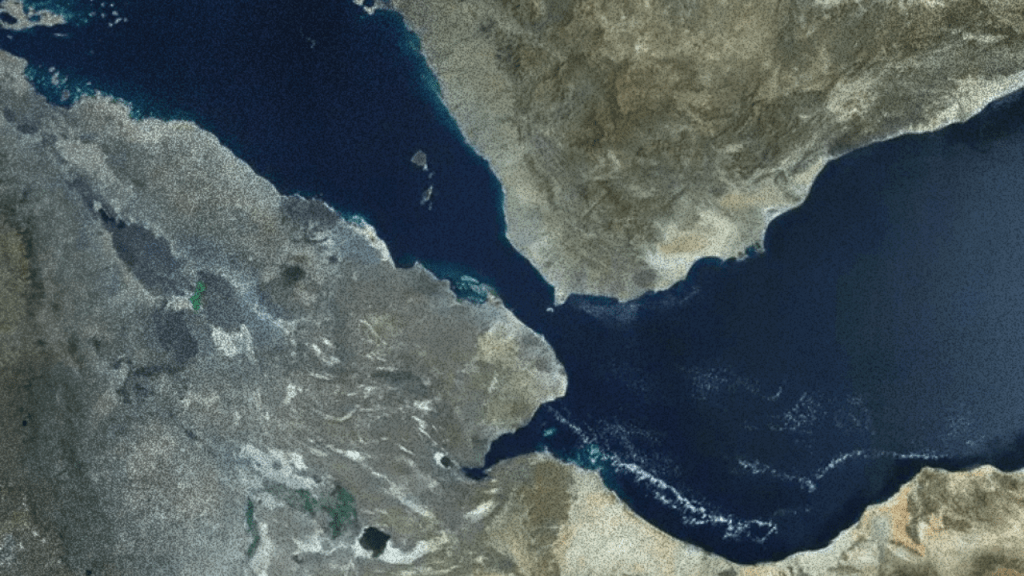
Bab al-Mandeb emerged as a second front by March 27, 2026 — not through new armies, but through the activation of pre-existing networks against global trade.
The Strait That Cannot Be Bypassed Without Consequences
The Bab al-Mandeb Strait sits between Yemen and the Horn of Africa, a narrow corridor connecting the Red Sea to the Gulf of Aden and, through the Suez Canal, to every major trade route linking Europe and Asia. It handles approximately 15 percent of global maritime trade — including 30 percent of container ship traffic — and there is no equivalent alternative. Rerouting around the African continent adds weeks and thousands of miles to every voyage. The geometry of the strait is itself a form of leverage, independent of who controls the land on either shore. That geography existed before this war. What changed in late March 2026 was who decided to use it.
Al Jazeera reporting described Bab al-Mandeb as the Houthis’ “ace.” With the Strait of Hormuz already throttled, a simultaneous disruption of the Red Sea corridor would create what analysts described as a “nightmare scenario” — two chokepoints closing simultaneously, compressing every alternative route and amplifying the war’s economic reach far beyond its military geography. Elisabeth Kendall of Cambridge University told Al Jazeera: if both straits are restricted at once, “you really will disrupt, if not cripple, trade toward Europe.” That possibility was not hypothetical by late March. It was announced operational policy.
The Houthis Are a Pre-Positioned Weapons System
Western coverage frames Ansarullah as a regional militia whose relevance is borrowed from Iran. That framing is operationally false. By March 2026, the Houthis had behind them a two-year maritime campaign in which they attacked over 100 merchant vessels in the Red Sea, struck US warships, and demonstrated targeting reach into Israeli territory. Stimson Center analysis confirmed that a 2024 UN experts report found IRGC support, Hezbollah expertise, and Iraqi militia training had transformed the Houthis from a local group into a heavily armed military force with advanced weapons systems used in live combat conditions. The Houthis had outlasted Hezbollah’s decapitation by Israel, outpaced the Iraqi PMF, and weathered multiple US air campaigns — demonstrating a structural resilience that distinguishes them from every other node in the Axis of Resistance network.
When Houthi leader Abdul-Malik al-Houthi declared in the weeks before their entry that “our hands are on the trigger whenever developments require it,” he was not issuing rhetoric. He was announcing a pre-existing capability entering a new operational phase. On March 28, Brigadier-General Yahya Saree announced the group’s first missile attack on Israel since the October 2025 Gaza ceasefire, confirmed by Wikipedia and multiple primary sources. The attacks were described as coordinated with the IRGC, the Iranian Army, and Hezbollah — a claim consistent with the structural relationship Stimson and the UN experts had documented for years. Deputy information minister Mohammed Mansour stated plainly: “closing the Bab al-Mandeb strait is among our options.”
Demonstrated Capability Is Permanent Leverage
The threat economy of a chokepoint does not require constant action to function. Once a capability has been demonstrated, it does not need to be exercised continuously to produce real economic effects. The 2024–2025 Red Sea campaign established this mechanism precisely: S&P Global confirmed confirmed that during the prior Houthi campaign, war risk premiums for the Bab al-Mandeb rose from 0.05 percent to 1.0 percent of hull value — a twentyfold increase — within three months, making transit commercially unviable for most operators even when physical attacks were intermittent. Those costs do not require a missile in the air. They require only the credible possibility of one.
By early March 2026, BIMCO’s chief safety and security officer Jakob Larsen warned that war risk premiums were expected to increase “manyfold” and that ships with business connections to the US or Israel may be “unable to obtain coverage at any price.” Container Management confirmed confirmed CMA CGM suspended Suez Canal transits indefinitely and rerouted via Cape of Good Hope even before the Houthis launched a single missile in the current conflict. Major liner operators had already diverted away from Bab al-Mandeb following the late-February escalation, according to Safety4Sea’s maritime intelligence. Restraint, in this context, is not the absence of pressure — it is pressure held in reserve, priced into every insurance policy and every route calculation across the system.
This Is Networked War — No Declaration Required
The architecture now visible around the Bab al-Mandeb is the same architecture operating across the broader conflict: geographically dispersed, operationally coordinated, non-state in form but state-supported in capability. The Houthis claimed their March 28 strikes on Israel were coordinated with the IRGC, the Iranian Army, and Hezbollah. Al Jazeera’s analysis confirmed that Iran’s leverage now runs through two chokepoints simultaneously — Hormuz and Bab al-Mandeb — meaning pressure can be applied, shifted, or escalated across different nodes without any single state crossing a threshold that triggers a formal military response. The Stimson Center identified the Houthis as the most resilient surviving node in this network after Hezbollah’s degradation. No new armies were raised. No new alliances were signed. The war widened by switching on what was already built.
That is the structural argument: the expansion is not additive, it is activational. how economic architecture shapes requires recognizing that trade infrastructure is not neutral backdrop — it is terrain. The Red Sea and the Suez Canal together carry 15 percent of global maritime trade; the Bab al-Mandeb is their gateway. Iran’s network was built, over years, specifically to be able to apply simultaneous pressure on that terrain. The activation of the Houthi node on March 28 was not an improvisation. It was the execution of a pre-positioned strategy whose costs had been prepaid — in weapons transfers, training missions, and two years of operational experience — long before this war began.
The War Expands by Intersecting With Systems
By late March 2026, the conflict had moved from a regional confrontation centered on Iran and its immediate adversaries into a system-level disruption operating through trade infrastructure. No new major state had formally entered. No front line had physically extended. What changed was the activation of a pre-positioned node — Ansarullah, controlling terrain adjacent to a chokepoint the global economy cannot afford to treat as expendable — in operational alignment with the broader network. The effects of that activation are not contained within the region. The war’s narrative architecture frames this as one conflict with defined parties. The economic reality is a networked disruption cascading through shipping lanes, insurance systems, and supply chains connecting every economy on the planet.
Higher insurance premiums, rerouted vessels, inflated transit times, and supply chain recalculations cascade outward regardless of where the missiles land. This is how wars extend beyond their initial scope in the contemporary period: not by marching armies across borders, but by intersecting with the systems that connect those borders. The Bab al-Mandeb is one such intersection. The question by the end of March was not whether the Houthis would act — they had. The question was how far the activation would go, and at what point the two-chokepoint scenario the global economy could not absorb would become the permanent operating condition of a conflict no one had budgeted to sustain.
Sources
- Al Jazeera — Houthis open new front, Bab al-Mandeb second front analysis (March 29, 2026)
- Al Jazeera — Yemen’s Houthis launch missile attack on Israel (March 28, 2026)
- Stimson Center — The Houthis must decide: join Iran’s war or abandon Iran (March 5, 2026)
- Wikipedia — 2026 Houthi strikes on Israel
- S&P Global — Marine war insurance for Hormuz dries up (March 2026)
- Container Management — Gulf war risk insurance crisis; BIMCO warning (March 1, 2026)
- Safety4Sea — Middle East maritime threat overview; Bab al-Mandeb rerouting (March 2026)
- Chatham House — What do Houthi attacks on Israel mean for the Iran war? (March 2026)
- Wikipedia — 2026 Iran War
- Iran War Narrative Inverts Who Struck First — Spark Solidarity
- China Is Not Imperialist — Spark Solidarity






 Spark Solidarity