
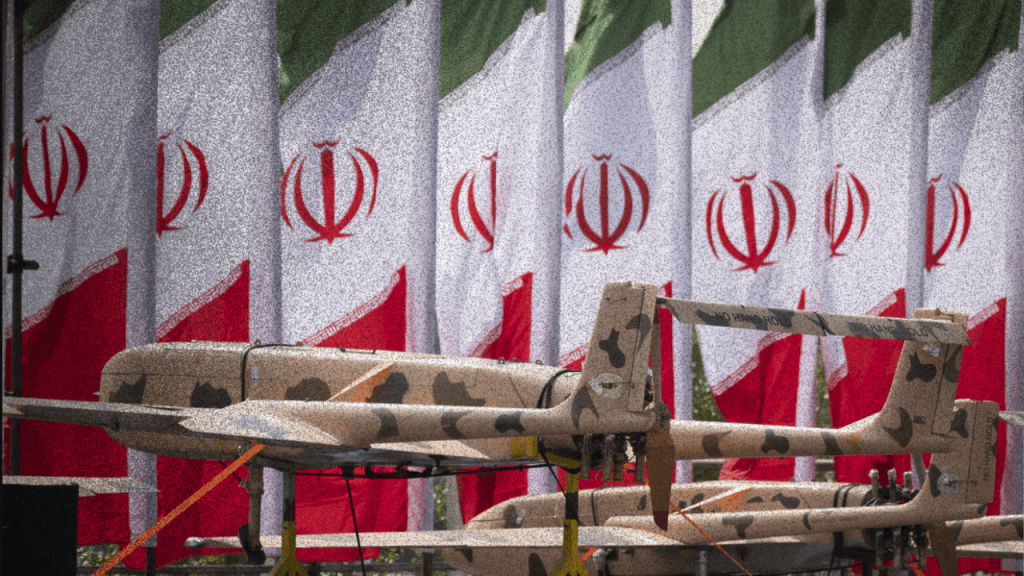
Iran’s attrition war after February 28 was not improvised retaliation — a doctrine two decades in the making, designed to make decisiveness impossible.
What Iran Activated Was a Doctrine, Not a Reaction
When the strikes hit on February 28 and Supreme Leader Khamenei was killed, Western analysts immediately reached for their familiar framework: escalation spike, retaliation, de-escalation window. That framework was wrong from the first hour. What Iran activated in the days that followed was not improvised retaliation. It was the structured execution of a military doctrine the Islamic Revolutionary Guard Corps had spent two decades building — the Decentralized Mosaic Defense strategy. Soufan Center confirms that Foreign Minister Araghchi stated this directly on March 1: “We’ve had two decades to study defeats of the U.S. military to our immediate east and west. We’ve incorporated lessons accordingly. Bombings in our capital have no impact on our ability to conduct war.”
The architecture is exactly what the name describes. Launch sites dispersed across vast geographic terrain. Command nodes fragmented so that no single strike terminates operational authority. Execution authority delegated downward to semi-autonomous regional IRGC units with their own intelligence assets, their own weapons stockpiles, their own command-and-control. Al Jazeera confirms that IRGC Commander Jafari split military command into 31 provincial cells after 2007 — each capable of functioning independently if others were destroyed. A centralized system can be decapitated. A decentralized system cannot. The system was engineered to absorb damage and persist — and that doctrinal engineering is what made everything that followed possible.
The March 1 Surge Was the Opening Signal, Not the Campaign
The scale of March 1 was staggering: CSIS data records 1,206 strikes in a single day — 867 drones and 339 missiles. Western coverage treated that wave as the main event, the peak from which retreat would follow. That reading missed the campaign design entirely. The surge was not the campaign. It was the opening signal — a deliberate saturation strike intended to stress defensive systems, consume high-end interceptors, and communicate that Iran’s capacity was real and immediate.
What followed the March 1 peak was a sharp drop on March 2 and then a steadier, sustainable rhythm for the rest of the week. Carnegie Endowment confirms Iran structured the follow-on campaign around domestic production capacity, decentralized launch systems, and selective pressure rather than maximal output. The pacing was deliberate. Capacity was not being exhausted — it was being rationed to maintain continuous pressure without burning through stockpiles. This is the shift from decisive-moment warfare to attrition: not a single overwhelming blow, but a sustained, calibrated mechanism of strain. The doctrine and the tempo are the same argument at different levels of abstraction.
Every Intercepted Drone Costs More Than the Drone
The cost asymmetry is not a talking point — it is a structural feature of how this type of war operates. Foreign Policy documents the core dynamic: Iranian Shahed drones estimated at roughly $20,000 apiece have repeatedly forced the United States and Gulf partners to expend Patriot and SM-6 interceptors costing millions of dollars each. A successful shoot-down is, in cost terms, frequently a net loss for the defender. The attacker draws from comparatively large stockpiles of low-cost systems. The defender burns through scarce, expensive munitions with each successful interception.
That dynamic extends beyond financial cost. FPRI analysis confirms specific radar losses attributable to Iranian strikes by March 10: the AN/FPS-132 early warning radar in Qatar; multiple AN/TPY-2 THAAD radars across Jordan, Kuwait, Saudi Arabia, and the UAE; and the AN/TPS-59 tactical radar in Bahrain. These are not peripheral assets — they are the sensing infrastructure that makes coordinated interception possible. Personnel operating these systems through continuous multi-directional engagement cycles face compounding cognitive and physical load that degrades coordination and increases error rates. The asymmetry is self-reinforcing: decentralized launch capacity means suppression at the source requires broader, more sustained operations, which generates additional resource expenditure on the suppressing side.
Iran Needs to Keep Arriving, Not Break Through
The strategic logic of this campaign does not require Iran to defeat defensive systems in any single engagement. The New Arab frames: Iranian drones generate persistent military and psychological pressure while conserving Iran’s most valuable missile assets, forcing Gulf governments to defend not only military installations but airports, desalination plants, refineries, ports, data centers, and commercial hubs simultaneously. In a region where infrastructure concentration is itself a strategic vulnerability, repeated attacks carry consequences far beyond their immediate physical footprint.
Even Chatham House — not an institution with any interest in overstating Iranian capability — Chatham House concluded that economic attrition is core to Iran’s strategy, and that playing defense will exhaust Gulf defensive systems before Iran runs out of drones and missiles. The threshold for Iranian strategic success per engagement is low by design. Cumulative damage, not breakthrough, is the objective — and cumulative damage is exactly what a sustained, paced, decentralized campaign produces. Each wave tightens the constraint on the defender regardless of the interception rate. The ratchet is the strategy.
By Week One, Time Had Already Become the Decisive Variable
The Bulletin of Scientists noted that by March 5, Iranian drone attack tempo had dropped 83 percent from the March 1 peak — and simultaneously noted that more than 2,000 low-cost Shahed drones had already entered the Gulf region since the war began. Western coverage read the drop as exhaustion. The structural reading is the opposite: the campaign had completed its saturation phase and settled into its attritional rhythm, exactly as designed.
Al Jazeera’s doctrinal analysis makes the underlying principle explicit: Iranian military thinking treats war primarily as a test of endurance, not a contest of firepower. The battlefield is designed to be difficult to resolve quickly — layered regular defense, irregular warfare, local mobilization, and long-term attrition operating simultaneously across geographic depth. The CRS March 26 report frames the ongoing contest as a war of attrition between Iran’s likely decreasing ability to sustain attacks and the possibly finite capacity of the United States and partners to sustain defense — which is precisely the terrain Iran’s doctrine was built to occupy. Uncertainty about who runs out first is not a sign the strategy failed. It is the structural endurance advantage of the side that designed for endurance over the side that planned for a short war.
Sources
- Soufan Center — Iran’s Mosaic Defense Strategy: Decentralization as Resilience
- Al Jazeera — How Iran Planned to Fight a Long War with the US and Israel
- CSIS — Unpacking Iran’s Drone Campaign: Early Lessons for Future Drone Warfare
- Carnegie Endowment — Iran Rewrites Its War Strategy
- Foreign Policy — The Drone Attrition Trap
- FPRI — Over 5,000 Munitions Shot in the First 96 Hours of the Iran War
- The New Arab — How Economic Attrition Is Central to Iran’s War Strategy
- Chatham House — Should the Gulf Arab States Join the War Against Iran?
- Bulletin of the Atomic Scientists — Iran Conflict Edges World Closer to Drone Arms Race
- Congressional Research Service — U.S. Conflict with Iran, March 26, 2026
- Wikipedia — 2026 Iran War
- Weaponized Diaspora and the Witnesses Empire Needs — Spark Solidarity
- China Is Not Imperialist — Spark Solidarity







 Spark Solidarity