
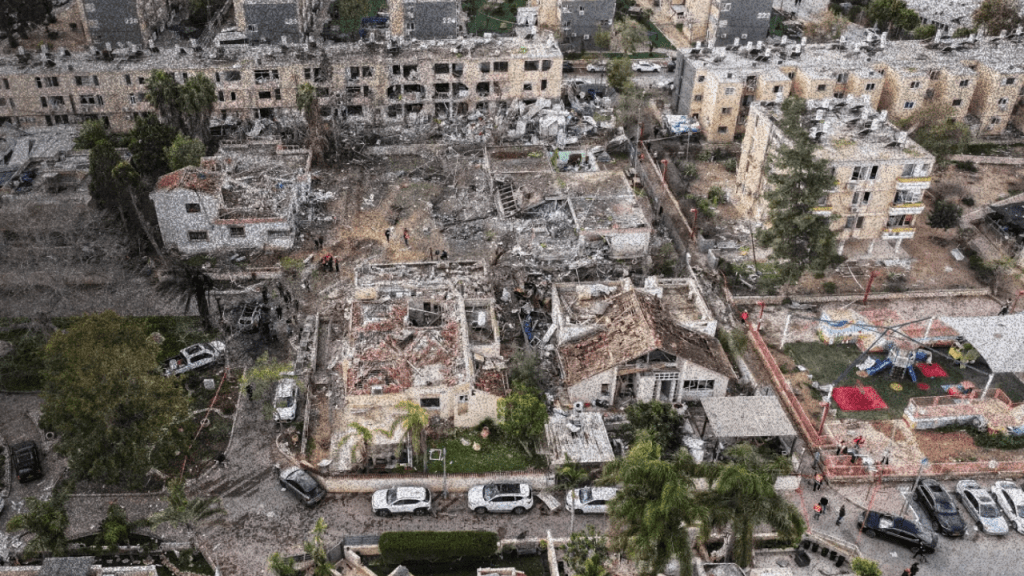
Iran strikes Dimona and Arad with ballistic missiles near Israel’s nuclear facility in retaliation for U.S.-Israeli attacks on Natanz, turning March’s false rumor into operational reality.
Iranian Missiles Reach the Nuclear Threshold Zone
Iranian ballistic missiles struck the southern Israeli cities of Dimona and Arad on March 21, injuring nearly 180 people and destroying residential buildings. Iranian state television framed the strikes as a response to U.S.-Israeli attacks on Iran’s Natanz enrichment site. The International Atomic Energy Agency confirmed no structural damage to the Shimon Peres Negev Nuclear Research Center and no abnormal radiation levels. The missiles hit Dimona city — approximately 10 to 15 kilometers from the nuclear facility — rather than the reactor complex itself. Iranian state media framed the city as the target; the IAEA confirmed the facility was not struck.
The distinction between striking the city and striking the reactor matters legally and diplomatically. It collapses operationally. Israel’s air defense system failed to intercept missiles in an area that houses its primary nuclear weapons production infrastructure. Iran’s Parliament Speaker Mohammad Bagher Ghalibaf stated that “if the Israeli regime is unable to intercept missiles in the heavily protected Dimona area, it is, operationally, a sign of entering a new phase of the battle.” The nuclear facility now operates inside an active strike zone. What previously functioned as a deterrence perimeter has become a margin measured in kilometers.
The March False Alarm Was the Dress Rehearsal
On March 1, a false rumor spread claiming Iran had already struck the Dimona nuclear facility. Fact-checking confirmed no credible sources verified any such attack — viral footage was traced to a 2017 ammunition depot explosion in Ukraine. The rumor spread rapidly before major outlets debunked it. The panic it generated revealed how thin the margin is between information events and material escalation when nuclear infrastructure enters the targeting equation.
That false alarm demonstrated fragility at the level of public perception. The March 21 strikes demonstrate fragility at the material level. What was previously a hypothetical scenario triggering global panic is now operational reality: missiles landing inside the city nearest to Israel’s nuclear weapons program, with Iran explicitly framing the facility as a legitimate military target, and Israeli air defenses failing to intercept. The progression from false rumor to confirmed strike compresses the decision-making window that nuclear deterrence theory assumes will remain open.
Load-Bearing Nodes Fail When Tested Under Pressure
The Negev Nuclear Research Center functions as a load-bearing node in Israel’s strategic architecture. The facility produces the plutonium and tritium necessary for maintaining Israel’s estimated 90 nuclear warheads. Five days after the U.S.-Israeli war began, an Iranian military official stated through the semi-official ISNA news agency that Tehran would target the Dimona reactor if Washington and Tel Aviv attempted regime change in Iran. That threat has now materialized as concrete military action, with missiles penetrating Israeli air defenses in the reactor’s immediate vicinity.
The near-hit versus direct-hit distinction matters, but it collapses under sustained pressure. Israeli decision-makers now operate under conditions where the next missile salvo could strike the reactor complex rather than residential areas 10 to 15 kilometers away. This compression of operational space is the point of the strike pattern. Iran is demonstrating that the nuclear facility’s vicinity is targetable, that air defenses cannot guarantee interception, and that the threshold between conventional retaliation and nuclear-adjacent escalation has become a margin measured in distance rather than a bright line. Israel’s IDF spokesperson acknowledged the failure — “the air defense systems operated but did not intercept the missile” — and said an investigation was underway, while insisting it was not a systemic problem. Netanyahu acknowledged that no one was killed in either city was “due to luck.”
The U.S.-Israeli strike on Natanz created the retaliation framework. Attacking Iran’s primary uranium enrichment facility directly targeted Iran’s nuclear program infrastructure. Iran responded by targeting the vicinity of Israel’s primary nuclear weapons production facility. The symmetry is deliberate. The difference is that Israel maintains an operational nuclear arsenal while Iran does not — meaning the stakes of facility damage are asymmetric in Israel’s favor, and Iran’s targeting logic accounts for that asymmetry by escalating the psychological and strategic pressure without triggering direct nuclear exchange.
The Battlefield Now Includes the Reactor’s Perimeter
Israel’s nuclear deterrence posture assumed the Negev facility would remain outside the direct strike zone through air defense superiority and the strategic ambiguity of its retaliation threshold. Both assumptions are now under pressure. Iranian missiles have demonstrated the technical capacity to reach the facility’s immediate region and the political willingness to target it. The interception failures in Dimona and Arad prove that air defense cannot be guaranteed even in Israel’s most heavily defended airspace, for a conflict that was sold as precision and control.
The casualty figures from residential strikes generate their own escalation pressure. Nearly 180 people injured, buildings destroyed, a city adjacent to a nuclear facility under active bombardment — this creates domestic political demand for retaliation inside Israel that will target Iranian nuclear or military infrastructure, which will generate Iranian counter-retaliation, which brings the cycle back toward Dimona. The facility is no longer protected solely by deterrence theory. It is protected only by the next interception, which has already failed twice.
This is what the March 1 false alarm revealed in advance: the system reacts to nuclear-adjacent events as if they are nuclear events because the decision-making window closes too fast for deliberation once the event is confirmed. The current strikes operate inside that window. Israeli leadership now makes decisions under conditions where the next missile salvo could hit the reactor, where air defenses have already failed in the reactor’s vicinity, and where Iranian officials have explicitly stated the facility is a military target. The deterrence architecture that protected the Negev facility for decades was built on the assumption that no adversary would risk testing it. That assumption has now been tested.
Sources
- Al Jazeera — Iran strikes towns near Israel’s nuclear site, at least 180 wounded, March 21, 2026
- NBC News — Iranian missile strikes injure 115 in Israel, puncturing air defenses, March 22, 2026
- PBS NewsHour — IAEA confirms no damage to Negev nuclear research center, March 22, 2026
- Times of Israel — Ghalibaf on Dimona defense failure; Iran threatens Dimona if regime change attempted, March 2026
- MEAWW — Fact-check: No evidence of Dimona nuclear strike on March 1, 2026
- Al-Estiklal — What we know about Dimona after Tehran’s threats to target it, March 2026







 Spark Solidarity