
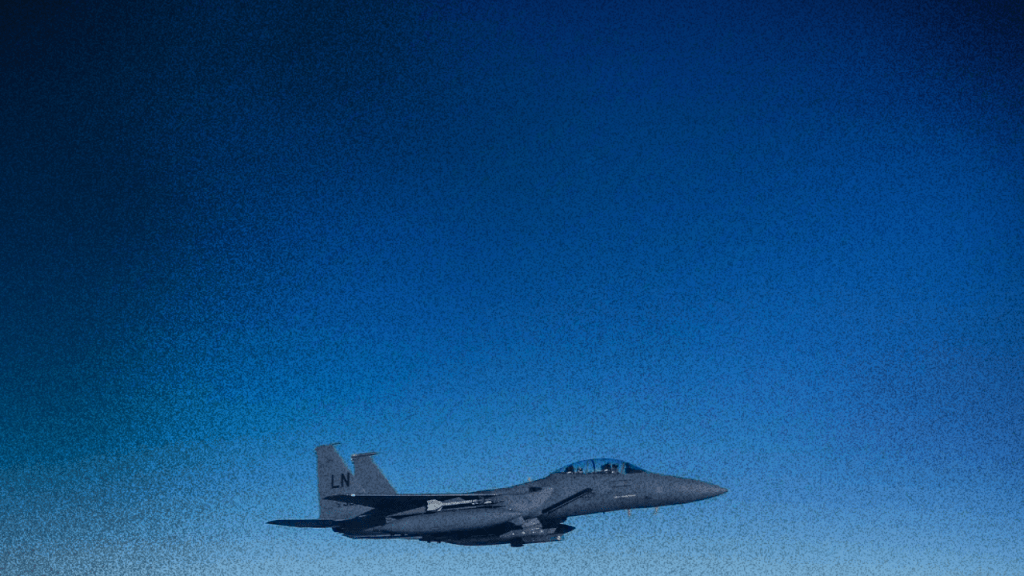
Air superiority in 2026 did not end the Iran war. Iran’s degraded but unbroken launch capability exposed dominance-based airpower doctrine’s core flaw.
The Theory of Victory Required Iran to Stop Shooting
The doctrine underpinning the U.S.-Israeli campaign against Iran was not complicated. Establish air superiority fast, strike command infrastructure, neutralize launch capacity, and foreclose the attritional phase before it can begin. The entire theory of victory depended on a single premise: that Iran’s ability to project force could be suppressed to a level that made continued resistance operationally incoherent. That premise shaped every targeting decision, every sortie, every press briefing in the opening days of the war. It was not a peripheral assumption — it was the load-bearing wall of the campaign’s strategic logic. The White House framed the operational picture in exactly those terms, declaring Iran’s ballistic missile capacity “functionally destroyed” and its navy “combat ineffective,” and asserting “complete and total aerial dominance over Iran” within the first week.
The coalition achieved aerial superiority within the first 24 hours. Strikes hit command nodes, missile infrastructure, and suspected launch sites with the kind of precision the doctrine demanded. In the first 24 hours alone, Iran fired 167 missiles and 541 drones at the UAE and Israel — a volley the coalition’s layered defenses absorbed and degraded. The opening phase went, in narrow technical terms, as planned. The narrative of dominance was built and broadcast in real time. The problem was what came after.
Iran Only Needed to Keep Launching — Not to Win
By day fifteen of the conflict, Iran’s daily strike volume against the UAE had collapsed from that opening salvo to four missiles and six drones, according to Al Jazeera’s tally of UAE Defence Ministry statements. The Pentagon reported missile launches down 90 percent and drone attacks down 86 percent from the first day. Western analysts and officials cited this decline as evidence the air campaign was working. What they described as degradation, the structural logic of the conflict reveals as sufficiency. Iran’s operational theory was never symmetry. It was persistence. As one analyst at the Doha Institute told Al Jazeera: “It does not matter how many you launch as long as you maintain a credible threat. It takes one successful drone to shatter a sense of security.”
War on the Rocks cautioned against reading launch-rate declines as evidence of actual capacity destruction. Iran’s Shahed drones require no fixed launch sites — they launch from angled rails on pickup trucks, and crews relocate immediately after firing. Prewar estimates of Iran’s drone inventory ranged from several thousand to above 10,000, and there was no established evidence that production had halted. The parallel with the 1991 Scud hunt is instructive: U.S. forces searched for Iraq’s truck-mounted ballistic missiles with full air superiority and never achieved a single confirmed kill. The distinction between declining launch tempo and destroyed capacity is not a technical detail. It is the central analytical question of the campaign — and the coalition’s public claims conflated the two.
Every Interception Costs More Than Iran Paid to Launch
Defensive systems are not renewable at the rate they are consumed in a sustained missile exchange. Israel entered the 2026 war already running low on ballistic missile interceptors — stocks drawn down during the June 2025 conflict had not been fully replenished. FPRI’s opening analysis of the first 96 hours found the coalition expended approximately 5,197 munitions across 35 types, carrying a replacement bill of $10–$16 billion in four days. At the initial firing rates, Israel would exhaust its Arrow interceptor stock in eight days; Gulf partners would deplete THAAD interceptors in twelve. The cost asymmetry compounds the problem structurally: PAC-3 interceptors cost $2–$4 million each; the Iranian Shahed drones they intercept cost between $20,000 and $50,000. Iran was imposing a cost ratio of roughly 100:1 on the coalition’s defensive expenditures.
By day twelve, CSIS’s day-twelve estimate total coalition expenditure at approximately $16.5 billion. Production timelines for the most stressed systems — Tomahawks, PAC-3, THAAD — run three to four years under current contracts, with no second-source manufacturers for critical components. The “magazine abyss” — the gap between expenditure rate and industrial replenishment — does not open dramatically. It opens across hundreds of intercepts, until the coalition is managing scarcity rather than superiority. Iran’s launch campaign, even at its most degraded, was calibrated precisely to drive that process. The CSIS assessment confirmed it explicitly: “interceptor inventories are being depleted, which may require resupply from U.S. stocks and could trigger policy debates.”
When War Keeps Going, Rapid-Dominance Has No Answer
Air campaigns built around rapid dominance are optimized for a specific duration. They are designed to compress the conflict into a phase short enough that industrial sustainability never becomes the decisive variable. The doctrine assumes the attritional phase is foreclosed — that the combination of precision strikes, air superiority, and degraded enemy infrastructure produces a military situation the opposing force cannot sustain. When that assumption fails, the doctrine does not adapt. It simply runs. The war continues, and the framework that was supposed to end it has no second act.
Iran demonstrated a further layer of structural resilience: its missile arsenal was dispersed more widely than coalition intelligence had assessed, launch sites were rebuilt or relocated after strikes, and decoys absorbed targeting resources. CSIS’s three-week assessment confirmed the pattern: “Iran shows no clear intention to cease hostilities and continues to launch limited attacks against Gulf states and Israel,” with “occasional surges” reappearing after initial declines. The longer the conflict extended, the more the balance shifted toward endurance, production capacity, and political will — the variables that rapid-dominance doctrine was designed to make irrelevant. Those are not variables the United States and Israel win on a long timeline. The urgency of the coalition’s strike tempo was not confidence. It was a race against conditions it was already losing.
The Narrative of Dominance Collapsed Before the Military Did
The expectation of air superiority carries a political function that extends beyond the battlefield. It communicates to allies, to domestic publics, and to the adversary that the outcome is not in question. When Iranian launches continued daily — even at dramatically reduced volume — that communicative function broke down. The narrative of dominance requires an adversary suppressed to the point of operational irrelevance. Iran was not that adversary. It was still there, still launching, still imposing costs. That operational fact, not any single strike or interception, is what shifted how the conflict was understood. The White House was declaring Iran’s capabilities “functionally destroyed” while Iranian missiles were striking towns in southern Israel and Iranian drones were hitting oil infrastructure in the Gulf. The gap between the official narrative and the observable pattern was not incidental — it was the conflict’s defining political condition by week three.
This shift did not hinge on a single date or event. It accumulated across the same pattern that was degrading the interceptor stockpiles — incrementally, through the absence of a suppression point that never arrived. By March 21, roughly three weeks into a war that was supposed to have resolved its central uncertainty in the first 72 hours, that pattern was established as the conflict’s defining character. The war had not ended. Iran was still in it. And the coalition’s theory of victory had made no provision for that possibility.
Air Superiority Is a Threshold — Not a War-Winning Condition
The lesson of the first three weeks is not that airpower failed. U.S. and Israeli aircraft continued to operate, targets continued to be hit, and the coalition retained every conventional metric of aerial dominance. The lesson is that dominance of the air domain does not produce dominance of the conflict when the adversary has structured itself to survive the opening phase and impose costs through the middle one. Air superiority is a threshold condition — necessary, but not sufficient. Once crossed, it does not close the war. It opens the phase for which rapid-dominance doctrine has no strategy: the attritional contest of production, endurance, and will.
Iran’s approach — dispersed arsenals, persistent launches at degraded but sustained rates, exploitation of the interceptor depletion curve — was not improvised. It was structurally coherent with a strategic position that had no prospect of matching U.S.-Israeli airpower conventionally and every reason to make the cost of dominance exceed the coalition’s tolerance for it. The sky is controlled. The war is not. Those are two different things, and the gap between them is where the 2026 Iran War will be decided.
Sources
- Al Jazeera — How Iran is still shooting despite US claims of destroyed capacity (March 16, 2026)
- War on the Rocks — Don’t count launches: misreading Iran’s drone capacity (March 18, 2026)
- FPRI — Over 5,000 munitions in the first 96 hours; $10–16B replacement cost; interceptor depletion rates (March 17, 2026)
- CSIS — Iran war cost estimate: $16.5B by Day 12; munitions and interceptor analysis (March 13, 2026)
- CSIS — Assessing the air campaign after three weeks: Iran war by the numbers (March 21, 2026)
- NBC News — What we know about Iran’s military capabilities; daily missile and drone tracking (March 2026)
- RFE/RL — Iran firing fewer missiles but hit rate increasing; dispersal and adaptation (March 2026)
- Wikipedia — 2026 Iran War
- Iran War Narrative Inverts Who Struck First — Spark Solidarity





 Spark Solidarity