
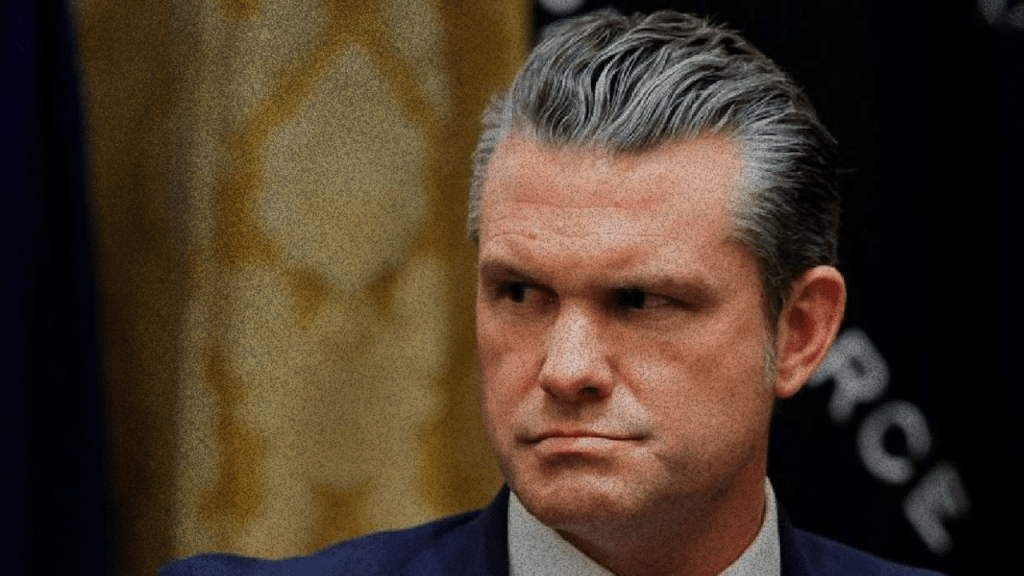
Signalgate is not the story. The story is what the Pentagon has done since — and what that reveals about the institution now running the Iran war.
Signalgate Was a Symptom. The Iran War Is the Crisis.
In March 2025, Defense Secretary Pete Hegseth shared detailed strike plans for a Houthi operation — weapons systems, flight schedules, attack sequencing — via Signal, a consumer messaging app, in a group that included the National Security Advisor, the Director of National Intelligence, and, inadvertently, a journalist. Israeli officials were furious: they had supplied intelligence about the Houthi target, and it had just been transmitted to a reporter on an unclassified platform. The administration’s response was denial, minimization, and an attack on the journalist. The institutional response was nothing that addressed why a Secretary of Defense felt no constraint transmitting live military intelligence over a platform cleared for personal use. Twelve months later, that same Secretary of Defense is managing the United States’ most consequential military conflict in a generation — against Iran, the country that has closed the Strait of Hormuz — and the institutional culture that produced the 2025 breach is not only intact, it is now applying its same logic to the institution’s own military press. The question is not whether Signalgate was serious. The question is what it revealed about a system whose discipline has continued to degrade under the weight of the very war it was supposed to be running.
The Pentagon Subordinated Its Own Military Press Mid-War
On March 9, 2026 — ten days into the U.S.-Israeli air campaign against Iran — the Pentagon issued an eight-page memo imposing what it called a “modernization plan” on Stars and Stripes, the historically independent military newspaper. The memo was effective immediately. It limited the use of wire services, barred comics and syndicated features, and stated that content must be consistent with “good order and discipline” — a phrase borrowed directly from the Uniform Code of Military Justice. Stars and Stripes reported that its editor-in-chief, Erik Slavin, had not been consulted. The publisher did not receive a copy of the memo despite it stating that one would be sent to him. The Pentagon didn’t send it — it issued a press statement instead.
The stated rationale was modernization. Chief Pentagon spokesman Sean Parnell framed it as returning the paper to its original mission and moving away from “woke distractions that syphon morale.” NPR reporting confirmed that the memo also moves the defense secretary’s public affairs office into an oversight role over the newsroom — a role it did not previously hold. PEN America’s journalism program director called it clearly an attempt by the Pentagon to “increase its influence over content decisions at Stars and Stripes.” More specifically, the memo’s wire service ban means Stars and Stripes cannot publish reporting from the Associated Press or Reuters — which includes almost all reporting from Iran, where the paper has no journalists currently deployed. The institution responsible for telling American service members what is happening in the war they are fighting has been prevented from sourcing that information independently, precisely while that war is underway.
Then, on March 19, Hegseth held a press conference at the Pentagon on the Iran war. the paper was excluded. “Stars and Stripes was not approved by the Pentagon to attend this press conference. I will be watching it on a screen instead,” the paper’s Pentagon reporter wrote on X that morning. The Pentagon’s response was that all 60 seats were filled. Stars and Stripes — the military’s own newspaper, owned by the Defense Department — was watching its own secretary brief the war on a screen.
When Official Story Diverges from Operational Reality
The Stars and Stripes subordination and the briefing exclusion are not the same failure as the 2025 Signal breach. They are the opposite failure, and together they describe the same institutional condition. Signalgate was an opsec breakdown — sensitive information escaping its proper channel through casualness. The Stars and Stripes subordination is a narrative lockdown — the institution working to ensure that information about the war reaches its own personnel only after filtering by political leadership. One failure is about information escaping. The other is about information being contained. Both failures indicate a war-fighting apparatus in which the management of information has displaced the management of the war itself as the primary institutional preoccupation.
This matters because the gap between official story and operational reality is not just a press freedom issue. It is a discipline issue. When the people inside an institution know that the official account and the factual account are not the same — when soldiers know that the newspaper covering their war has been told what it can and cannot source — the rules lose their authority. This war’s narrative architecture has been managed from its first hours: in whose aggression was named, whose restraint was ignored, which diplomacy was buried. Stars and Stripes, for all its institutional limitations, was one of the remaining channels through which that management could be contested from inside the apparatus. The March 9 memo closed it. The March 19 exclusion demonstrated the closure in real time.
Internal Incoherence Is Strategically Legible to Adversaries
The internal state of an institution at war is not a domestic matter. It is information. Iranian planners, Houthi commanders, allied intelligence services, and every government assessing American capacity and resolve in the Gulf are reading the same signals that domestic observers are: a defense secretary who has publicly clashed with his own advisers, fired senior staff in a leak hunt during an active conflict, and been excluded from his own briefings by Pentagon logistics while simultaneously barring the institution’s newspaper from attending them. Hegseth’s tenure has included documented missteps — his use of Signal to share strike plans, internal firings during active hostilities, and now the exclusion of the institution’s own newspaper — that have created compounding political problems while a larger war demands institutional coherence. Multiple officials have described a defense secretary who has become increasingly isolated, managing a narrowing inner circle as the conflict has expanded. This is the signature of institutional brittleness: the center becomes more tightly controlled as the periphery becomes less reliable, which increases the cost of each decision and decreases the institution’s capacity to process the war’s actual complexity.
Israeli officials’ 2025 fury at the Signalgate breach was a direct expression of this legibility. They shared human intelligence with a partner. That partner transmitted it on a platform that a journalist could read. The lesson drawn was not procedural — it was about the partner’s actual discipline. Governments remember those lessons. The Stars and Stripes subordination adds a different lesson: that the same institution is now actively managing what its own military personnel know about the war they are fighting. That is not competence management. That is fragility management. And fragility, in a conflict this consequential, is strategic information.
This Is What Institutional Decay Looks Like During a War
The Signal breach in 2025. The Stars and Stripes subordination in March 2026. The briefing exclusion in March 2026. The firing of senior Pentagon staff during active hostilities. The contradictory public statements from Rubio, Hegseth, and Trump on war objectives, timelines, and diplomatic progress. Each of these events has been explained individually: human error, modernization, space constraints, leak investigations, communications strategy. That is precisely how institutions rationalize systemic failure — by treating each symptom as a discrete event and declining to name the condition producing all of them. The materialist reading is different. These incidents share a structural origin: an administration that has reorganized its military and media institutions around loyalty to political leadership rather than operational coherence. That reorganization degrades discipline. Degraded discipline produces opsec failures. Opsec failures produce ally estrangement and adversary opportunity. And the response — deny, minimize, exclude, attack — accelerates the degradation rather than arresting it.
The system is not collapsing. Systems under this kind of strain can continue to function for extended periods. The aircraft carriers are in position. The strikes continue. The machinery of force projection is intact. But the institutional infrastructure managing that machinery has demonstrated, in public and in real time, that it is operating with diminished internal coherence — between what it says and what it does, between the information it controls and the information it shares, between the official account of the war and the war that service members and adversaries are actually experiencing. That gap is now part of the conflict. And no memo about editorial independence — whether it claims to protect it or removes it — is going to close it.
Sources
- Stars and Stripes — Pentagon modernization plan expands oversight (March 13, 2026)
- NPR — Pentagon tightens controls over Stars and Stripes (March 14, 2026)
- Daily Beast — Hegseth bars Stars and Stripes from briefing (March 19, 2026)
- Newsweek — Israeli officials furious over Signal war plans leak (March 2025)
- Wikipedia — United States government group chat leaks (Signalgate)
- Wikipedia — 2026 Iran War
- Iran War Narrative Inverts Who Struck First — Spark Solidarity




 Spark Solidarity