
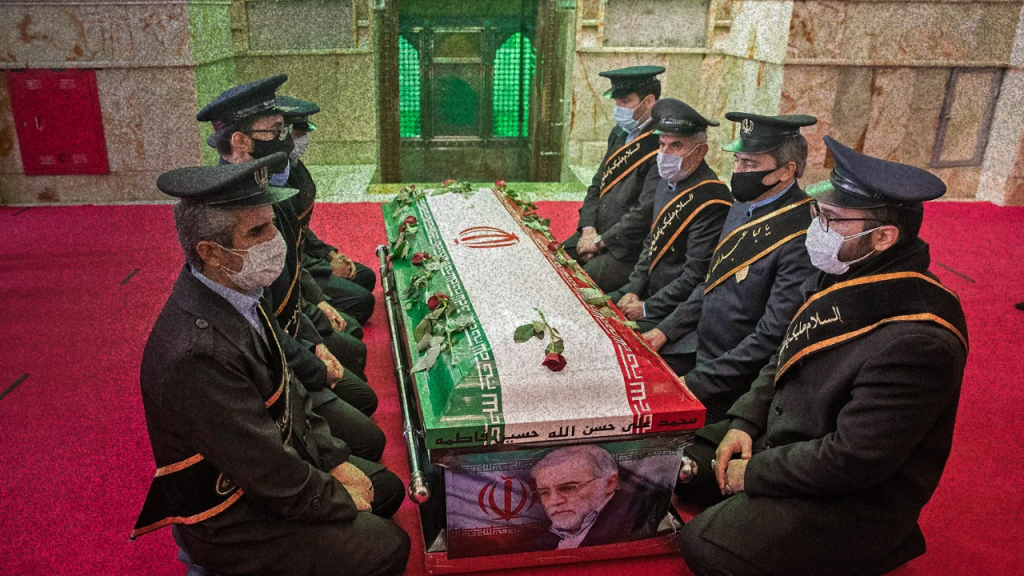
Israel Iran assassination strategy has moved beyond military capacity — it is now dismantling the political infrastructure through which wars end.
The 48-Hour Window That Revealed the Strategy
Within a 48-hour window on March 17, 2026, Israel killed three of Iran’s most senior officials: Ali Larijani, Secretary of the Supreme National Security Council; Esmail Khatib, the intelligence minister; and Gholamreza Soleimani, commander of the Basij. These were not three military commanders caught in the same strike package. They were the intelligence apparatus, the internal paramilitary command, and the country’s most senior political-security coordinator — the three nodes through which Iran’s governing capacity is organized, not just its battlefield capacity. Israeli Prime Minister Benjamin Netanyahu removed any ambiguity about intent: “We are undermining this regime in the hope of giving the Iranian people an opportunity to remove it.” That is not a military objective. It is a governance objective. The campaign is not improvised escalation. It is policy.
What distinguishes this moment from earlier phases of the conflict is not that military strikes have stopped — they have not. Drone depots, ballistic missile production sites, and naval assets have been systematically degraded in parallel. The significance is the simultaneity. Military degradation and political decapitation are running as a single unified strategy. Western framing presents these tracks as distinct — one “legitimate” under laws of armed conflict, the other more troubling — but that distinction serves to obscure what is operationally a coherent whole. You cannot understand the targeting of Larijani in isolation from the targeting of missile production lines. They are components of the same project: dismantling Iran as a functioning state capable of both fighting and negotiating.
Larijani’s Value Was a Function, Not a Title
Titles in Iran’s security structure can be reassigned. Larijani’s function could not be. As Zeid Ra’ad Al Hussein of the International Peace Institute put it after the killing, he seemed to be “the one person who the international community could talk to.” That formulation understates the structural reality. Larijani’s capacity was not simply external-facing. He operated inside the security state — shaping Iran’s nuclear posture, managing IRGC institutional interests — while simultaneously maintaining the credibility to engage in external negotiation. He had been Iran’s chief nuclear negotiator, served as parliament speaker for over a decade, and was, in the weeks before the current escalation, shuttling between Gulf states and visiting Moscow for pre-war backchannel diplomacy. That combination — trusted by the security establishment, legible to external interlocutors — is not a personality trait. It is a structural position produced over decades of relationship-building inside an intensely factional system.
Replacing Larijani with a more hardline figure restores a name to the role. It does not restore the function. The new occupant will not have Larijani’s standing with the IRGC, will not carry his credibility as a potential interlocutor, and will operate in a system that has just watched its most senior negotiating figure assassinated mid-process. The signal that sends internally is unambiguous: engagement with the outside is a liability, not an asset. The institutional incentive structure now runs decisively against whoever might occupy the moderate-intermediary position. The replacement problem is not one of finding the right individual. The position itself has been structurally degraded.
Closing the Off-Ramps Is a Strategic Choice, Not a Side Effect
Western analysis consistently frames the removal of intermediaries as a regrettable secondary consequence of military necessity. This framing is false in this case and Netanyahu’s own statement proves it. When the stated objective is regime removal — not ceasefire, not concession, not behavioral change — then the elimination of figures capable of producing a negotiated off-ramp is not collateral. It is the mechanism. A regime that can negotiate its way to a settlement does not need to be removed. A regime stripped of its negotiators cannot produce one. The targeting logic follows directly from the political objective, and the political objective is declared.
The structural consequence is that escalation stops being a choice and becomes a condition. When credible interlocutors exist, states under pressure can signal willingness to negotiate without appearing to capitulate — the intermediary absorbs the political cost of contact. Remove the intermediary and the signal cannot be sent. Hardliners, already ascendant in wartime, face no internal counterweight. The institutional logic of the IRGC — which has always viewed the conflict as existential — now operates without the friction that figures like Larijani provided. Escalation does not require a decision at that point. It is the default output of a system whose moderating components have been deliberately removed.
Decapitation Strategies Produce Fragmentation, Not Compliance
The historical record of decapitation strategies is not ambiguous. In Iraq after 2003, eliminating the Ba’athist command structure did not produce a compliant successor state. It produced a decade-long insurgency, the fragmentation of state institutions, and the eventual emergence of ISIS from the power vacuum. In Libya after 2011, the removal of Gaddafi’s governing apparatus did not produce a democratic transition. It produced competing armed factions, a fractured state that has not recovered, and a permanent NATO liability. The pattern is consistent: decapitation strategies remove the centralizing capacity that makes states negotiable adversaries. What replaces it is not a more pliable leadership but a more diffuse, less controllable set of actors for whom no single decision-maker can commit to an agreement.
Iran is not Iraq in 2003. Its institutions are older, its security apparatus more cohesive, its revolutionary legitimacy more deeply embedded in the population. Mohamad Elmasry, professor at the Doha Institute, described the targeting campaign to Al Jazeera as a “game of Whac-A-Mole” — there is always another leader, and the regime has not collapsed despite losing scores of senior officials over four weeks. But this observation cuts in both directions. The regime’s resilience does not mean the campaign is ineffective. It means the campaign is producing exactly the outcome the historical pattern predicts: not collapse, but rigidity. Not a more tractable adversary, but a more militant, more fragmented, more unpredictable one — and crucially, one that has lost the institutional capacity to negotiate its way out even if it wanted to.
Without Intermediaries, Escalation Becomes the Default
The cumulative logic of the campaign runs toward a single structural outcome: a conflict without architecture for resolution. Military degradation narrows Iran’s options on the battlefield. Political decapitation narrows Iran’s options at the table. The two tracks together produce a state that is simultaneously under maximum pressure and minimally equipped to respond to that pressure through anything other than continued resistance. This is not a paradox. It is the predictable output of a strategy that has regime removal as its objective and has correctly identified that regimes capable of negotiating settlements are harder to remove than regimes that can only fight.
The war continues not because either side has made a rational calculation that continuation serves its interests. It continues because the structures that would allow it to end have been systematically dismantled. The infrastructure of political management that moderates conflicts — the intermediaries, the backchannels, the figures trusted by both their own systems and outside interlocutors — has been treated as a target, not a resource. Larijani’s assassination is the clearest marker of that transition. It is not another escalation in a sequence. It is the removal of the mechanism through which the sequence could stop. What comes next is not determined by strategy. It is determined by the logic of a system that no longer has the components it needs to produce a different outcome.
Sources
- Al Jazeera — Iran confirms Larijani and Basij commander Soleimani killed, March 2026
- NPR/KCCU — Iran suffers another blow to its leadership with two top officials killed, March 2026
- Bloomberg — Iran Crisis: After Larijani Killing Who Else in Tehran Can the US Talk To?, March 2026
- CBS News — Iran’s top security official Ali Larijani killed — why his death is significant, March 2026




 Spark Solidarity